
Table of Contents
- 1. Hidden in Plain Sight: Decoding the High-Velocity “Micropoints”
- 1.1. Designed for Slender Shafts
- 1.2. Evidence of Impact Fracture
- 2. The Evolutionary Whodunit: Neanderthals or Modern Humans?
- 2.1. The Case for Neanderthals
- 2.2. The Case for Homo Sapiens
- 3. A Prehistoric Melting Pot: The Hybrid Child of Obi-Rakhmat
- 4. Global Connections: From Uzbekistan to the Caves of France
- 5. The Next Steps for Archeological Science
- 6. Frequently Asked Questions
- 6.1. How old are the arrowheads found in Uzbekistan?
- 6.2. Why does this discovery change the history of human weaponry?
- 6.3. Were these tools definitely used as arrowheads?
- 6.4. Did Neanderthals or modern humans create these weapons?
- 6.5. What else has been found at the Obi-Rakhmat rock shelter?
80,000-Year-Old Arrowheads in Uzbekistan Could Rewrite the History of Human Weaponry
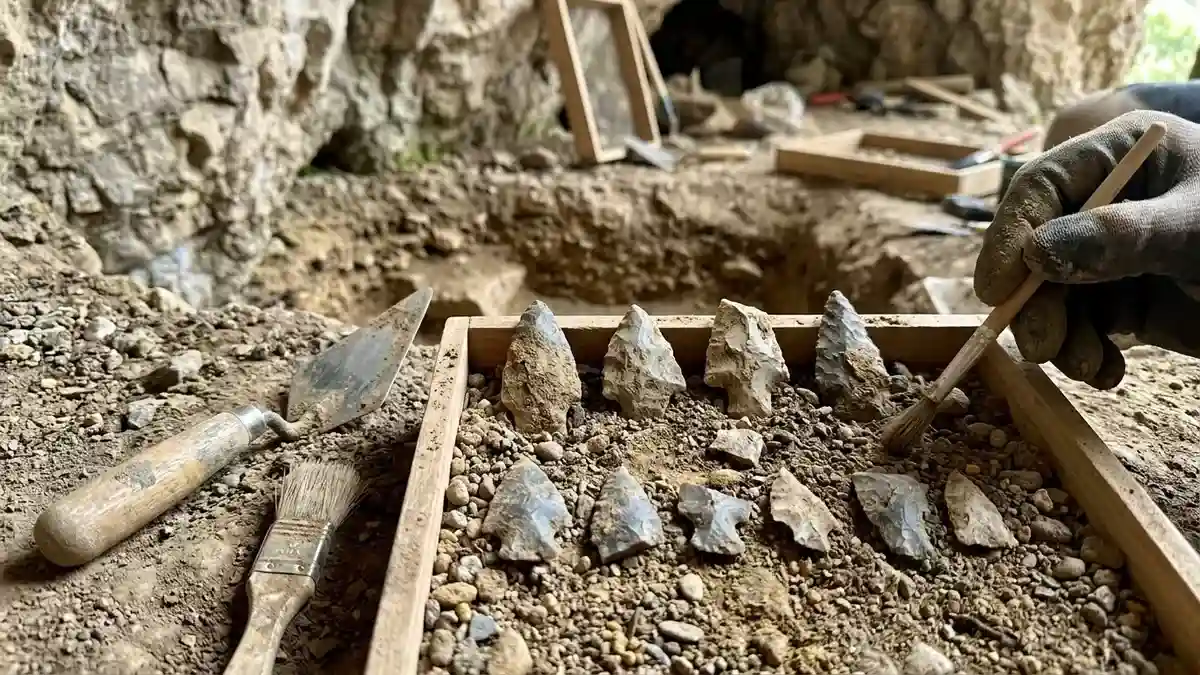
A spectacular archaeological discovery in Central Asia is challenging everything we know about prehistoric hunting technology. Deep within the Obi-Rakhmat rock shelter in northeastern Uzbekistan, an international team of researchers has unearthed tiny, triangular stone tools dating back roughly 80,000 years. According to a groundbreaking study published in the scientific journal PLOS One, these miniature stone points—referred to by scientists as “micropoints”—served as the tips of prehistoric arrows.
If verified by the broader scientific community, this monumental find will officially push the timeline of bow-and-arrow technology back by roughly 6,000 years. Previously, the oldest known evidence of arrowheads consisted of 74,000-year-old specimens recovered in Ethiopia. The fact that this technological leap occurred in Central Asia rather than Africa adds a fascinating new layer to the mystery of early human innovation.
80,000-Year-Old Arrowheads in Uzbekistan Could Rewrite the History of Human Weaponry

Hidden in Plain Sight: Decoding the High-Velocity “Micropoints”
For years, these specific artifacts did not receive much attention. Because the stone tips were almost always broken or severely fractured, initial excavation teams assumed they were simply debris or shattered scraps from larger stone tools. However, modern forensic analysis has completely overturned that assumption.
Designed for Slender Shafts
When researchers re-examined the dimensions of these points, they realized the tools were far too narrow, lightweight, and thin to have ever functioned efficiently as handheld cutting knives or heavy thrusting spears. Instead, their physical proportions were meticulously tailored to fit perfectly onto slender, aerodynamic shafts—the unmistakable design signature of an arrow.
Evidence of Impact Fracture
The smoking gun came from microscopic analysis of the breakage patterns. The fractures on the tips are completely consistent with high-velocity impact damage. This specific type of structural shattering occurs exclusively when a projectile strikes a hard target, such as the bone of a prey animal, at extreme speeds—a force that can only be generated by a mechanical projectile launcher like a bow.

The Evolutionary Whodunit: Neanderthals or Modern Humans?
The discovery has ignited an intense scientific debate over who actually manufactured these weapons. Eighty thousand years ago, Eurasia was a melting pot of different hominin species, and the timeline places this technology right at the crossroads of evolutionary history.
The Case for Neanderthals
During this period, Neanderthals were the dominant inhabitants of Central Asia. To date, archaeologists have never found definitive, undisputed proof of Neanderthals utilizing bow-and-arrow technology, as they are traditionally viewed as ambush hunters who relied on heavy, close-range thrusting spears. If Neanderthals made these arrowheads, it would fundamentally shatter the long-held stereotype that they lacked the cognitive capacity for complex, long-range ballistic engineering.
The Case for Homo Sapiens
Conversely, this precise style of highly specialized projectile weaponry is a hallmark of later Homo sapiens (early modern human) hunting kits. Because of this, some scientists argue that early modern humans must have engineered the Obi-Rakhmat points during an early, undocumented wave of migration out of Africa.

“The architectural design of these points was not meant to withstand heavy, repeated impact. They were engineered specifically to pierce deep into prey, allowing the shaft to penetrate smoothly—a highly sophisticated ballistics strategy.” — Research Analysis, PLOS One
A Prehistoric Melting Pot: The Hybrid Child of Obi-Rakhmat
The rock shelter itself has a history of yielding fossils that blur the lines between human species. Back in 2003, archaeologists working at the site discovered the skull fragments and teeth of a prehistoric child.
Anatomical analysis of the remains revealed a baffling mixture of physical characteristics:
Neanderthal Features: Certain aspects of the cranial structure directly mirrored classic Neanderthal anatomy.
Homo Sapiens Features: Other dental and facial traits leaned unmistakably toward early modern humans.
This physical evidence strongly suggests that northeastern Uzbekistan was an ancient “contact zone” where distinct hominin populations overlapped. Whether these groups actively interbred to create hybrids or simply lived in close proximity and exchanged cultural ideas, the site proves that the region was a vibrant hub of genetic and technological interaction. It is highly possible that Neanderthals, modern humans, and even the mysterious Denisovans met here, trading both genes and tool-making secrets.
Global Connections: From Uzbekistan to the Caves of France
The specific engineering style of the Obi-Rakhmat micropoints shares an uncanny resemblance with artifacts found thousands of miles away. Similar high-velocity arrowheads have been documented at the Grotte Mandrin site in southern France.
At Grotte Mandrin, evidence shows that early Homo sapiens utilized bows to hunt local wildlife approximately 54,000 years ago. Finding nearly identical ballistic concepts in Uzbekistan—except dated to 80,000 years ago—suggests that this crucial technology has a much deeper, more interconnected Eurasian history than anyone previously anticipated. It implies that advanced hunting techniques were either passed along vast migration networks or independently invented multiple times in response to similar environmental pressures.
The Next Steps for Archeological Science
The international research team emphasizes that the investigation is far from over. Moving forward, scientists plan to expand their field operations to explore even older geological layers across Central Asia. They are particularly eager to map out potential cultural connections with ancient communities in the Levant (the modern-day Middle East), an area known to be a vital stepping stone for early modern humans spreading across the Eurasian landmass.
While the forensic impact marks on the stone points provide an incredibly strong circumstantial case, the team notes that the ultimate validation would be the discovery of direct physical evidence—such as one of these 80,000-year-old micropoints embedded clearly inside the fossilized ribcage of an ancient prey animal. For now, the Obi-Rakhmat arrowheads stand as a powerful reminder that prehistoric technology was profoundly sophisticated, pushing the boundaries of human ingenuity back into the deep recesses of the Ice Age.
Frequently Asked Questions
How old are the arrowheads found in Uzbekistan?
The triangular stone arrowheads discovered at the Obi-Rakhmat rock shelter are approximately 80,000 years old.
Why does this discovery change the history of human weaponry?
Prior to this find, the oldest confirmed evidence of bow-and-arrow technology consisted of 74,000-year-old artifacts found in Ethiopia. This discovery pushes back the timeline of mechanical projectile weapons by roughly 6,000 years and shifts the geographic origin of the oldest known examples to Central Asia.
Were these tools definitely used as arrowheads?
While some researchers initially overlooked them as broken scraps, recent microscopic analysis revealed high-velocity impact fractures. Additionally, the points are mathematically too narrow and light to have functioned as knives or hand-thrown spears, making them perfectly suited for slender arrow shafts.
Did Neanderthals or modern humans create these weapons?
The exact creator remains a mystery. Neanderthals were the primary residents of Central Asia 80,000 years ago, but this style of tool is strongly associated with Homo sapiens. The site may have been a contact zone where both species interacted and shared technology.
What else has been found at the Obi-Rakhmat rock shelter?
In 2003, archaeologists discovered the skull and teeth of a child exhibiting a mix of both Neanderthal and Homo sapiens physical traits, supporting the theory that the region was a major melting pot for different ancient human groups.