
Table of Contents
- 1. Football Pitches to Field Archaeology: The Discovery
- 2. Masterpieces of Metal and Thread
- 2.1. The Gold-Bound Spearhead
- 2.2. The Scabbard and the Pommel
- 2.3. A Time Capsule of Ancient Organic Material
- 3. Rewriting History: Scotland’s First Warrior Elite
- 4. Inside the New Exhibition
- 5. Conclusion
- 6. Frequently Asked Questions
- 6.1. When and where can the public see the Carnoustie Hoard?
- 6.2. How old is the Carnoustie Hoard?
- 6.3. Why is the gold-decorated spearhead considered so rare?
- 6.4. How did the wooden scabbard and textiles survive for 3,000 years?
- 6.5. Why does the location of this discovery change our view of the Bronze Age?
3,000-Year-Old Scottish Treasure Reveals Secrets of Ancient Warriors
A spectacular collection of prehistoric weapons and textiles, known as the Carnoustie Hoard, has been officially acquired by National Museums Scotland. Trapped beneath the soil for over three millennia, this breathtaking Bronze Age treasure is finally stepping into the spotlight. The artifacts are making their historic public debut as the centerpiece of a major new exhibition, Scotland’s First Warriors, running at the museum from June 27, 2026, through May 17, 2027.
Dating back to a window between 1120 and 920 BCE, the hoard features a collection of weapons and rare organic materials that are reshaping our understanding of ancient tribal society. Among the most stunning discoveries are a uniquely gold-decorated spearhead and a pristine bronze sword, both hidden away in a ritual burial that remained undisturbed until modern development crossed its path.
3,000-Year-Old Scottish Treasure Reveals Secrets of Ancient Warriors
 100,000-year-old Homo sapiens bones from Ethiopia may preserve earliest evidence of human cremation
Football Pitches to Field Archaeology: The Discovery
The story of the Carnoustie Hoard’s recovery begins when a team from GUARD Archaeology was brought in to survey a tract of land near Carnoustie, Angus, ahead of a local development project intended to build new football pitches. What started as a routine pre-construction assessment quickly exploded into one of the most significant archaeological operations in Scottish history.
The excavation site acted as a deep chronological archive, revealing an immense wealth of historical material that spanned nearly 3,000 years of continuous human activity. Investigators found structural and domestic traces that stretched all the way from the early Neolithic period down to the late Bronze Age. However, the most emotionally poignant and historically staggering find was a carefully prepared bundle of lethal weaponry, wrapped meticulously in natural fibers before being lowered into the earth.
Masterpieces of Metal and Thread
The sheer craftsmanship displayed in the Carnoustie weapons highlights a high level of technical sophistication among prehistoric Scottish metalsmiths. The items were not merely tools for combat; they were intricate symbols of status and engineering excellence.

The Gold-Bound Spearhead
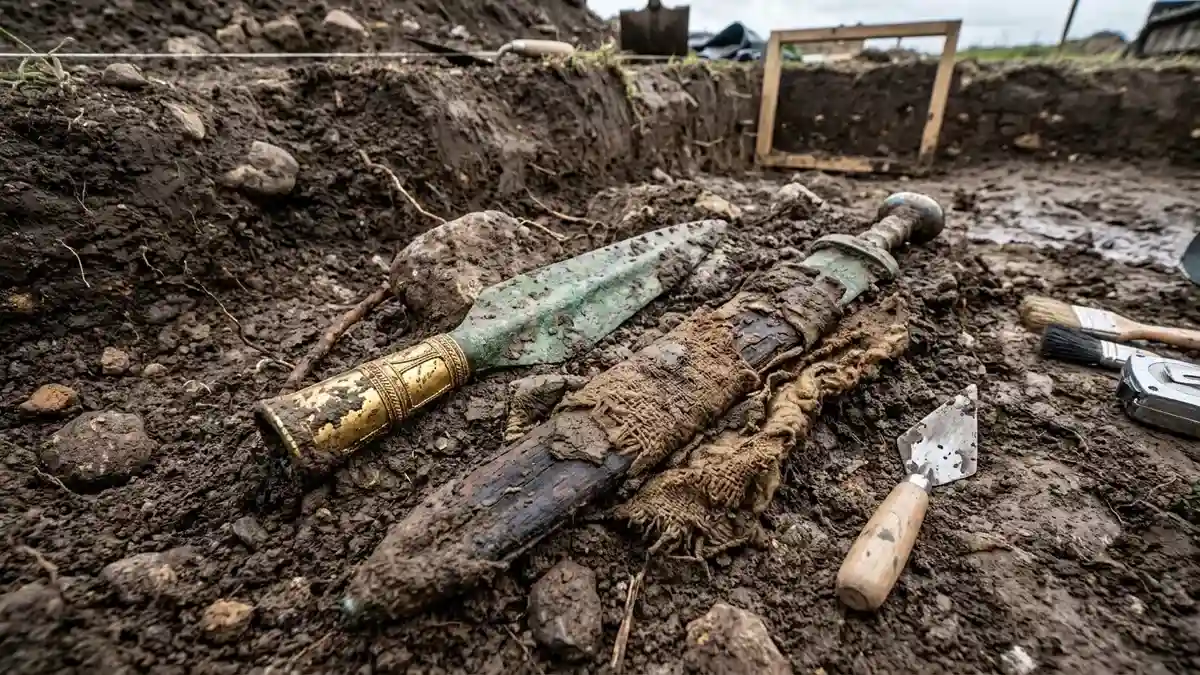
The crown jewel of the weapon cache is an exceptionally rare spearhead. The socket of the weapon features intricate gold-bound decoration—an ultra-luxurious adornment that indicates it was a symbol of immense power. To date, only one other comparable example of a gold-adorned Bronze Age spearhead has ever been recovered anywhere in Scotland, making this piece an incredibly vital asset for international research.
The Scabbard and the Pommel
Found alongside the spearhead was an elegant bronze sword. The weapon is fitted with a rare lead-tin alloy pommel, designed to perfectly balance the blade for active combat. Remarkably, the blade was still encased inside its original wooden scabbard, a component that almost always rots away completely within a few decades of burial.
A Time Capsule of Ancient Organic Material
What truly elevates the Carnoustie Hoard from a great find to a legendary one is the miraculous preservation of organic materials. Because the weapons were wrapped tightly before being buried, microscopic and visible remnants of the packaging survived:

Woven Wool: Fragile sections of authentic Bronze Age textiles, showcasing early weaving techniques and patterns.
Sheepskin: Remnants of animal hides used to cushion and protect the metal blades from environmental wear.
Disc-Headed Pin: A specialized bronze pin used specifically to secure the organic wrappings around the weapons.
These incredibly rare organic fragments provide researchers with an unprecedented look into prehistoric textile manufacturing, animal husbandry, and domestic ritual practices that were entirely lost to time.
Rewriting History: Scotland’s First Warrior Elite
For generations, archaeologists have discovered Bronze Age weapon hoards tucked away in lonely bogs, rivers, or hidden mountain passes—locations that suggest isolated hoards or emergency storage. The Carnoustie find completely shatters that trend.
This marks the first time in Scottish history that a Bronze Age weapon hoard has been discovered directly within a clearly defined residential settlement. The items were intentionally buried adjacent to a traditional Bronze Age roundhouse, proving that the deposition was not a temporary hiding spot but a highly localized, staged community act.
The proximity of such high-status, gold-adorned weaponry to the daily lives of the villagers provides strong circumstantial evidence of a structured warrior elite operating in the region of Angus over 3,000 years ago. It allows specialists to study exactly how weapons of war were intertwined with social hierarchies, communal identity, and domestic religious rituals.
Inside the New Exhibition
The acquisition of the hoard follows an exhaustive, multi-year conservation process. Conservators spent countless hours under microscopes, stabilizing the fragile wood fibers, consolidating the decaying textiles, and carefully cleaning centuries of corrosion off the gold and bronze surfaces without damaging the underlying tool marks.
Now fully stabilized, the hoard will anchor National Museums Scotland’s expansive new exhibition. Scotland’s First Warriors showcases more than 250 ancient objects, many of which have never been seen by the public.
The exhibition maps out the dark and fascinating evolution of organized conflict in prehistoric Scotland, tracking development from the stone-tool skirmishes of the Neolithic period up to the massive military clashes that occurred when the Roman legions marched north. Visitors will be guided through the practical mechanics of how ancient populations fought, the socio-economic motivations that drove tribes to open warfare, and the deep, lasting consequences that cyclical violence left on the development of early Scottish society.
Conclusion
The preservation of the Carnoustie Hoard marks a turning point in British archaeology. By saving not just the metal weapons but the delicate threads and organic wraps that bound them, scientists have unlocked an intimate window into the spiritual and social lives of the people of ancient Angus. These items reveal that warfare in the Bronze Age was not just about survival, but about ritual, craftsmanship, and community identity. As the public views these treasures for the first time, our understanding of Scotland’s early history grows richer and more complex than ever before.
Frequently Asked Questions
When and where can the public see the Carnoustie Hoard?
The hoard is on public display for the very first time as part of the Scotland’s First Warriors exhibition at National Museums Scotland. The exhibition opened on June 27, 2026, and runs until May 17, 2027.
How old is the Carnoustie Hoard?
The artifacts date back to the late Bronze Age, specifically created and buried between 1120 and 920 BCE, making the entire hoard over 3,000 years old.
Why is the gold-decorated spearhead considered so rare?
The spearhead features an incredibly rare gold-bound socket. This level of luxury decoration on a weapon of war has only been documented in one other archaeological find in the entire history of Scotland, highlighting its connection to an elite ruling class.
How did the wooden scabbard and textiles survive for 3,000 years?
The weapons were wrapped tightly in layers of wool and sheepskin before being buried in specific soil conditions near a domestic settlement. This careful preparation created a micro-environment that protected fragments of the wood, wool, and hide from total decay.
Why does the location of this discovery change our view of the Bronze Age?
Traditionally, Bronze Age weapon hoards are found isolated in nature, such as in lakes or fields. The Carnoustie Hoard is unique because it was deliberately buried inside an active village settlement right next to a roundhouse, proving that weapons were deeply integrated into everyday community life and social identity.