
Table of Contents
- 1. The Great Qumran Debate: Where Did the Scrolls Come From?
- 1.1. The Qumran Sectarian Theory
- 1.2. The Jerusalem Library Hypothesis
- 1.3. The Ancient Genizah Model
- 2. Fusing Machine Learning with Molecular Fingerprinting
- 2.1. Molecular Fingerprinting of Antiquity
- 2.2. The Role of Artificial Intelligence in Paleography
- 3. Mapping the Scribes: The Hands That Wrote the Bible
- 4. A Powerhouse International Alliance
- 5. Frequently Asked Questions (FAQ)
- 5.1. What are the Dead Sea Scrolls and why are they important?
- 5.2. How can chemical testing tell us where a scroll was written?
- 5.3. How is artificial intelligence used to study these ancient texts?
- 5.4. Did all the Dead Sea Scrolls originate from the Qumran community?
- 5.5. Can the public view the results or the scroll fragments?
25,000 Scroll Fragments Unravel Hidden Origin Mystery Today
One of the greatest archaeological detective stories of the modern era is entering a groundbreaking new phase. For nearly eight decades, the Dead Sea Scrolls have captivated historians, theologians, and the public alike, offering an unparalleled window into the roots of ancient Judaism and early Christianity. Yet, despite decades of intense scrutiny, a fundamental, highly debated mystery remains unsolved: Where exactly were these sacred manuscripts manufactured and copied?
Now, a pioneering international research initiative is poised to crack this cold case wide open. Armed with a massive €2.5 million grant from the European Research Council (ERC), a team of elite scientists and paleographers is launching a five-year investigation. By fusing cutting-edge artificial intelligence (AI) algorithms with high-precision atomic and chemical testing, the project aims to definitively map the geographic birthplaces of these legendary texts, fundamentally reshaping our understanding of ancient literacy and religious networks.
25,000 Scroll Fragments Unravel Hidden Origin Mystery Today
The Great Qumran Debate: Where Did the Scrolls Come From?
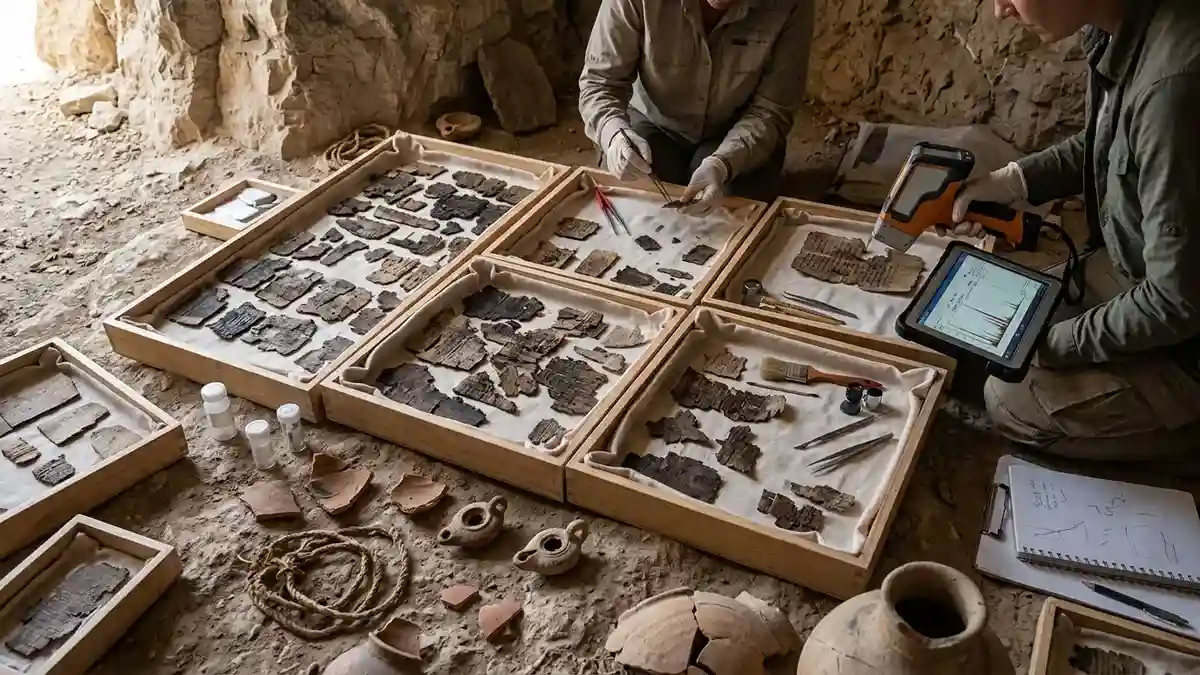
Discovered by Bedouin shepherds between 1947 and 1956 within a series of rugged limestone caves near the northwestern shore of the Dead Sea, the manuscripts are widely considered the most significant archaeological find of the 20th century. Curated and meticulously preserved by the Judean Desert Scrolls Unit of the Israel Antiquities Authority (IAA) in Jerusalem, the massive archive comprises roughly 25,000 individual fragments. When painstakingly pieced together like a giant, ancient puzzle, these fragments form approximately 1,000 distinct manuscripts, including the oldest surviving copies of the Hebrew Bible, apocryphal texts, and unique sectarian community rules.
Despite their historical weight, the precise origin of the vast majority of these documents has remained a subject of fierce academic conflict. For decades, scholars have divided themselves into three primary schools of thought:
The Qumran Sectarian Theory
The traditional, long-standing consensus argues that an isolated, highly ascetic Jewish sect—frequently identified as the Essenes—lived at the nearby archaeological site of Khirbet Qumran. Adherents of this theory believe these scribes operating an elite scriptorium (writing workshop) directly inside the Qumran settlement copied, studied, and compiled the vast majority of the scrolls before stashing them in the adjacent caves for safekeeping.
The Jerusalem Library Hypothesis
Conversely, a growing contingent of modern revisionist historians argues that the diversity of handwriting styles, linguistic variations, and theological philosophies across the scrolls makes a single, isolated sect highly unlikely. Instead, they suggest that the collection represents a massive cross-section of libraries from major urban centers, particularly Jerusalem. According to this view, as Roman legions advanced to crush the Great Jewish Revolt around 68 CE, panicking priests, librarians, and citizens bundled up their most precious holy texts, fled into the Judean Desert, and hid them in the remote caves of Qumran.
The Ancient Genizah Model
A third alternative theory posits that the Qumran caves did not function as a secret emergency bunker or an active library, but rather as a genizah—a designated, sacred storage repository for worn, damaged, or ritually unusable religious texts. Under Jewish law, any document containing the holy name of God cannot be casually thrown away; it must be respectfully retired, which might explain why so many highly fragmented, heavily worn documents accumulated in these desert vaults.
Fusing Machine Learning with Molecular Fingerprinting
To finally resolve this multi-decade academic deadlock, the newly minted project—aptly named Tracing Scribes and Scrolls—will shift the analytical focus away from purely literary interpretations and toward empirical, physical evidence. Led by Professor Mladen Popović, an internationally acclaimed paleographer and historian at the University of Groningen in the Netherlands, the multidisciplinary team will systematically extract and analyze approximately 250 micro-samples from the scroll collection.
Molecular Fingerprinting of Antiquity
The material samples—encompassing fragile animal parchment, fibrous organic papyrus, and microscopic traces of ancient ink—will undergo a battery of high-resolution chemical and elemental tests. Because parchment is manufactured from the skin of goats and sheep that drank from localized water sources and grazed on regional vegetation, its organic composition retains a distinct geographic signature.
By analyzing the specific ratios of stable isotopes, trace elements, and mineral trace elements embedded within the skins, scientists can reconstruct the environment where the animals were raised. The team will contrast these Judean samples with authenticated papyri imported from ancient Egypt, creating an extensive elemental baseline database. If the chemical composition of a scroll’s parchment matches the unique water-and-soil profile of the Qumran oasis, it provides undeniable proof of local production. Conversely, if the parchment reflects minerals unique to the Judean hills or the Nile Delta, a completely different geographic origin is revealed.
The Role of Artificial Intelligence in Paleography
Sifting through the gargantuan mountains of chemical, elemental, and isotopic data generated by laboratory testing is a task far beyond human capabilities. This is where advanced machine learning and neural networks become indispensable.
The project’s custom-built AI algorithms will be trained to cross-reference thousands of chemical variables simultaneously, identifying subtle molecular correlations and hidden patterns that traditional archaeological methods would inevitably miss. The AI will not operate in a vacuum; its computational findings will be systematically synthesized with:
Physical Codicology: Evaluating how each individual sheet of parchment or papyrus was physically processed, lined, margined, and bound.
Stitching Techniques: Analyzing the distinct thread materials, knot styles, and sewing patterns used to connect separate sheets into massive, rolling scrolls.
Linguistic Evidence: Scanning the texts for regional dialects, idiosyncratic idioms, and specific spelling variations unique to certain geographic sectors of the ancient Mediterranean.
Mapping the Scribes: The Hands That Wrote the Bible
The Tracing Scribes and Scrolls project marks the logical expansion of Professor Popović’s previous, highly celebrated ERC-backed campaign, The Hands That Wrote the Bible. In that foundational study, Popović and his team utilized deep-learning computer vision software to analyze the microscopic, subconscious handwriting habits of the ancient scribes.
The AI was able to look past the uniform, stylized “square” Hebrew script to detect microscopic variations in letter angles, pen strokes, and ink thickness. This breakthrough allowed the team to prove that a single manuscript—such as the monumental Great Isaiah Scroll—was actually penned by two separate, highly trained scribes working in perfect stylistic harmony, effectively identifying the individual human creators behind the prehistoric ink.
While the previous project successfully isolated who wrote the texts, this new five-year phase will determine where those individuals actually dipped their pens into inkwells. By anchoring those identified scribal “hands” to specific chemical material signatures, the research team aims to create the world’s very first comprehensive, large-scale spatial model tracking more than 25,000 scroll fragments.
This historic digital map will effectively plot the movement of books, ideas, and intellectual elites across the ancient Levant, revealing exactly how knowledge, theological innovations, and prophetic literature circulated through ancient Jewish society before the catastrophic destruction of the Second Temple.
A Powerhouse International Alliance
Reflecting the immense technological and logistical complexity of the task, Professor Popović has assembled a world-class international coalition of scientific institutions. The core research network includes:
The University of Groningen (Netherlands): Serving as the central hub for advanced paleography and AI coordination.
The Israel Antiquities Authority (Jerusalem): Granting crucial, controlled laboratory access to the fragile fragments through its elite Judean Desert Scrolls Unit.
The University of Pisa and University of Naples Federico II (Italy): Lending world-renowned expertise in chemical analysis and organic material spectroscopy.
The University of Southern Denmark: Providing advanced structural testing methodologies.
To further deepen the comparative analysis, the team has established strategic partnerships with major global repositories, including prestigious museums in Berlin and Turin, along with the Catholic University of Leuven (KU Leuven) in Belgium. These institutions will supply critical reference samples of historical papyri, ensuring the chemical baseline for Egyptian and Mediterranean trade goods is airtight.
Ultimately, this profound merger of natural science and the humanities represents the future of historical research. By interrogating the very atoms of the Dead Sea Scrolls through the lens of artificial intelligence, the Tracing Scribes and Scrolls project will replace long-standing academic speculation with hard, empirical data, finally allowing these 2,000-year-old fragments to reveal exactly where they were born.
Frequently Asked Questions (FAQ)
What are the Dead Sea Scrolls and why are they important?
The Dead Sea Scrolls are an ancient collection of approximately 981 distinct manuscripts discovered between 1947 and 1956 in eleven caves near the ancient settlement of Khirbet Qumran. Dating from the 3rd century BCE to the 1st century CE, they are globally important because they contain the oldest surviving copies of the Hebrew Bible, alongside critical non-biblical sectarian texts that illuminate the diverse theological landscape of late Second Temple Judaism.
How can chemical testing tell us where a scroll was written?
Parchment is made from animal skins, which absorb the distinct environmental, mineral, and isotopic signatures of the specific region where the animals lived, ate, and drank. By running high-precision elemental and isotopic scans on micro-samples of the scrolls and comparing them to localized soil and water baselines, scientists can determine the exact geographic location where the parchment was manufactured.
How is artificial intelligence used to study these ancient texts?
Artificial intelligence plays a dual role in modern scroll research. First, advanced pattern-recognition algorithms analyze handwriting variations to identify individual, unnamed scribes. Second, machine-learning models process massive, complex datasets of chemical and material tracking points to find hidden geographical correlations that human researchers cannot detect.
Did all the Dead Sea Scrolls originate from the Qumran community?
This is the central question the new project aims to answer. While traditional theories suggest an isolated sect wrote most of them at Qumran, many modern scholars argue that a significant portion of the collection was actually copied in major intellectual and urban centers like Jerusalem before being hidden in the desert caves during Roman military invasions.
Can the public view the results or the scroll fragments?
Yes. The physical fragments are meticulously conserved in Jerusalem by the Israel Antiquities Authority, which has partnered with Google to create the Leon Levy Dead Sea Scrolls Digital Library, allowing anyone worldwide to view high-resolution, multi-spectral images of the fragments online. The ongoing findings of the new Tracing Scribes and Scrolls project will be systematically published in open-access scientific journals over the next five years.