
Table of Contents
- 1. The Mystery of the Bog Offering at Als
- 2. The Pine Pitch Proof: Mapping the Invaders’ Homeland
- 2.1. The Age of the Vessel
- 2.2. The Source of the Sealant
- 3. Touch from the Past: An Ancient Fingerprint in Tar
- 4. Advanced Iron Age Engineering
- 5. Future Frontiers: DNA and Tree Rings
- 6. Frequently Asked Questions
- 6.1. Why is the ship named the Hjortspring boat?
- 6.2. How did a wooden boat survive for over 2,000 years?
- 6.3. What does “sewn-plank” construction mean?
- 6.4. Was the Hjortspring boat propelled by oars or sails?
- 6.5. What happened to the weapons found alongside the boat?
2,300-Year-Old Warship Secrets: Fingerprints and Pine Pitch Reveal Baltic Warfare Long Before the Vikings
A stunning scientific breakthrough has rewritten the early history of European seafaring. For decades, the Hjortspring boat—Northern Europe’s oldest known plank-built vessel—was shrouded in mystery. Discovered in a Danish bog alongside a massive cache of iron weapons, the 20-meter warship pointed to a forgotten, Pre-Roman Iron Age invasion.
Now, modern chemical forensics and a piece of literal human touch have revealed where these ancient invaders came from, proving that complex maritime warfare existed centuries before the dawn of the Viking Age.
2,300-Year-Old Warship Secrets Fingerprints and Pine Pitch Reveal Baltic Warfare Long Before the Vikings
The Mystery of the Bog Offering at Als
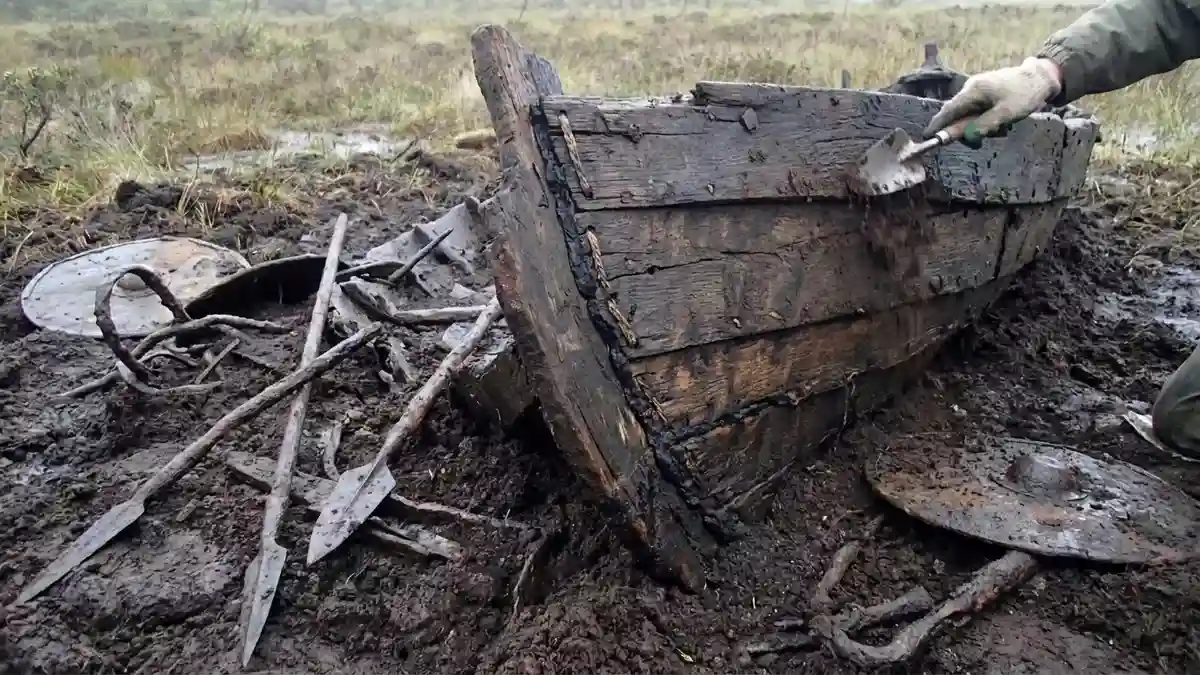
The story of the Hjortspring boat began over two millennia ago on the Danish island of Als. Sometime during the fourth or third century BCE, a large fleet of foreign warriors launched a daring amphibious assault on the local population. The raid failed spectacularly.

The victorious locals collected the invaders’ gear—including swords, spears, shields, chainmail armor, and the massive warship itself—and systematically destroyed or sank them into a sacred bog as a ritual offering of thanks to their gods.
Excavated in the 1920s, the ship became a crown jewel at the National Museum of Denmark. However, the true homeland of the defeated warriors remained a complete historical dead-end—until researchers went back to the archives with modern technology.
The Pine Pitch Proof: Mapping the Invaders’ Homeland
Publishing their findings in the journal PLOS ONE, an international research team bypassed the wood itself to examine the overlooked materials used to construct and waterproof the vessel: cordage and caulking.
 Seizure of Carthaginian Bronze Coins Highlights Ancient Economy and Illicit Antiquities Trade
The Age of the Vessel
Using ultra-precise radiocarbon dating on the plant-fiber cordage used to literally sew the ship’s planks together, scientists securely locked the vessel’s construction into the fourth or third centuries BCE. This timeline places it squarely in the Pre-Roman Iron Age.
The Source of the Sealant
The real shock came from a chemical analysis of the caulking material used to keep the hull watertight.
Expected Local Materials: Typical Danish boatbuilders of the era utilized regional resources like animal fat or linseed oil.
The Foreign Recipe: The Hjortspring sealant was a precise compound of animal fat mixed with imported pine pitch (tar).

During this era, pine forests were virtually nonexistent in Denmark and northern Germany. Instead, vast, dense pine ecosystems dominated the eastern Baltic Sea coast—modern-day Poland, the Baltic states, or southern Sweden.
This chemical signature proves the ship was manufactured far to the east. The warriors did not launch a short, spontaneous coastal raid; they planned, built, and navigated a massive open-water military expedition across the Baltic Sea.
Touch from the Past: An Ancient Fingerprint in Tar
Among the most breathtaking discoveries of the new study was a direct, physical link to a human being who lived 2,300 years ago.
While examining a fragment of the preserved caulking material, scientists noticed a faint impression left in the ancient resin. High-resolution X-ray tomography scanning confirmed it: a partial human fingerprint, perfectly cast into the tar while it was still warm and malleable during the ship’s construction or repair.
Finding human fingerprints from the European Iron Age is exceptionally rare. This tiny impression offers an intimate, emotional window into a prehistoric laborer or warrior prepping a warship for battle.
Advanced Iron Age Engineering
The structural design of the Hjortspring boat shatters the old myth that early Scandinavian societies were primitive before the Viking era.
| Feature | Engineering Details |
| Length | Nearly 20 meters (approx. 65 feet) |
| Capacity | Easily accommodated a crew of 24 paddlers plus warriors |
| Construction Method | “Sewn-plank” technique; overlapping lime-wood boards stitched together with flexible cordage |
| Aesthetics | Unique, curved, twin-pronged extensions at both the bow and stern |
This lightweight, flexible, and hydrodynamic design allowed the vessel to cut through choppy Baltic waters at impressive speeds. The engineering lineage of the iconic Viking longships clearly began here, centuries earlier than previously believed.
Future Frontiers: DNA and Tree Rings
The investigation into the Hjortspring boat is far from over. The research team is already looking ahead to future testing phases to pinpoint the exact beach where this ship was built.
By utilizing dendrochronology (analyzing tree-ring growth patterns inside the wood using non-invasive imaging) and attempting to extract ancient DNA (aDNA) trapped inside the sticky pine tar, scientists hope to identify the specific tribal identity of the warriors who sailed this vessel into an ambush 2,300 years ago.
Frequently Asked Questions
Why is the ship named the Hjortspring boat?
The vessel is named after the Hjortspring Mose (Hjortspring Bog) on the island of Als, Denmark, where it was discovered by farmers in the late 19th century and formally excavated by archaeologists in the early 1920s.
How did a wooden boat survive for over 2,000 years?
The boat survived due to the unique environment of the peat bog. Bogs are highly acidic, low-oxygen, and nutrient-poor environments. These conditions prevent bacteria and fungi from thriving, which halts the natural decay process and spectacularly preserves organic materials like wood, leather, and even human tissue.
What does “sewn-plank” construction mean?
Before the widespread use of iron rivets or wooden dowels to fasten ships together, ancient shipwrights used a sewn-plank technique. They carved long wooden planks, drilled small holes along the edges, and literally stitched the hull together using strong, flexible ropes made from roots, animal sinew, or plant fibers, sealing the seams with tar.
Was the Hjortspring boat propelled by oars or sails?
The Hjortspring boat was entirely paddle-driven. It did not have a mast, rigging, or a keel deep enough to support a sail. The crew consisted of roughly 24 individuals who used long wooden paddles to navigate rivers and open coastal waters.
What happened to the weapons found alongside the boat?
The weapons—including hundreds of iron spearheads, wooden shields, and early single-edged swords—were deliberately bent, snapped, or crushed by the local victors before being thrown into the bog. This intentional destruction was a common Iron Age ritual practice meant to “kill” the weapons and offer them exclusively to the deities of the marsh.