
Table of Contents
- 1. The Genetic Breakthrough Hidden in Ancient Teeth
- 2. Ritual Burials or a Genetic Anomaly?
- 2.1. The Case for Gender-Segregated Burials
- 2.2. The Missing Gene Hypothesis
- 3. Why Anthropologists Must Rewrite the Textbooks
- 4. Unexpected Evolutionary Ties and Deep African Roots
- 5. A New Era for Archeological Discovery
- 6. Frequently Asked Questions
- 6.1. What is Homo naledi?
- 6.2. How did scientists determine that the skeletons were female?
- 6.3. Is it possible that male skeletons are actually in the cave?
- 6.4. Why did scientists previously think some of the skeletons were male?
- 6.5. What is the significance of the link to Paranthropus robustus?
All-Female Skeletons Discovered in Mysterious Ancient Human Burial Site
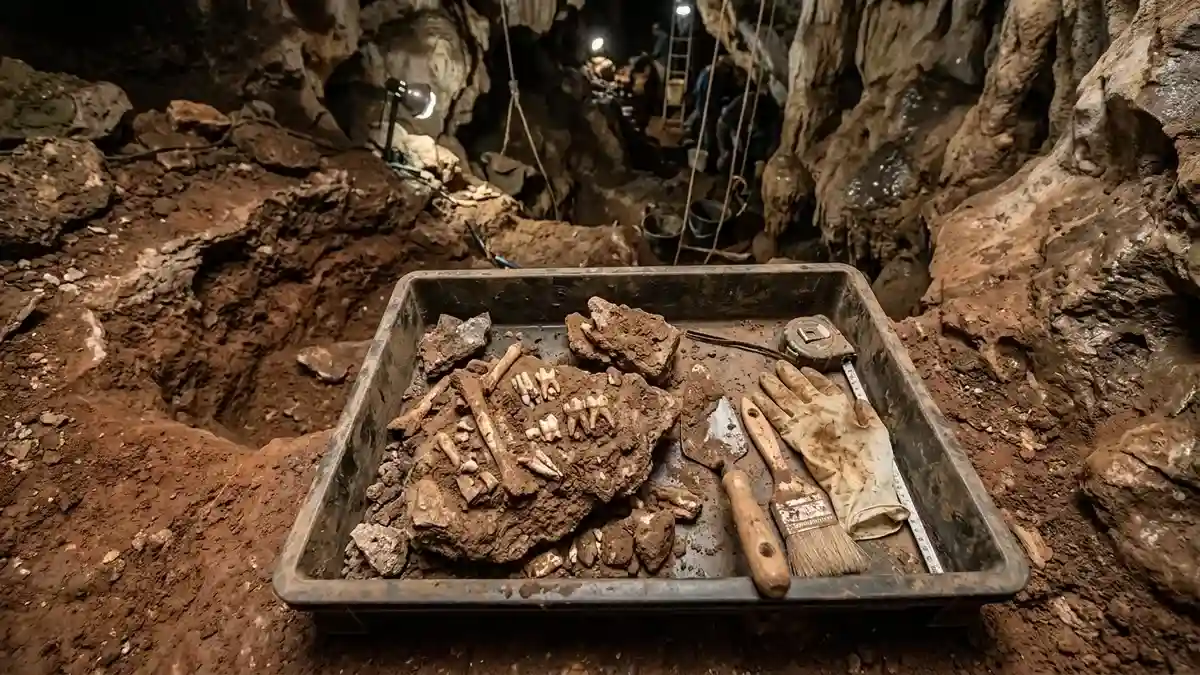
The deep, twisting chambers of South Africa’s Rising Star cave system have baffled scientists for over a decade. Since 2013, researchers have been unearthing the remains of Homo naledi—an enigmatic, small-brained relative of modern humans that lived roughly 300,000 years ago. But a groundbreaking genetic breakthrough has just turned the field of paleoanthropology entirely on its head: every single skeleton recovered from the site appears to be female.
A peer-reviewed study published in the journal Cell reveals that a cutting-edge analysis of fossilized dental enamel from 20 different individuals yielded a uniform result. For the first time in history, scientists have uncovered an ancient hominin site exclusively occupied by one biological sex. This baffling discovery challenges long-held assumptions about how these ancient relatives lived, died, and interacted, sending shockwaves through the scientific community.
All-Female Skeletons Discovered in Mysterious Ancient Human Burial Site
The Genetic Breakthrough Hidden in Ancient Teeth
To determine the sex of the ancient skeletons, an international team of scientists turned to a revolutionary technique known as paleoproteomics. While ancient DNA degrades rapidly in the warm, humid climates of African caves, proteins trapped within tooth enamel can survive for hundreds of thousands of years.
Researchers targeted specific enamel proteins coded by amelogenin genes (AMEL), which are directly linked to sex chromosomes.
AMELX: This protein variant is coded by the X chromosome and is present in both biological males and females.
AMELY: This protein variant is coded strictly by the Y chromosome and is unique to biological males.

By analyzing 20 distinct teeth from the Rising Star collection, the team discovered an abundant presence of AMELX proteins, but a total absence of AMELY. Remarkably, this all-female profile included the nearly complete skeletons known as “Neo” and “DH1″—the flagship specimens of the species that anthropologists had textually categorized as male for years based purely on their larger bone structure.
Ritual Burials or a Genetic Anomaly?
Experts are grappling with how to interpret a hominin population entirely devoid of males. No other ancient human cemetery or nonhuman primate fossil collection on Earth features a single-sex demographic. Currently, researchers are divided between two compelling theories: cultural selection and genetic mutation.
The Case for Gender-Segregated Burials
Lee Berger, a National Geographic explorer-in-residence who has spearheaded the Rising Star project since its inception, suggests that the all-female demographic points toward highly sophisticated social behaviors.

If Homo naledi purposely selected who was placed in the cave based on sex or gender, it would rewrite our timeline of cultural evolution. Homo naledi possessed a brain roughly one-third the size of a modern human’s. Finding evidence of sex-specific mortuary practices would confirm that complex, symbolic thought did not require a massive skull.
The Missing Gene Hypothesis
Not everyone is fully convinced that the cave was an exclusive sanctuary for females. Independent experts point out that a biological quirk could be masking the presence of males.
In rare instances among modern humans and ancient Neanderthals, a genetic mutation causes a deletion of the AMELY gene. If the males of this particular Homo naledi clan completely lacked the AMELY gene, their dental protein profiles would look identical to those of females. However, the study’s authors note that a systematic deletion across an entire population or even half of the 20 tested specimens remains statistically improbable.
Why Anthropologists Must Rewrite the Textbooks
The revelation that science has only ever looked at female Homo naledi specimens fundamentally changes our anatomical understanding of the species.
When Homo naledi was first introduced to the world in 2015, scientists assumed the larger skeletons in the cave were male and the smaller ones were female, mirroring the sexual dimorphism (size differences between sexes) seen in modern humans and older ancestors like Australopithecus.
However, a 2024 anatomical review noted that the skeletal and dental variations within the collection were remarkably narrow. The new proteomic data explains why: the physical differences observed are not variations between men and women, but rather natural variations among women of different sizes, ages, and builds. As of right now, humanity has never actually laid eyes on a male Homo naledi.
Unexpected Evolutionary Ties and Deep African Roots
Beyond the mystery of the all-female group, the proteomic analysis yielded a second major surprise. The data revealed that Homo naledi shared a distinct genetic variant related to collagen production with Paranthropus robustus—a flat-faced, massive-toothed hominin cousin that lived in South Africa between 1 and 2 million years ago.
This specific collagen variant is entirely absent in modern humans, Neanderthals, and Denisovans. While both species occupied the same geographic region of South Africa, they are separated by vast stretches of time. Anthropologists do not yet know if this shared trait points to a direct ancestor-descendant relationship or if it is simply a lingering genetic baseline characteristic of early African hominins.
To fully map where Homo naledi fits on the human family tree, scientists will need to extract similar protein data from other key African fossils, such as Homo erectus and Australopithecus africanus.
A New Era for Archeological Discovery
The success of this study proves that scientists can extract crucial evolutionary data from Pleistocene-era fossils without destroying them. Because paleoproteomics requires only a microscopic scraping of enamel, it leaves priceless fossils visually undamaged.
This non-destructive methodology opens the door to re-examining thousands of fragile fossils tucked away in museum vaults worldwide. By looking past the limits of degraded DNA, this new frontier of science promises to unlock the deep-seated secrets of human origins, one tooth at a time.
Frequently Asked Questions
What is Homo naledi?
Homo naledi is an extinct species of ancient hominin discovered in 2013 within the Rising Star cave system in South Africa. They lived approximately 300,000 years ago and possessed a unique mixture of primitive traits, like a small ape-sized brain, alongside modern human-like hands and feet.
How did scientists determine that the skeletons were female?
Scientists utilized paleoproteomics to sequence ancient proteins extracted from dental enamel. They looked for sex-linked amelogenin proteins. The teeth showed a total absence of the male-only AMELY protein, while containing high amounts of the AMELX protein, which is found in females.
Is it possible that male skeletons are actually in the cave?
Yes, there are two possibilities. First, males may have been buried elsewhere due to cultural traditions. Second, the males of this species might have suffered from a rare genetic mutation that deleted their AMELY gene, making their protein profiles look identical to females under current testing methods.
Why did scientists previously think some of the skeletons were male?
Initial classifications in 2015 assumed that the larger skeletons belonged to males and the smaller ones to females, which is a common pattern in human evolution. The new study disproves this assumption, showing that the size variations were simply differences among female individuals.
What is the significance of the link to Paranthropus robustus?
The study revealed a shared collagen gene variant between Homo naledi and Paranthropus robustus, an older hominin that lived over a million years earlier. This unexpected connection suggests deep evolutionary roots in South Africa, though the exact lineage link requires further research.