
Table of Contents
- 1. The Terminal Pleistocene: Smoke-Drying Over Ancient Fires
- 2. Shifting Timelines: Older Than Egypt and Chile
- 3. A Geographic Web of Pre-Neolithic Burial Sites
- 3.1. Zengpiyan Cave (Guangxi, China)
- 3.2. Huiyaotian Shell Mound (Guangxi, China)
- 3.3. Con Co Ngua (Northern Vietnam)
- 3.4. Gua Harimau (Southern Sumatra, Indonesia)
- 4. Deep Roots: Genetics, Rituals, and Human Innovation
- 5. Frequently Asked Questions
- 5.1. What makes these newly discovered mummies the oldest in the world?
- 5.2. How did ancient hunter-gatherers preserve these bodies?
- 5.3. Where exactly were these ancient burials found?
- 5.4. Who are these ancient people related to?
- 5.5. Why did they bury people in squatting or crouched positions?
12,000-Year-Old Asian Burials Rewrite the History of Human Mummification
When most people think of ancient mummies, their minds immediately drift to the gold-laden tombs of Egyptian pharaohs or the remarkably preserved remains of the Chinchorro culture in the coastal deserts of northern Chile. For decades, standard history textbooks taught that complex artificial preservation of the dead originated in these desert regions. However, a stunning archaeological discovery in Southeast Asia has completely overturned this narrative, pushing back the timeline of human mummification by thousands of years.
An international team of archaeologists has unearthed evidence of an incredibly sophisticated, pre-Neolithic mummification tradition stretching across Southeast Asia and southern China that dates back as far as 12,000 years. This pioneering study proves that long before the first pyramids were engineered, ancient hunter-gatherer societies were already utilizing complex chemical and heat-based techniques to preserve their deceased.
By placing Southeast Asia at the absolute center of early human mortuary innovation, these findings alter our understanding of ancient technology, spirituality, and long-distance cultural connections.
12,000-Year-Old Asian Burials Rewrite the History of Human Mummification

The Terminal Pleistocene: Smoke-Drying Over Ancient Fires
Published in the Proceedings of the National Academy of Sciences (PNAS), the comprehensive study examined 54 distinct human burials recovered across 11 separate archaeological sites. The data captures a highly active mortuary tradition running from the Terminal Pleistocene through the early Holocene epochs.
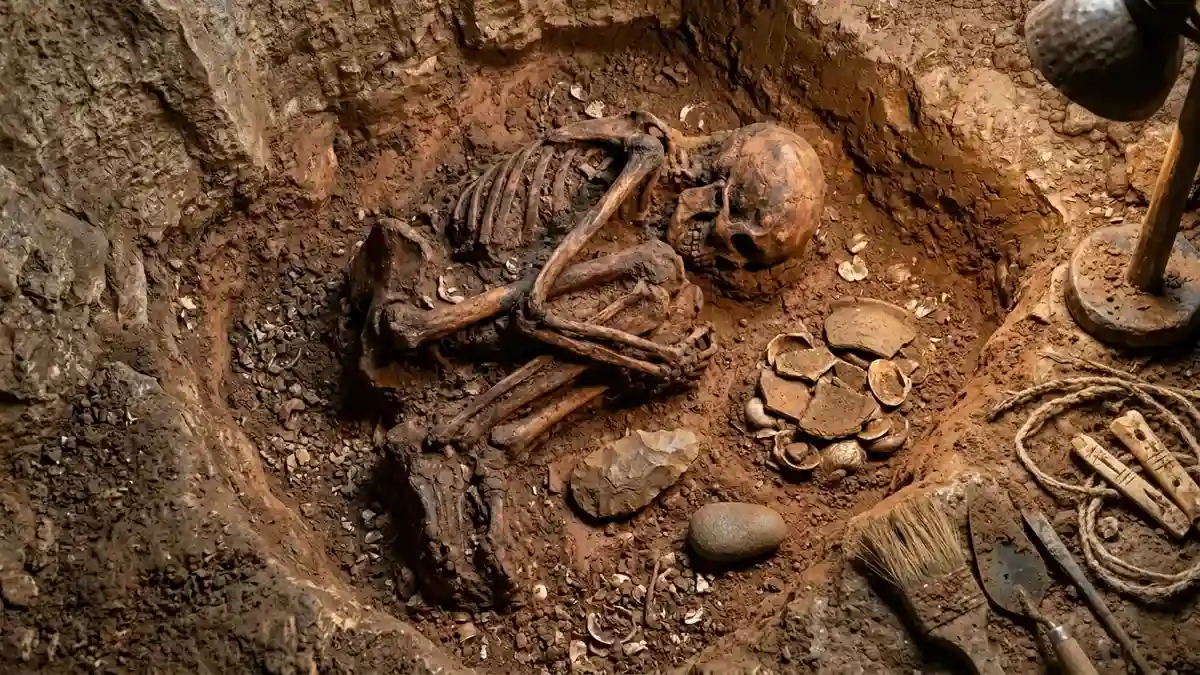
Rather than laying bodies flat on their backs in the relaxed, supine positions that became popular among later farming communities, these ancient hunter-gatherers utilized highly stylized, tightly bound postures. Skeletal remains are consistently found in:
Tightly flexed positions where limbs are pulled tight against the torso.
Hyper-flexed or squatting poses requiring immense physical manipulation to achieve.
Intentionally dismembered arrangements accompanied by signs of post-mortem ritual processing and partial burning.

To determine exactly how these ancient people treated their dead, scientists subjected the bones to advanced laboratory tests, including X-ray diffraction and Fourier-transform infrared spectroscopy. These techniques allowed researchers to analyze microscopic structural and chemical transformations hidden inside the ancient bone matrix.

[Deceased Individual] ──► Intricate Hyper-Flexed Binding ──► Prolonged Fire Smoke-Drying
                                                                     │
                                                                     ▼
                                                   Chemical & Structural Bone Changes
The results confirmed that the remains had been subjected to intense, prolonged exposure to controlled heat. Instead of a standard cremation, these corpses were intentionally smoke-dried over low-intensity fires. This exact artificial preservation method mirrors the traditional mummification techniques still practiced today by Indigenous Australians and the Highland populations of New Guinea, indicating a deeply shared cultural lineage.
Shifting Timelines: Older Than Egypt and Chile
The sheer age of these Southeast Asian discoveries completely upends the traditional timeline of world mummification. By proving that artificial preservation was fully operational 12,000 years ago, these hunter-gatherer burials successfully predate the world’s previously known early mummies by immense stretches of time.
| Culture / Region | Preservation Method | Approximate Age |
| Southeast Asia & Southern China | Active fire smoke-drying and binding | Up to 12,000 years old |
| Chinchorro Culture (Chile) | Anatomical disassembly and clay modeling | Around 7,000 years old |
| Ancient Egypt | Natron salt drying and linen wrapping | Around 4,500 years old |
This dramatic chronological gap proves that complex mortuary care did not start with sedentary agricultural civilizations. Highly mobile hunter-gatherer communities possessed the technical foresight, anatomical knowledge, and symbolic desire to preserve the physical forms of their ancestors long before the dawn of agriculture.
A Geographic Web of Pre-Neolithic Burial Sites
The study highlights how widespread this artificial preservation practice was, mapping an unbroken network of shared funeral traditions that spanned thousands of miles across modern-day China, Vietnam, the Philippines, Laos, Thailand, Malaysia, and Indonesia.
Several key regional excavation sites provided massive quantities of data for the project:
Zengpiyan Cave (Guangxi, China)
This inland cave site yielded 26 distinct pre-Neolithic burials. The individuals were uniformly arranged in highly complex flexed or squatting positions, showcasing early technical mastery of body manipulation.
Huiyaotian Shell Mound (Guangxi, China)
A massive coastal shell-midden deposit that produced 169 historical burials. A significant portion of these skeletons exhibited extreme hyper-flexed postures, carefully bound on their sides or crouched tightly into fetal positions.
Con Co Ngua (Northern Vietnam)
This remarkably dense cemetery contained 267 ancient human burials. The vast majority of the population was interred in strict, upright squatting postures, indicating a highly standardized regional funeral custom.
Gua Harimau (Southern Sumatra, Indonesia)
This multi-layered cave site revealed a deep chronological sequence, containing pre-Neolithic smoke-dried flexed burials directly underneath later, standard Neolithic and Iron Age graves.
Across nearly all of these ancient sites, archaeologists observed that the smoke-dried bodies were positioned with extreme, deliberate care. In many instances, heavy stones were placed over the bound corpses, suggesting an intricate system of protective rituals designed to anchor the deceased within their final resting places.
Deep Roots: Genetics, Rituals, and Human Innovation
Beyond the mechanical tricks of preservation, the study exposes deep ancestral and genetic links that connect these ancient populations across continents. Craniofacial measurements and genetic analysis indicate that these 12,000-year-old Southeast Asian hunter-gatherers share close biological relationships with modern Indigenous Australians and New Guinea Highland societies.
Achieving these hyper-flexed, bound positions required an extraordinary amount of anatomical preparation, likely involving the tight wrapping of the corpse in fabric or cordage immediately after death while the body was still pliable. This heavy investment of time, fuel, and labor proves that these ancient funeral practices carried immense spiritual and social weight for the community.
Rather than viewing the smoking of the dead as an isolated, short-lived experiment, the data paints a picture of a profound cultural continuity that successfully endured for more than 10,000 years. These hunter-gatherers built a resilient ideological anchor that crossed islands and mainland valleys, placing Southeast Asia at the very forefront of early human intellectual and spiritual innovation.
Frequently Asked Questions
What makes these newly discovered mummies the oldest in the world?
The smoke-dried burials discovered across Southeast Asia and southern China date back as far as 12,000 years. This timeline makes them thousands of years older than the famous Chinchorro mummies of Chile (7,000 years old) and the mummies of Ancient Egypt (4,500 years old).
How did ancient hunter-gatherers preserve these bodies?
Advanced structural testing on the bones revealed that the corpses were bound into tight, hyper-flexed positions and suspended above low-intensity fires to be smoke-dried. This controlled heat removed moisture from the tissues, preventing natural decay.
Where exactly were these ancient burials found?
The study analyzed 54 burials spread across 11 different archaeological sites in Southeast Asia and southern China. Major concentrations of these graves were excavated at Zengpiyan Cave and the Huiyaotian shell mound in China, Con Co Ngua in Vietnam, and Gua Harimau in Sumatra, Indonesia.
Who are these ancient people related to?
Anatomical and genetic data indicate that these pre-Neolithic hunter-gatherers share deep biological, craniofacial, and cultural ties with modern Indigenous Australians and New Guinea Highlands populations, who still practice similar smoke-drying customs today.
Why did they bury people in squatting or crouched positions?
Achieving these extreme, tightly bound postures required immense effort and anatomical care immediately following death. Archaeologists believe these specific positions held profound ritualistic and spiritual significance, often accompanied by placing heavy stones over the body for symbolic protection.