
Table of Contents
- 1. The Innovation of the Howiesons Poort Culture
- 1.1. Analyzing the Invisible Residues
- 2. Unlocking nature’s Pharmacy: The Toxic Bushman’s Bulb
- 3. The Strategic Shift: Persistence Hunting and Chemistry
- 4. A Window into Prehistoric Human Intelligence
- 5. Frequently Asked Questions
- 5.1. How old is the oldest evidence of poisoned weapons?
- 5.2. What kind of plant did ancient humans use for the poison?
- 5.3. Where was this discovery made?
- 5.4. Did the poison kill the prey instantly?
- 5.5. How did scientists detect the poison after 60,000 years?
60,000-Year-Old Arrowheads Reveal World’s Earliest Poisoned Weapons
The history of primitive warfare and survival has been radically rewritten by a microscopic chemical discovery in South Africa. Scientists have long debated when early humans transitioned from simple spear-thrusting to deploying complex, chemically altered weapons.
Now, a pioneering study published in Science Advances has found the world’s oldest direct evidence of poisoned weapons, dating back an astonishing 60,000 years. By detecting preserved plant toxins on ancient stone arrowheads, researchers have pushed back the timeline for this advanced hunting technology by more than 50,000 years, revealing a level of prehistoric intelligence and ecological mastery that was previously thought impossible for the era.
60,000-Year-Old Arrowheads Reveal World’s Earliest Poisoned Weapons
The Innovation of the Howiesons Poort Culture
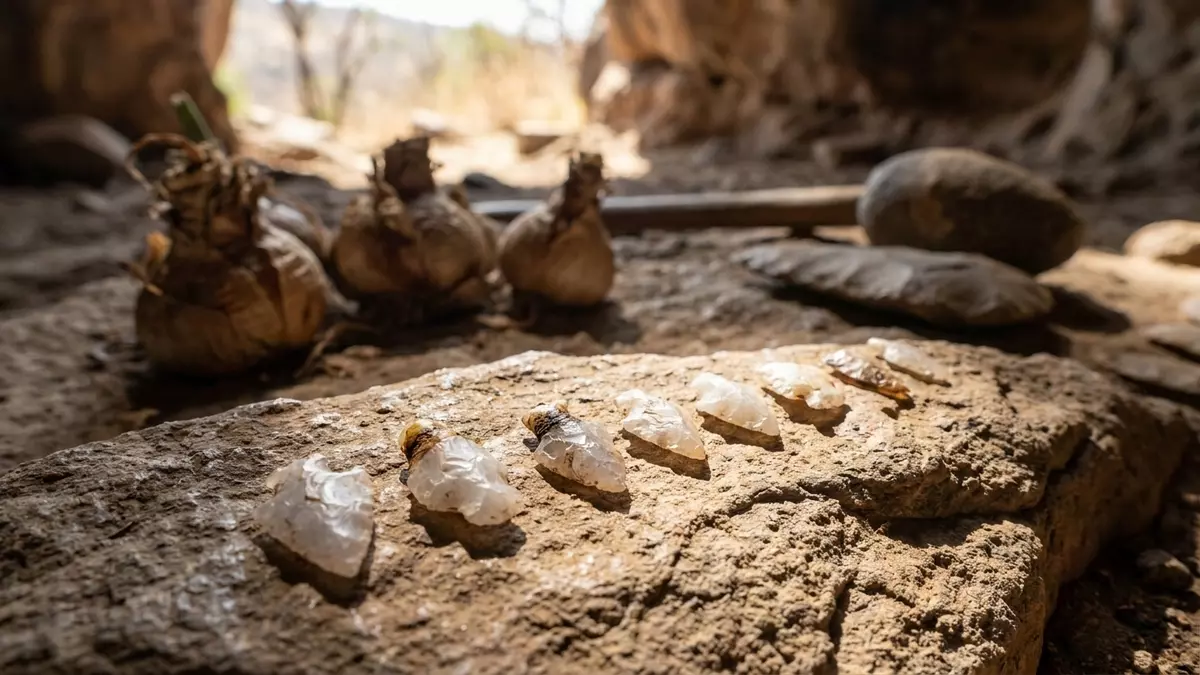
The groundbreaking discovery was made during a high-tech analysis of quartz arrowheads excavated from the Umhlatuzana Rock Shelter, a famous archaeological site located in the KwaZulu-Natal province of South Africa.
 Under the Layers of Deception: High-Tech Scans Reveal Hidden Nazi Symbols Beneath Postwar Painting
These tiny stone tips, known as microliths, belong to the Howiesons Poort cultural tradition. This specific period of the Middle Stone Age is renowned among anthropologists as a golden age of innovation for early Homo sapiens, marked by rapid advancements in tool design, symbolic art, and hunting strategies.
Analyzing the Invisible Residues
For decades, these arrowheads were preserved in archive collections, their surfaces holding microscopic secrets. A research team led by biomolecular archaeologists utilized advanced, non-destructive microchemical analyses to scrape and test the organic crusts clinging to the quartz edges.
Out of ten arrowheads subjected to the testing, five retained clear, definitive chemical footprints of highly lethal plant toxins.

Unlocking nature’s Pharmacy: The Toxic Bushman’s Bulb
The biomolecular testing identified the exact organic compounds trapped on the stone tips: the alkaloids buphandrine and epibuphanisine.
These highly toxic compounds are exclusive to the Amaryllidaceae family of plants. Specifically, they match the exact chemical profile of Boophone disticha (commonly known as the Bushman’s bulb or tumbleweed), a toxic plant native to southern Africa.
[Boophone disticha Bulb] ---> [Extract Toxic Alkaloids] ---> [Apply to Quartz Arrowhead]
          |                                                               |
(Modern Indigenous Use)                                         (60,000-Year-Old Residue)
To verify their findings, the authors compared the 60,000-year-old ancient residues against two control sources:
Poison residues scraped from historical African arrowheads collected by ethnographers during the 18th century.
Fresh chemical extracts harvested directly from modern-day Boophone disticha bulbs.
The profiles matched seamlessly. This reveals an astounding, unbroken line of ecological knowledge and hunting traditions spanning tens of millennia within southern Africa.
The Strategic Shift: Persistence Hunting and Chemistry
The choice of Boophone disticha poison highlights a profound understanding of animal physiology. The alkaloids found in the bulb are slow-acting neurotoxins. When an arrow pierced an animal’s hide, the poison would not drop the prey instantly; instead, it entered the bloodstream and gradually induced severe weakness, respiratory distress, and eventual collapse over several hours.
This slow-acting nature perfectly complemented advanced prehistoric hunting techniques:
Distance Hunting: Hunters no longer needed to risk their lives wrestling dangerous game at close range with heavy thrusting spears. They could shoot a animal from a safe distance and trail it securely.
Facilitating Persistence Hunting: Persistence hunting involves tracking an animal until it collapses from exhaustion. By introducing a weakening neurotoxin into the animal’s system, hunters drastically reduced the physical demands of the chase and exponentially increased their chances of a successful kill.
“The production and use of poisoned arrows require meticulous planning, an intimate understanding of plant chemistry, and an abstract grasp of delayed cause-and-effect relationships.”
A Window into Prehistoric Human Intelligence
Before the Umhlatuzana Rock Shelter study, the earliest confirmed physical evidence of poisoned weapons was only a few thousand years old. Any older usage was purely speculative, inferred from indirect clues like bone applicators or abstract rock art that couldn’t be conclusively linked to actual weapons.
The presence of these toxins 60,000 years ago provides direct proof of sophisticated human cognition during the late Pleistocene. Crafting a poisoned weapon is a multi-step cognitive process:
Botanical Identification: Knowing exactly which plant bulb contains lethal properties despite its harmless appearance.
Chemical Processing: Safely extracting, concentrating, and binding the sap so it adheres to stone without losing its potency.
Delayed Cause-and-Effect: Recognizing that an action taken in the present (poisoning a tip) will yield a vital result hours later down the trail.
Furthermore, the study proves that fragile organic residues can survive for vast stretches of deep time under the right environmental conditions. This technical milestone opens up thrilling new possibilities for archaeologists to scan ancient stone tools worldwide, potentially unlocking a hidden history of prehistoric medicine, chemistry, and warfare.
Frequently Asked Questions
How old is the oldest evidence of poisoned weapons?
The oldest direct evidence of poisoned weapons is 60,000 years old. This new discovery pushes the definitive timeline of human poison use back by more than 50,000 years compared to previous physical archaeological specimens.
What kind of plant did ancient humans use for the poison?
Ancient hunters extracted toxins from the bulb of Boophone disticha, commonly known as the Bushman’s bulb. This plant contains lethal alkaloids that act as a slow-acting neurotoxin when introduced into an animal’s bloodstream.
Where was this discovery made?
The poisoned arrowheads were recovered from the Umhlatuzana Rock Shelter, a key archaeological cave site located in the KwaZulu-Natal province of southern Africa.
Did the poison kill the prey instantly?
No. The plant toxins are slow-acting. Instead of instant death, the poison gradually weakened the animal over several hours, allowing hunters to track the prey safely from a distance until it collapsed.
How did scientists detect the poison after 60,000 years?
Archaeologists utilized advanced microchemical and biomolecular analyses to identify the specific alkaloids (buphandrine and epibuphanisine) preserved within the microscopic organic crusts on the surfaces of the quartz arrowheads.