
Table of Contents
- 1. Unearthing the Damhus Hoard: A Window into Ninth-Century Denmark
- 1.1. What Was a Viking “Penny” Actually Worth?
- 2. The Science Behind the Silver: How Archaeologists Traced its Origin
- 2.1. The Life Cycle of Global Bullion
- 3. The Mint at Ribe: A Powerhouse of Early Medieval Industry
- 3.1. Decoding the Imagery: Odin and the Stag
- 4. From Lindisfarne to Baghdad: The Vast Scope of Viking Networks
- 5. Conclusion: A Connected Medieval World
- 6. Frequently Asked Questions
- 6.1. What is the Damhus hoard?
- 6.2. How do scientists know the silver came from the Islamic world?
- 6.3. What did a Viking penny look like?
- 6.4. Why did the Vikings melt down Islamic coins instead of using them?
- 6.5. What was the historical significance of the town of Ribe?
Viking Silver Secret: Islamic Dirhams Fueled Denmark’s Earliest Coins
Centuries before globalization became a modern buzzword, an intricate network of medieval trade connected the frozen fjords of Scandinavia with the bustling, wealthy marketplaces of the Islamic world. For decades, historians have pieced together stories of Norse merchants traversing vast rivers and foreign lands in search of wealth. Now, ground-breaking archaeological science has provided definitive proof of this legendary connection, revealing that some of the very first Viking pennies were actually made from melted-down Islamic silver coins.
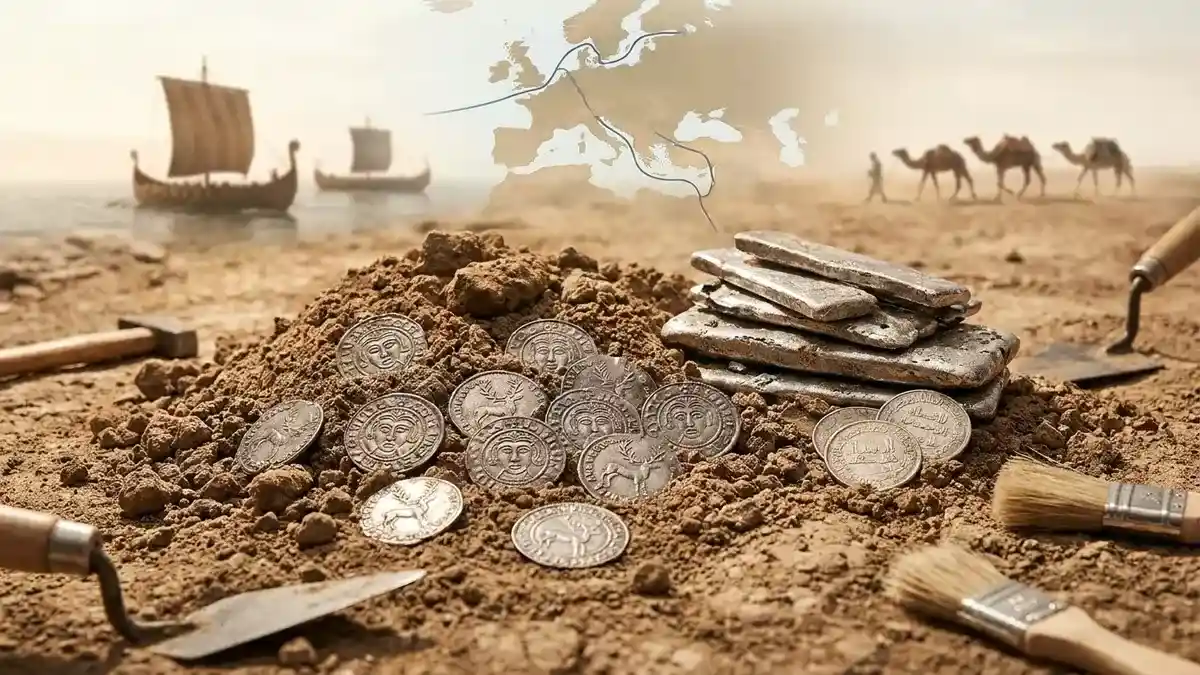
A new study published in the journal Archaeometry has unlocked the secrets of the Damhus hoard, a spectacular collection of 226 early Viking pennies unearthed in 2018 near the historic town of Ribe on Denmark’s Jutland Peninsula. Dated back to a window between A.D. 830 and 850, these pristine artifacts are among the earliest currency ever struck by Norse hands. The chemical fingerprints hidden inside the metal confirm that the global reach of the Viking economy was far more vast—and sophisticated—than anyone previously realized.
Viking Silver Secret Islamic Dirhams Fueled Denmark’s Earliest Coins

Unearthing the Damhus Hoard: A Window into Ninth-Century Denmark
When metal detectorists discovered the Damhus hoard, they knew they had stumbled upon something extraordinary. The coins were remarkably well-preserved despite spending over a thousand years buried in the Danish soil. But beyond their exceptional condition, it is their age that truly excites historians. Struck in the mid-ninth century, these pennies offer a snapshot of a crucial transitional era in Scandinavian history.
During this period, Denmark was not yet a unified country. It was a fragmented landscape ruled by competing pagan chieftains and regional kings. This was more than a century before King Harald Bluetooth would famously unite the Danes and convert the realm to Christianity. Instead, this was the raw, early dawn of the Viking Age, a time when regional trade hubs were just beginning to establish local monetary systems to replace traditional bartering.
What Was a Viking “Penny” Actually Worth?
While modern audiences might hear the word “penny” and think of pocket change, these early medieval equivalents were incredibly valuable. The word itself traces its lineage back to the Old English term pening (closely related to the High German pfennig).
Unlike the fiat currency we use today, the value of a Viking pening was tied entirely to its physical weight in high-purity silver. Thomas Birch, an archaeologist at the National Museum of Denmark and lead author of the study, notes that a single silver penny held significant purchasing power in a ninth-century market. Carrying just one of these coins was enough to buy a steady supply of ale, fresh bread, or essential iron tools for the homestead.
The Science Behind the Silver: How Archaeologists Traced its Origin
To uncover where the silver originated, researchers subjected 25 coins from the Damhus hoard to high-tech non-destructive testing, including X-ray fluorescence spectrometry. This analytical technique allows scientists to determine the precise elemental makeup of an object by measuring the secondary X-rays it emits when bombarded with a high-energy X-ray source.
By looking at the specific trace elements and lead isotopes—variants of elements with differing numbers of neutrons in their atomic nuclei—mixed into the silver, the team could map the “fingerprint” of the metal. The results were undeniable. In multiple tested pennies, more than half of the precious metal content matched the exact chemical signature of Islamic silver coins known as dirhams.

The Life Cycle of Global Bullion
The data indicates that this silver did not come fresh from a European mine. Instead, it had already lived an entire economic life cycle thousands of miles away in the Middle East. The sequence of events likely flowed across a vast international supply chain:
Silver was mined and minted into dirhams within the vibrant economic centers of the Islamic Caliphates.
Traders, merchants, and perhaps even Norse raiders transported these coins northward along Eastern European river routes.
Once the silver reached large trading centers, it was melted down in bulk into portable ingots.
These foreign ingots were finally traded to the mint masters at Ribe, who transformed the raw metal into distinctly local currency.
The Mint at Ribe: A Powerhouse of Early Medieval Industry
The sheer scale of the coin production discovered at Ribe challenges the outdated stereotype of Vikings as simple, disorganized barbarians. By closely examining the coins, researchers noticed subtle variations in the designs. Coins are struck using hard metal stamps called dies, which naturally wear down over time and must be replaced.
In the Damhus hoard alone, scientists identified the use of at least 30 different dies. Based on how quickly these stamps degraded during the minting process, the study estimates that hundreds of thousands of these silver pennies were pumped out by the single mint at Ribe.
Decoding the Imagery: Odin and the Stag
The artwork stamped onto these early pennies offers a fascinating glimpse into Norse mythology and identity. The coins are double-sided, featuring distinct cultural motifs:
The Obverse (Front): Features a highly stylized, abstract human face. Scholars believe this face represents Wodan—more commonly known today as Odin—the chief, one-eyed deity of the Norse pantheon associated with wisdom, war, and magic.
The Reverse (Back): Depicts a striking image of a stag. In Norse mythology, stags hold deep symbolic value, frequently associated with the world tree Yggdrasil and the natural forces of life and regeneration.
This imagery acted as a powerful statement of cultural identity, ensuring that even though the silver came from the Islamic world, the coins themselves were completely integrated into the pagan worldview of early Denmark.
From Lindisfarne to Baghdad: The Vast Scope of Viking Networks
The timeline of the Damhus hoard perfectly matches the historical explosion of the Viking Age. The era is traditionally defined as beginning in A.D. 793, when Norse sea-raiders launched a brutal, unexpected assault on the Christian monks at the Holy Island of Lindisfarne in England. This hit-and-run piracy earned them the name vikingr, an Old Norse word translating roughly to “pirate” or “raider.”
However, while western raids on the British Isles and France dominated Anglo-Saxon chronicles, an equally important expansion was happening toward the east. Norse explorers traveled down the Volga and Dnieper rivers, establishing trade routes that connected Scandinavia directly to Constantinople and Baghdad.
The presence of hundreds of thousands of coins minted from Islamic silver reveals that trade, rather than mere raiding, was a massive engine of the Viking economy. The mid-ninth century marks the exact historical juncture where Middle Eastern silver flooded into the Baltic region, appearing not just in coins, but also in elaborate silver jewelry and arm rings found in hoards across Sweden, Norway, and Denmark.
Conclusion: A Connected Medieval World
The discovery that Islamic dirhams fueled the creation of Denmark’s earliest pennies fundamentally rewrites our understanding of early medieval economics. It proves that the regional mint at Ribe was not isolated, but was instead deeply tied to a sprawling commercial network that stretched across continents.
By melting down the wealth of the Islamic Caliphates to stamp the face of Odin onto their own currency, the early Vikings demonstrated an incredible ability to adapt foreign resources into their own growing civilization. The Damhus hoard stands as a shining testament to an era when silver bound the world together, proving that the paths of history are far more interconnected than we ever dared to imagine.
Frequently Asked Questions
What is the Damhus hoard?
The Damhus hoard is a collection of 226 ancient Viking Age silver pennies discovered in 2018 near the town of Ribe on Denmark’s Jutland Peninsula. It dates back to between A.D. 830 and 850, making it one of the oldest Viking coin troves ever found.
How do scientists know the silver came from the Islamic world?
Archaeologists used advanced analytical techniques, including X-ray fluorescence spectrometry, to study the trace elements and lead isotopes within the coins. The distinct chemical signature of the silver matched that of Islamic silver coins, called dirhams, confirming the metal originated in the Middle East.
What did a Viking penny look like?
The pennies in the Damhus hoard feature a stylized face on one side, which historians believe represents the chief Norse god Odin (Wodan). The reverse side features the image of a stag, a powerful symbol in Norse pagan culture.
Why did the Vikings melt down Islamic coins instead of using them?
While foreign coins were often accepted by weight in casual trade, local rulers and merchants in major trading hubs like Ribe wanted to establish their own standardized currency systems. Melting foreign silver into local coins allowed regional authorities to control the design, weight, and cultural identity of the money circulating in their markets.
What was the historical significance of the town of Ribe?
During the ninth century, Ribe was one of the most important trading ports and urban centers in the Norse world. The discovery of hundreds of thousands of pennies minted there proves that Ribe possessed a highly sophisticated, large-scale industrial mint long before Denmark was unified under a single Christian king.