
Table of Contents
- 1. The SuedOstLink Excavations: Unlocking Germany’s Prehistoric Corridor
- 2. The Secret of the Canine-Adorned Pouches
- 2.1. Crafting a Prehistoric Luxury Item
- 2.2. How the Garments Were Worn
- 3. Ancient Motherhood and the Elite Baby Carrier Hypothesis
- 3.1. Signs of an Elite Social Class
- 4. Sacred Landscapes: How the Corded Ware Honored the Baalberge Ancestors
- 4.1. The Baalberge Burial Mounds
- 4.2. Cultural Inheritance and Burial Rituals
- 5. Preserving Germany’s Prehistoric Heritage
- 6. Frequently Asked Questions (FAQ)
- 6.1. What is the Corded Ware culture?
- 6.2. Why did ancient people use dog teeth to decorate bags?
- 6.3. Were these bags actually used as baby carriers?
- 6.4. How did archaeologists find these graves if they weren’t visible on the surface?
- 6.5. What will happen to the artifacts discovered at Krauschwitz?
4,500-Year-Old Elite Graves Discovered by German Archaeologists
Deep beneath the soil of central Germany, a stunning archaeological discovery has revealed the intimate lives, elite status, and heartbreaking losses of prehistoric mothers. During excavations ahead of a massive green energy infrastructure project, researchers unearthed a series of 4,500-year-old graves belonging to the Corded Ware culture. Among the most remarkable findings are the remnants of lavishly decorated pouches adorned with hundreds of canine teeth—luxury items that experts believe served as prestigious baby carriers for high-status women.
This rare glimpse into Neolithic society does more than just showcase ancient craftsmanship; it provides profound insight into how early European communities honored motherhood, navigated social hierarchy, and commemorated their dead.
4,500-Year-Old Elite Graves Discovered by German Archaeologists

The SuedOstLink Excavations: Unlocking Germany’s Prehistoric Corridor
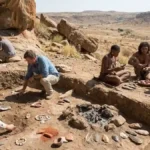
The groundbreaking discoveries occurred near the village of Krauschwitz, located in the state of Saxony-Anhalt, Germany. The archaeological dig was launched as a salvage operation ahead of the construction of the SuedOstLink, a major power transmission line managed by the network operator 50Hertz.
Spanning a 170-kilometer corridor from Wolmirstedt to Droyßig, the infrastructure route cuts directly through a landscape dense with ancient history. Recognizing the archaeological potential of the region, the State Office for Heritage Management and Archaeology of Saxony-Anhalt (LDA) has been working in close coordination with engineers to document and preserve features before construction begins.
The corridor has proven to be an archaeological goldmine. So far, researchers have mapped out numerous prehistoric structures, including:
15 burial mounds belonging to the Middle Neolithic Baalberge culture.
15 distinct graves tied to the later Corded Ware culture.
Among these sites, the Corded Ware burials have captured the attention of the global scientific community due to the unparalleled preservation of elite funerary goods.
The Secret of the Canine-Adorned Pouches
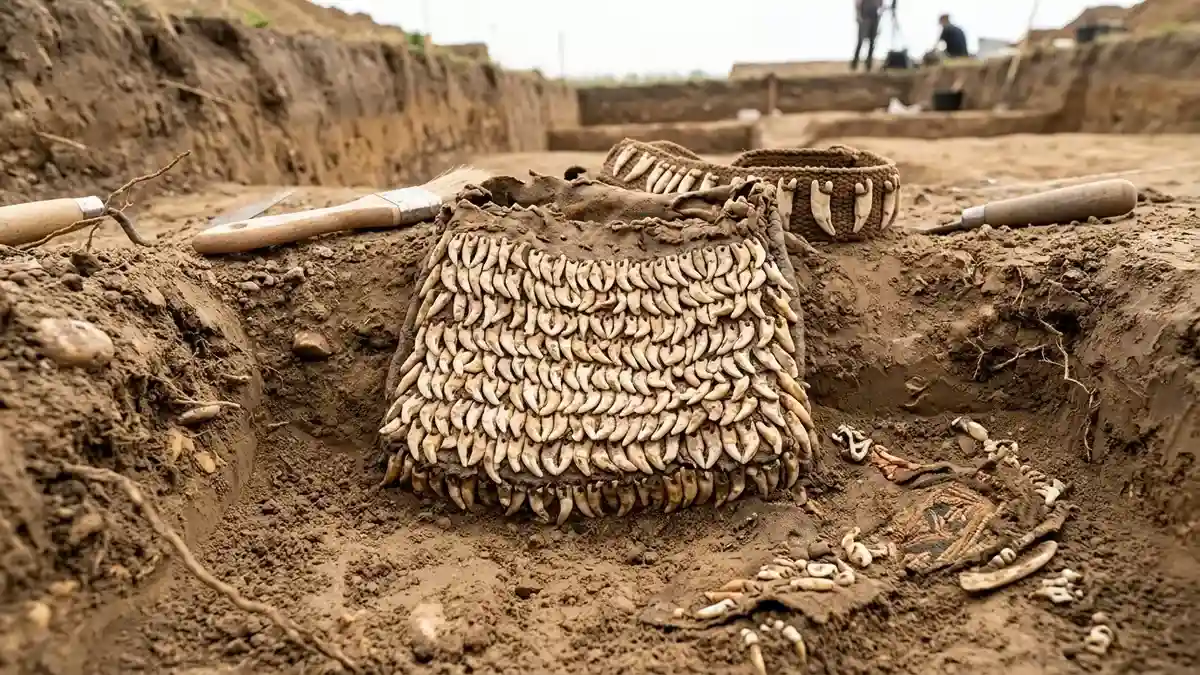
The standouts of the Krauschwitz excavation are three specific Corded Ware graves containing highly ornate bags. While the organic components of the pouches—most likely leather, animal hide, or woven textiles—completely disintegrated over four millennia, their structural designs remained perfectly preserved in the earth thanks to an astonishing decorative element: hundreds of pierced dog teeth.
Crafting a Prehistoric Luxury Item
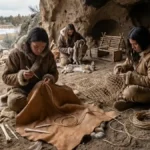
Archaeologists estimate that a single bag required approximately 350 individual teeth to complete. The canine teeth were meticulously drilled and sewn onto the exterior of the fabric in overlapping rows, resembling the pattern of modern roofing tiles. Measuring roughly 30 centimeters in length and 20 centimeters in height, these pouches represented an immense investment of time, skill, and resources.
Analysis of the teeth reveals a sobering reality about Neolithic animal husbandry and ritual sacrifice. The teeth did not come from random scavenging; instead, they were harvested from a specific, medium-sized dog breed physically comparable to the modern Small Münsterländer. Evidence suggests these dogs were intentionally bred and sacrificed at a young age specifically to harvest their teeth for luxury goods.
How the Garments Were Worn
According to the LDA research team, these heavy, glittering pouches were worn at the front of the body. They were suspended from wide, supportive waist belts that were also embellished with predatory wolf teeth, creating a striking visual display of wealth and status.
Ancient Motherhood and the Elite Baby Carrier Hypothesis
Beyond their aesthetic value, the context in which these bags were buried has revolutionized our understanding of Neolithic family life. Several of the tooth-adorned pouches were discovered containing the fragile, highly decayed skeletal remains of infants and fetuses.
This specific placement strongly indicates that the bags were not merely decorative purses, but highly prestigious baby carriers or swaddling slings. The discovery suggests that high-status women in Corded Ware society used these heavily ornamented items to carry their children, symbolizing the continuation of their elite lineage.
The sophistication of prehistoric childcare practices is further highlighted by the presence of accompanying textiles. Researchers identified remnants of protective cloths, including 20-centimeter-wide shawls. These garments were intricately embroidered with reflective sequins and lined with durable dog molars, offering both physical protection and symbolic status to the infants wrapped within them.
Signs of an Elite Social Class
The distribution of these artifact-rich graves suggests a highly stratified society. The LDA notes that these exquisite, tooth-adorned bags appear in only about 20% of the female burials analyzed in the region. The sheer amount of labor required to breed the animals, harvest the teeth, and assemble the embroidery means these items were strictly reserved for a wealthy ruling class.
This maternal association was reinforced by a parallel discovery in nearby Nessa, located just 1.7 kilometers from the primary Krauschwitz site. There, another female burial was uncovered featuring an identical canine-tooth pouch interred alongside a fetus, confirming that this funeral custom was a widespread marker of elite maternal identity across the regional elite.
Sacred Landscapes: How the Corded Ware Honored the Baalberge Ancestors
The excavations at Krauschwitz also revealed a deep historical continuity spanning thousands of years. Long before the Corded Ware people occupied the region, the Middle Neolithic Baalberge culture utilized the exact same landscape for their sacred rituals.
The Baalberge Burial Mounds
Archaeologists exposed five monumental Baalberge mounds dating back roughly 6,000 years. These structures were originally built by constructing trapezoidal wooden huts directly over grave sites, which were then systematically covered with thick layers of loess soil to create massive earthen mounds.
Though centuries of agricultural cultivation have flattened these mounds so they are no longer visible to the naked eye, their structural foundations, surrounding trenches, and grave pits remain entirely intact beneath the topsoil. In their prime, these mounds served as permanent, highly visible territorial markers, signaling communal strength and ancestral reverence.
Cultural Inheritance and Burial Rituals
Fascinatingly, the Corded Ware communities who arrived 1,500 years later were clearly influenced by these ancient landmarks. Rather than destroying or ignoring the Baalberge mounds, the Corded Ware people intentionally placed their own cemeteries immediately adjacent to the older tombs, establishing a direct connection to the perceived sacred power of the landscape.
However, the Corded Ware culture brought its own highly rigid, gender-segregated funerary customs to the site. Spanning a massive geographic area from the French Alsace region to Ukraine, and from Scandinavia to the Alps, this culture adhered to strict burial orientations:
Alignment: The deceased were consistently oriented facing toward the south.
Men: Laid to rest on their right side, typically accompanied by utilitarian weapons like polished stone axes.
Women: Laid to rest on their left side, accompanied by domestic items, ceramic vessels, intricate jewelry, and the iconic tooth-adorned maternal pouches.
Preserving Germany’s Prehistoric Heritage
Because of the extreme fragility of the organic traces and the complex positioning of the hundreds of canine teeth, field archaeologists chose not to excavate the delicate bags entirely on-site. Instead, the burials containing the pouches were encased in massive blocks of earth and removed intact.
These earth blocks have been safely transported to the specialized laboratories of the State Office for Heritage Management and Archaeology in Halle. Here, conservators and anthropologists will utilize advanced micro-excavation techniques, digital imaging, and chemical analysis to study the textiles, teeth, and human remains without risking damage.
Field excavations at the Krauschwitz site are scheduled to continue through July. Once the archaeological teams have fully documented and cleared the prehistoric features, the land will be officially handed over to 50Hertz, allowing construction of the SuedOstLink power line to proceed.
Frequently Asked Questions (FAQ)
What is the Corded Ware culture?
The Corded Ware culture was a major European archaeological horizon that flourished during the late Neolithic and early Bronze Age, roughly between 2900 BCE and 2350 BCE. It extended across vast territories of Northern, Central, and Eastern Europe and is characterized by its distinctive pottery decorated with cord impressions, its specific burial customs, and its mobile, pastoral lifestyle.
Why did ancient people use dog teeth to decorate bags?
In prehistoric European societies, animal teeth were highly valued symbols of status, hunting prowess, and spiritual protection. For the Corded Ware elite, using hundreds of carefully matched dog teeth demonstrated immense wealth and access to resources, as it required breeding and sacrificing specific domestic animals to create a single garment.
Were these bags actually used as baby carriers?
While organic fabrics have decayed, the presence of infant and fetal skeletal remains directly inside or immediately adjacent to these highly decorated pouches strongly suggests they functioned as elite baby carriers, ceremonial swaddling slings, or prestigious maternal identity symbols.
How did archaeologists find these graves if they weren’t visible on the surface?
The graves and ancient burial mounds were discovered during mandatory archaeological surveys conducted ahead of the construction of the SuedOstLink power transmission line. Modern technology, historical mapping, and trial trenching allow archaeologists to locate subterranean features like grave pits and foundation trenches that have been flattened by centuries of farming.
What will happen to the artifacts discovered at Krauschwitz?
The artifacts, including the tooth-adorned pouches, have been lifted out of the ground within protective blocks of soil. They are currently housed in the laboratories of the State Office for Heritage Management and Archaeology of Saxony-Anhalt, where they will undergo meticulous scientific analysis, conservation, and eventual public display.