
Table of Contents
- 1. Unearthing the Giants: The Discovery at Wyskoć
- 2. Prehistoric Mega-Structures: Dimensions and Astronomical Alignment
- 2.1. The Geometric Design
- 2.2. Mapping the Skies
- 3. A Triumph of Stone Age Engineering and Logistics
- 3.1. Centuries of Heavy Degradation
- 4. Inside the Tombs: Shamanic Rites and Prehistoric Opium
- 4.1. Mortuary Practices and Grave Offerings
- 5. Expanding the Map of Ancient European Monuments
- 6. Frequently Asked Questions (FAQ)
- 6.1. What are the “Polish pyramids”?
- 6.2. Who built these ancient monuments in Poland?
- 6.3. How did Stone Age people move 10-ton boulders?
- 6.4. Why were these massive tombs built for just one person?
- 6.5. What kind of artifacts are found inside these tombs?
5,500-Year-Old Polish Pyramids Reveal Secrets of Neolithic Engineering
A stunning archaeological breakthrough in western Poland has peeled back the layers of time, revealing the immense engineering capabilities and complex spiritual lives of some of Europe’s earliest agricultural pioneers. Deep within a protected landscape park, researchers have discovered two massive megalithic tombs dating back more than 5,500 years. Frequently referred to as the “Polish pyramids” or “giants’ graves” due to their monumental scale and distinctive triangular profiles, these prehistoric structures are rewriting the history of Neolithic architecture in Central Europe.
Far from being simple earthen mounds, these long-hidden monuments provide undeniable proof that Stone Age communities possessed an advanced grasp of geometry, astronomy, and heavy logistics long before the construction of Egypt’s famous pyramids.
5,500-Year-Old Polish Pyramids Reveal Secrets of Neolithic Engineering
Unearthing the Giants: The Discovery at Wyskoć
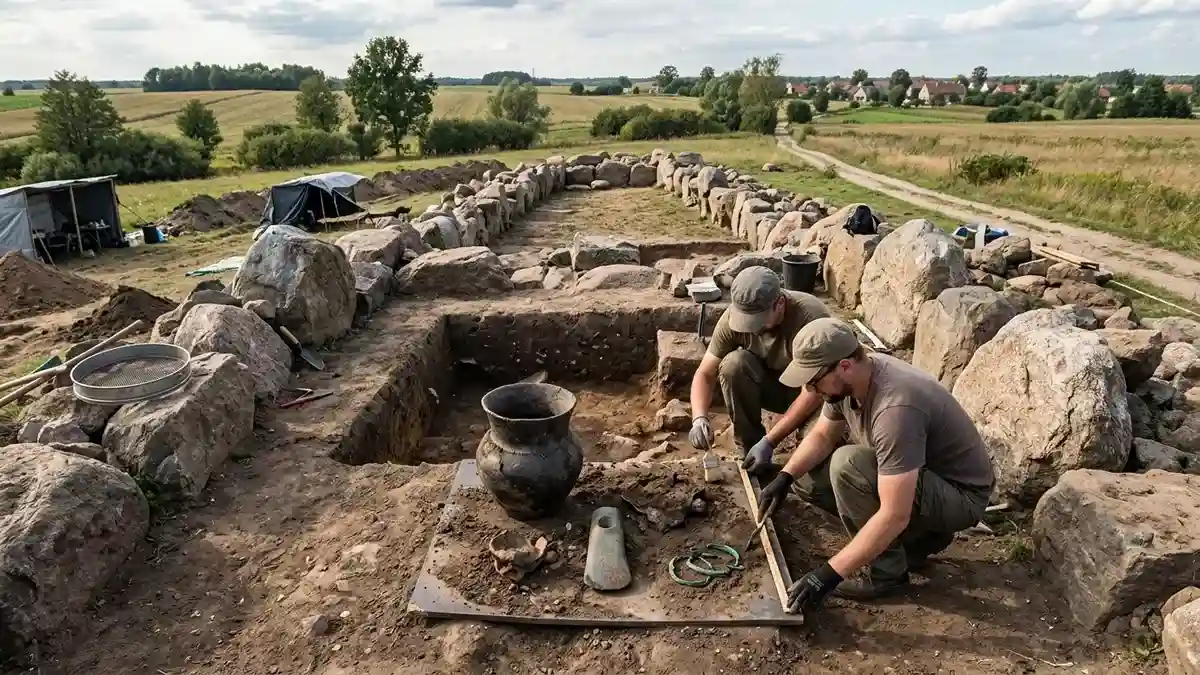
The remarkable find occurred near the quiet village of Wyskoć, situated inside the scenic General Dezydery Chłapowski Landscape Park in Poland’s Wielkopolska province. A team of expert archaeologists from Adam Mickiewicz University in Poznań initially located the hidden features during a systematic field survey. Rather than relying solely on traditional shovels and maps, the researchers utilized cutting-edge remote sensing technology to peer beneath the agricultural topsoil, identifying anomalies in the earth that pointed to prehistoric construction.
Following the high-tech aerial survey, targeted ground excavations confirmed the presence of the ancient monuments. The builders of these massive tombs have been identified as the Funnelbeaker Culture, a transformative Neolithic society named after their distinctive, funnel-necked ceramic vessels. This culture is widely celebrated by historians for introducing intensive farming, livestock herding, and large-scale monumental stone architecture to the European landscape.
This discovery is exceptionally rare for western Poland. While similar structures have occasionally been found elsewhere in the country, this marks only the second time in history that megalithic tombs of this specific style have been verified in the Wielkopolska region, following a lone discovery in 2019.

Prehistoric Mega-Structures: Dimensions and Astronomical Alignment
The sheer scale of the Wyskoć tombs has left the scientific community awestruck. Stretching up to an incredible 200 meters (roughly 656 feet) in length and originally rising to heights of approximately four meters, these monuments were designed to dominate the prehistoric landscape.
The Geometric Design
Architecturally, the tombs were built in an elongated, trapezoidal format. They feature a wide, towering eastern facade that gradually tapers down into a narrow, low western “tail.” Archaeologists believe this specific geometric layout held deep symbolic and cosmological meaning for the Funnelbeaker people, representing an advanced regional understanding of spatial layout and design aesthetics.
Mapping the Skies
Remarkably, the structures were precisely aligned to the cardinal directions (North, South, East, and West). This deliberate orientation demonstrates that these ancient builders were not merely piling dirt and stones at random; instead, they possessed a sophisticated understanding of astronomy, tracking the movements of the sun, moon, and stars across the seasons to orient their sacred spaces.

A Triumph of Stone Age Engineering and Logistics
Constructing monuments of this magnitude during the Stone Age required extraordinary physical coordination, social organization, and mechanical ingenuity. The perimeters of the great trapezoidal mounds were originally framed using massive glacial boulders, some of which weighed up to a staggering 10 tons.
Without the aid of modern machinery, draft horses, or even metal tools, the Funnelbeaker engineers successfully transported these colossal stones across the prehistoric terrain. Experts believe they achieved this feat using low-tech but highly efficient transport systems, loading the boulders onto heavy wooden sledges and pulling them over cleared tracks using pure human muscle power and integrated rope systems.
Centuries of Heavy Degradation
Regrettably, visitors to the site today will not see the stone walls intact. Over the intervening five millennia, subsequent human populations heavily disrupted the monuments. Because high-quality stone has been a precious building commodity for thousands of years, local peoples throughout the Bronze Age, Iron Age, and medieval periods systematically raided the tombs. They split the massive boulders apart to build foundations, roads, and homes.
According to Artur Golis, a head specialist for nature and landscape conservation at the Wielkopolska Province Landscape Parks Complex, this continuous recycling of materials has left the prehistoric objects heavily degraded, with most of the original framing stones lost to time.
Inside the Tombs: Shamanic Rites and Prehistoric Opium
Despite the external damage to the stone borders, the interior grave pits continue to yield invaluable clues regarding the social hierarchies and spiritual rituals of ancient Poland.
The Funnelbeaker Culture is generally viewed by anthropologists as a relatively egalitarian tribal society without rigid class divisions. However, the construction of these monumental “pyramids” indicates that certain individuals held immense social, political, or spiritual importance. These elite tombs were reserved exclusively for revered tribal leaders, powerful shamans, or spiritual priests.
Mortuary Practices and Grave Offerings
Evidence suggests that each colossal tomb was constructed to hold just a single distinguished body. The deceased was typically laid flat on their back, with their legs fully extended toward the eastern front of the mound—aligning them directly with the rising sun.
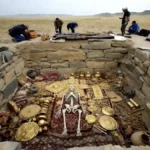
While the actual human skeletons have largely dissolved due to the high acidity of the local soil over 5,500 years, the durable grave goods buried alongside them have a much higher survival rate. Excavators look for a variety of elite offerings intended to accompany the leaders into the afterlife, including:
Finely crafted Funnelbeaker ceramic vessels
Polished stone ceremonial axes
Rare, imported copper ornaments signifying vast trade wealth
Specialized ritual vessels believed to have held opium or other psychoactive substances used in shamanic ceremonies
Expanding the Map of Ancient European Monuments
Historically, the vast majority of these trapezoidal megalithic monuments—often called Kuyavian-type tombs—were found clustered in the Kuyavia region of northwestern Poland. The discovery of two additional tombs far to the west in Wielkopolska radically expands the known geographic footprint of this monumental tradition.
Out of five highly probable locations identified by archaeologists during their initial remote sensing surveys, two have officially been confirmed as monumental tombs. With only one of the two structures fully excavated so far, scientists are highly optimistic that the remaining unexcavated areas will yield even more profound insights into the daily lives, regional trade networks, and complex spirituality of Poland’s first farmers.
Currently, the Wyskoć archaeological site is strictly closed to the general public to protect the fragile subterranean features from weather and looting while scientific excavations continue. Long-term plans for public tourism or educational access will depend entirely on future preservation assessments and funding. For now, these silent earthen giants stand as a powerful testament to an ingenious, deeply reverent Stone Age society that honored its dead with architectural wonders.
Frequently Asked Questions (FAQ)
What are the “Polish pyramids”?
The “Polish pyramids” are monumental, trapezoidal-shaped megalithic burial tombs built by the Neolithic Funnelbeaker Culture over 5,500 years ago. They are called pyramids due to their massive size and triangular, elongated earthen profiles, though they predate the stone pyramids of Egypt.
Who built these ancient monuments in Poland?
They were constructed by the Funnelbeaker Culture, one of the earliest agricultural societies in Central Europe. They are known for transitioning Europe away from a hunter-gatherer lifestyle toward farming, animal domestication, and unique pottery styles.
How did Stone Age people move 10-ton boulders?
Without metal tools or machinery, the builders utilized advanced social organization and clever physics. They likely used heavy wooden sledges, log rollers, and woven ropes, combining the collective muscle power of large tribal communities to haul the massive stones from nearby glacial deposits.
Why were these massive tombs built for just one person?
While the society was mostly egalitarian, certain individuals like tribal chiefs, elite warriors, or spiritual shamans held extraordinary status. Constructing a 200-meter-long monument for a single leader served as a display of communal unity, tribal power, and deep spiritual reverence for the dead.
What kind of artifacts are found inside these tombs?
Though human bones often decay in the soil, the tombs frequently contain durable artifacts such as beautifully molded pottery, pristine stone axes, early copper jewelry, and ritual vessels that chemical analysis suggests were used to hold opium for spiritual ceremonies.