
Table of Contents
- 1. The Catastrophe at Heraclea Sintica
- 2. Unearthing a 1,600-Year-Old Tragedy
- 3. Surviving Against All Odds: The Story of Victim 2N
- 4. A Unique Case of Ancient Empathy
- 5. Why the Bulgarian Discovery is Locally Vital
- 6. Frequently Asked Questions
- 6.1. What did the discovery in Heraclea Sintica reveal about the Roman world?
- 6.2. What is Apert syndrome, and how did it affect the ancient victim?
- 6.3. How did the men inside the Roman cistern die?
- 6.4. Why weren’t the bodies ever recovered or buried by their families?
- 6.5. Where is Heraclea Sintica located?
Ancient Earthquake Victims Reveal Compassion for the Disabled in the Roman World
Deep within the ruins of an ancient Roman forum, a tragic scene frozen in time for over 1,600 years is fundamentally altering our understanding of social welfare in antiquity. While popular history often depicts the Roman Empire as a ruthless society that prized physical perfection and marginalized the weak, a profound new forensic discovery tells a very different story—one rooted in community care, empathy, and family devotion.
By analyzing the skeletal remains of individuals who perished during a catastrophic 4th-century earthquake in Heraclea Sintica, located in modern-day southwestern Bulgaria, anthropologists have uncovered the living profile of a severely disabled young man. His survival into adulthood provides undeniable physical proof that ancient communities invested significant resources, time, and daily care into supporting their most vulnerable members.
Ancient Earthquake Victims Reveal Compassion for the Disabled in the Roman World
The Catastrophe at Heraclea Sintica
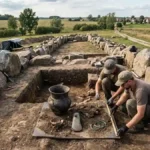
Heraclea Sintica was once a booming, prosperous civic center nestled along the fertile banks of the Struma River and the shadows of the Kozhuh highlands. Having flourished under Greek influence before being integrated into the Roman Empire, the city featured a monumental forum—the beating heart of local commerce, politics, and religious life—complete with grand porticoes, municipal offices, and massive, brick-vaulted water cisterns.
Sometime during the late 4th century CE, the city’s prosperity came to a violent halt. A massive earthquake—part of a destructive wave of seismic shocks that rippled across the eastern Mediterranean—struck the region. The intense tremors caused widespread structural failure across the city, including the immediate, explosive collapse of the forum’s underground water infrastructure.
Unearthing a 1,600-Year-Old Tragedy
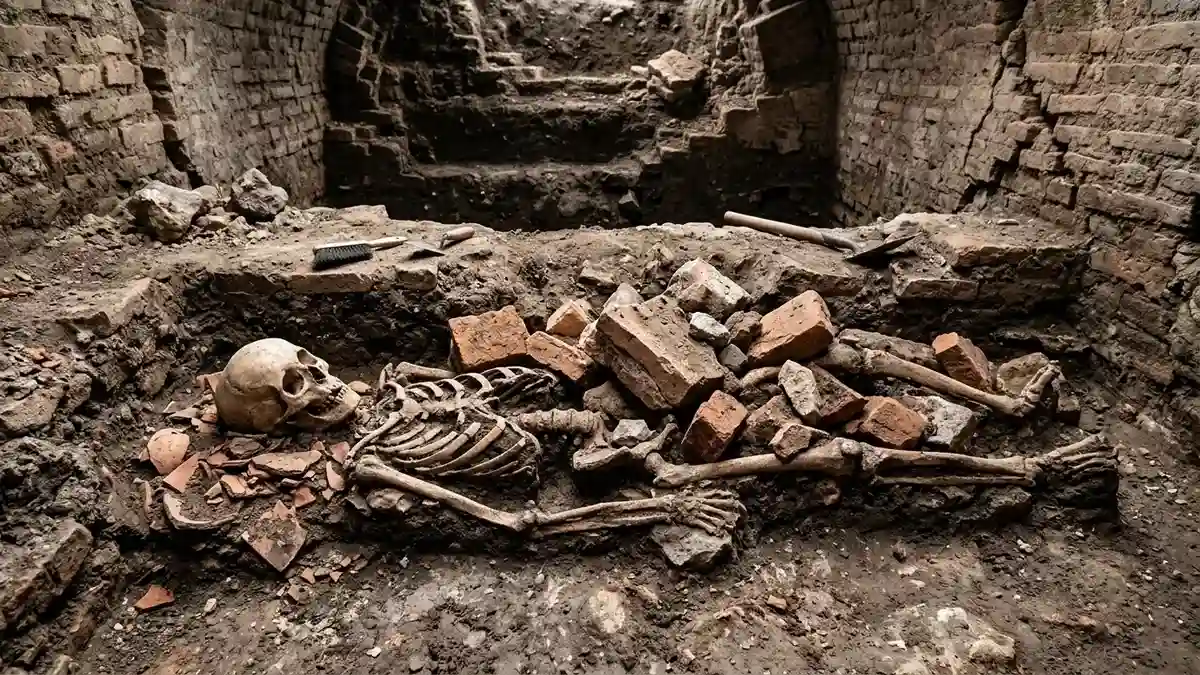
During recent excavations in the southwestern corner of the forum, archaeologists dug down six meters (nearly 20 feet) below the surface, eventually breaching the heavy rubble of a collapsed brick cistern. Beneath the masonry debris, they uncovered a heartbreaking scene: the intact skeletons of five young men lying flat on their backs where they had been pinned down by the falling vault.

A sixth skeleton was discovered at a slightly higher geological layer, separated from the others by a distinct shelf of soil and fallen bricks. Archaeologists hypothesize that this sixth individual may have been standing in an adjacent building or was actively rushing into the plaza to provide emergency aid to the trapped men when a secondary collapse killed him.
Forensic analysis of the bones revealed that the victims were all young men between the ages of 18 and 35. Their remains exhibited severe, extensive trauma—including crushed rib cages, shattered long bones, and catastrophic skull fractures—consistent with near-instantaneous death caused by falling from a great height or being crushed beneath tons of collapsing brickwork. Because the bodies were left completely unburied and untouched by scavengers, historians believe the community was so devastated by the disaster that this specific cistern was simply abandoned and forgotten.
Surviving Against All Odds: The Story of Victim 2N
While the forensic details of the disaster are fascinating, it was the physical structure of one specific skeleton, labeled Individual 2N, that completely stunned researchers.
An exhaustive osteological examination conducted by anthropologists Vanya Russeva and Lilia Manoilova at the Bulgarian Academy of Sciences revealed that this young man, who was between 18 and 25 years old when he died, suffered from Apert syndrome. This rare genetic disorder causes severe developmental anomalies, including:
A significantly deformed, pointed skull structure caused by the premature fusing of cranial bones.
A severe cleft palate, which hampers normal swallowing and speech.
Varying degrees of intellectual challenges and physical joint malformations.
In the ancient Mediterranean, a child born with Apert syndrome faced an incredibly bleak survival outlook. The severe cleft palate alone would have made nursing as an infant exceptionally difficult, requiring specialized feeding methods. Throughout his life, his cognitive and physical impairments meant he would have been entirely incapable of independent survival, requiring round-the-clock assistance, specialized food preparation, and constant physical protection from his family or community from the day he was born.
A Unique Case of Ancient Empathy
The fact that Individual 2N managed to survive all the way into early adulthood is a monumental historical revelation. It stands as a physical testament to the deep empathy, compassion, and structured care provided by his peers.
In a surprising twist, the team discovered that a second skull from the exact same collapse site, designated 2_3N, also exhibited a distinct cleft palate. This recurring skeletal anomaly strongly points to a potential familial or genetic link between the victims. If upcoming ancient DNA testing confirms a biological relationship, it will provide an unprecedented look into how Roman-era families managed hereditary disabilities, showing that households actively pooled their wealth and labor to ensure their disabled children were loved, protected, and fully integrated into the community.
Why the Bulgarian Discovery is Locally Vital
While previous earthquake excavations in places like Kourion, Cyprus, or Eleutherna, Crete, have yielded fascinating data about architectural engineering and seismic destruction, they rarely preserve such deep, individual human narratives. The find at Heraclea Sintica is a true archaeological rarity because it captures multiple lives in a single, un-disturbed disaster context, giving scientists an unbiased look into both the sudden terror of the earthquake and the compassionate social systems that operated during the twilight of the Roman Empire.
Frequently Asked Questions
What did the discovery in Heraclea Sintica reveal about the Roman world?
The discovery proved that Roman-era provincial communities possessed a high degree of empathy and compassion for individuals with severe physical and cognitive disabilities, providing them with long-term, resource-intensive care from infancy into adulthood.
What is Apert syndrome, and how did it affect the ancient victim?
Apert syndrome is a rare genetic disorder characterized by the premature fusing of skull bones, facial deformities, a cleft palate, and physical or intellectual challenges. The ancient victim would have required constant, daily help with feeding, speaking, and mobility to survive.
How did the men inside the Roman cistern die?
The six men were killed instantly during a catastrophic earthquake in the late 4th century CE when the heavy, brick-vaulted roof of a municipal water cistern collapsed directly on top of them, burying them beneath meters of debris.
Why weren’t the bodies ever recovered or buried by their families?
Because the bodies were found in their exact death positions without any signs of formal burial or disturbance, historians believe the earthquake was so physically and economically devastating to Heraclea Sintica that the community lacked the resources to clear the ruins, likely unaware that the men were trapped inside the cistern.
Where is Heraclea Sintica located?
Heraclea Sintica is an ancient Greek and Roman city located in what is now southwestern Bulgaria, situated strategically near the Struma River valley and the volcanic Kozhuh highlands.