
Table of Contents
- 1. Moving Beyond the Field: The Laboratory Phase
- 2. Isotopic Mapping: Tracking the Origins of the Deceased
- 2.1. How Tooth Enamel Acts as a Geographic Journal
- 3. Paleogenomics: Reconstructing Ancient DNA
- 4. Engineering with Human Bones: A Unique Structural System
- 5. Demographics and Mortuary Insights
- 5.1. The Mystery of the Child Skulls
- 5.2. The Technical Feat of Mandible Retention
- 6. Protecting a Vulnerable Monument
- 7. Conclusion: Humanizing the Past
- 8. Frequently Asked Questions
- 8.1. What exactly is the Huei Tzompantli?
- 8.2. How do scientists know where the sacrifice victims grew up?
- 8.3. Were only male warriors sacrificed at the tower?
- 8.4. Why are the child skulls in the tower different from the adult skulls?
- 8.5. How did the Aztecs keep the lower jaws attached to the skulls?
10-Year Study of Aztec Skull Tower Exposes Secrets of the Sacrificed
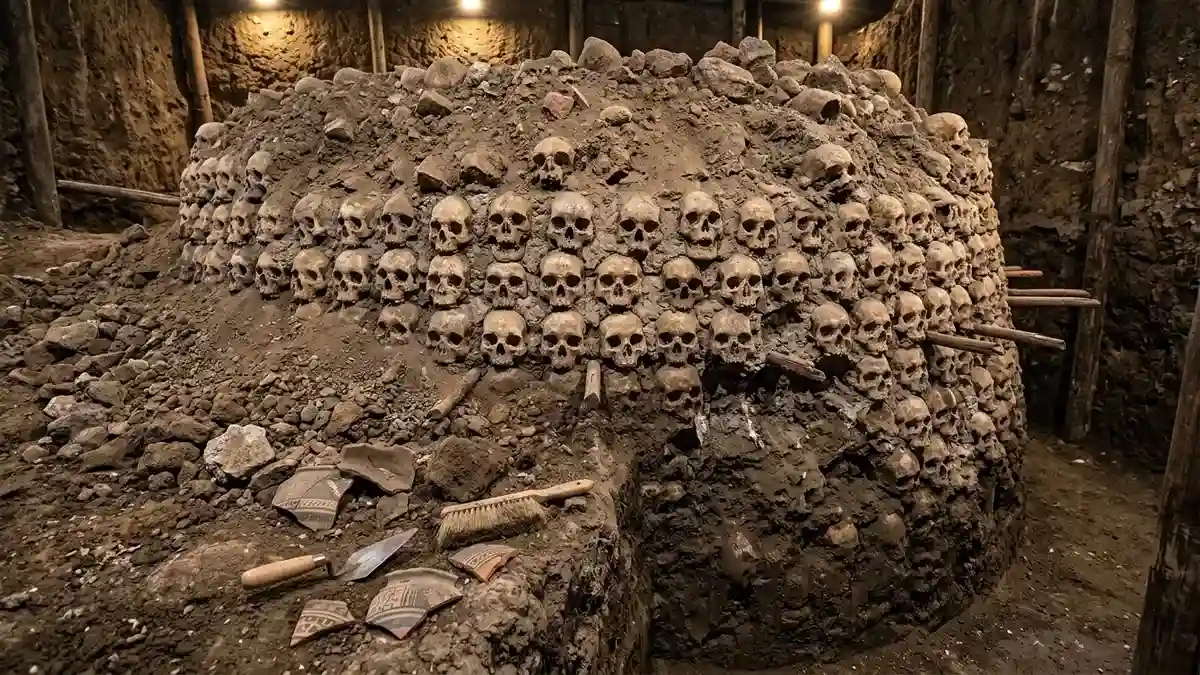
In 2015, construction workers and archaeologists digging beneath the bustling streets of Mexico City’s Historic Center made a discovery that sent shockwaves through the global scientific community. Buried deep within the colonial subsoil near 24 Guatemala Street, they uncovered the Huei Tzompantli of Tenochtitlan—a massive, circular tower constructed entirely out of thousands of human skulls. For centuries, Western historians had dismissed Spanish conquistador accounts of towering skull walls as hyperbolic war propaganda. The physical reality of the tower proved that the conquistadors had been telling the truth, revealing an unprecedented monument to Mexica (Aztec) religious devotion and state-sponsored human sacrifice.
Now, more than a decade after its initial unearthing, the Huei Tzompantli has transitioned from a chaotic field excavation into one of the most intensive, high-tech laboratory investigations in the history of Mesoamerican archaeology. Operating out of the specialized research spaces of the Templo Mayor Museum, an international team of bioarchaeologists, geneticists, and forensic scientists is using advanced biochemical analysis to extract the deeply personal life histories hidden within the bone architecture. Their findings are dismantling long-held myths about who these sacrifice victims were, where they came from, and how Mexica priests executed their complex rituals.
10-Year Study of Aztec Skull Tower Exposes Secrets of the Sacrificed
Moving Beyond the Field: The Laboratory Phase
While the initial public excitement focused on the dramatic images of skulls cemented together in a macabre architectural spiral, the real historical breakthroughs are happening behind closed laboratory doors. The physical excavation of the tower’s primary structures has long been completed, clearing the way for an exhaustive analytical phase.
Scientists have selected a baseline sample of 214 meticulously cleaned, stabilized, and restored skulls for deep forensic study. This monumental task relies on a multi-institutional alliance combining the practical field experience of the National Institute of Anthropology and History’s (INAH) Urban Archaeology Program with the highly specialized technical laboratories of the National School of Anthropology and History (ENAH). Together, these researchers are using a dual-pronged approach that pairs dental isotope mapping with cutting-edge paleogenomics to reconstruct the living profiles of the deceased.
Isotopic Mapping: Tracking the Origins of the Deceased
The first major line of inquiry focuses on stable isotope analysis, a chemical tracking technique that allows scientists to reconstruct an individual’s geographic movements across their lifespan. By measuring the precise ratios of carbon, oxygen, and strontium preserved deep within the enamel of the victims’ first molars, researchers can effectively map out where these individuals spent their early childhood years.
How Tooth Enamel Acts as a Geographic Journal
Human teeth develop during early childhood, absorbing the specific chemical signatures of the local water supply and the unique soil composition of the region where food was grown. Once the enamel hardens, these isotopic levels are locked away permanently, remaining unaltered even after centuries spent buried underground.
Thanks to targeted research funding provided by Mexico’s Ministry of Culture, a select cohort of 83 high-quality dental samples has been sent to the specialized mass spectrometry laboratories at the University of Georgia in the United States. By comparing the strontium and oxygen signatures extracted from these teeth with established geological baselines across Mesoamerica, scientists can determine whether the sacrifice victims were local residents born and raised in the imperial capital of Tenochtitlan, or if they were captured outsiders brought into the city through imperial expansion, tribute systems, or trade routes.
Paleogenomics: Reconstructing Ancient DNA
The second major branch of the investigation delves into the realm of ancient DNA (aDNA). While isotopes reveal where a person lived and what they ate, genetic sequencing uncovers their deep ancestral lineage and biological relationships to other indigenous populations across the Americas.
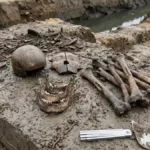
Skeletal samples are carefully prepared under sterile conditions at the ENAH laboratories in Mexico City before being shipped to the Max Planck Institute for Evolutionary Anthropology in Germany, the undisputed global leader in paleogenomics. This international cooperation operates under a formal research agreement between INAH and the Max Planck Institute, bridging the gap between Mexican historical expertise and European laboratory technology.
At the center of this genomic reconstruction is Mexican biochemist Rodrigo Barquera, an alumnus of ENAH who now serves on the permanent research staff at the Max Planck Institute. Collaborating directly with physical anthropologist Víctor Acuña, Barquera is working to sequence the complete nuclear genomes of the Huei Tzompantli victims. This data will allow researchers to construct a comprehensive genetic map of the Aztec Empire, revealing the ethnic diversity of those caught in the web of Mexica state rituals.
Engineering with Human Bones: A Unique Structural System
One of the most profound realizations to emerge from the decade-long study is that the Huei Tzompantli was not a disorganized, chaotic dump site for bodies, nor was it a purely decorative display. The lead engineering teams at the Templo Mayor Museum have noted a massive difference between the Aztec skull tower and the famous historic ossuaries found across Europe, such as Paris’s Catacombs or Portugal’s famous Chapel of Bones.
In European ossuaries, human bones were typically moved from overflowing cemeteries and arranged ornamentally against existing stone walls to serve as artistic reminders of mortality. The Mexica, however, utilized human skulls as an actual, primary structural building material. The skulls were bound together with a specialized mortar mixture composed of lime, sand, and volcanic tezontle stone, forming a load-bearing, self-supporting architectural tower.
Investigating this unique structural matrix presented an immense challenge for physical anthropologists. Before they could safely examine the intact, beautifully preserved skulls embedded deep within the core, the conservation team had to carefully extract, catalog, and stabilize more than 11,000 loose bone fragments. This painstaking process allowed researchers to map out five distinct, consecutive building phases of the tower, proving that the monument was systematically expanded over decades to mirror the growth and military triumphs of the Aztec Empire.
Demographics and Mortuary Insights
The demographic breakdown of the 214 skulls currently undergoing laboratory analysis has fundamentally challenged the traditional historical stereotype that Aztec human sacrifice was reserved exclusively for captured young male warriors.
The forensic data reveals a highly diverse cross-section of society:
Adult Males: Account for 46.3% of the analyzed skulls, many showing physical skeletal indicators consistent with active military lifestyles or hard physical labor.
Adult Females: Make up a staggering 37.4% of the collection, proving that women played a massive, institutional role in the state’s sacrificial programs.
Children and Incomplete Specimens: Comprise the remaining portion of the analyzed sample, highlighting that no age group was completely exempt from the empire’s religious obligations.
The Mystery of the Child Skulls
The physical trauma profiles of the skulls vary dramatically based on the age of the individual. Adult skulls within the main rack system exhibit uniform, circular perforations drilled cleanly through the left and right parietal bones (the sides of the skull). These holes allowed the heads to be slid onto massive wooden poles, forming a horizontal display rack.
In striking contrast, the skulls belonging to children show absolutely zero signs of parietal perforation. Anthropologists hypothesize that Mexica priests purposefully omitted the drilling process for children because the thin, fragile cranial bones of young individuals would have completely shattered under the force of the drill. This indicates a highly specialized, nuanced ritual protocol tailored to the physical age of the victim.
The Technical Feat of Mandible Retention
Another major forensic mystery currently being investigated by the Templo Mayor Museum team is the perfect preservation of the lower jaws (mandibles). In natural decomposition, the soft tissues, muscles, and ligaments that connect the jaw to the rest of the skull rot away within a matter of weeks, causing the mandible to naturally detach and drop off.
Yet, the skulls within the Huei Tzompantli are preserved with their mandibles locked perfectly in their correct anatomical positions, completely untouched by post-burial animal disruption or natural dislocation. This perfect alignment provides undeniable proof that Mexica priests possessed a highly advanced, sophisticated understanding of anatomy. They executed precise ritual skinning, defleshing, and stabilization techniques immediately following the sacrifice, ensuring the jaw remained structurally locked to the cranium before the mortar could dry.
Protecting a Vulnerable Monument
Because the Huei Tzompantli was built using a porous mixture of bone and lime mortar, the remains are highly susceptible to sudden changes in environmental conditions. Exposure to modern air currents, shifting humidity levels, and microscopic fungal spores can cause the 500-year-old bone matrix to rapidly flake, crack, and turn to dust.
To prevent this irreversible destruction, specialized conservation teams from the Templo Mayor Museum maintain a constant, round-the-clock monitoring program over the in situ (original location) structures. They utilize sensitive digital hygrometers to track moisture levels and deploy long-term, non-invasive chemical barriers to shield the fragile monument from deterioration, ensuring this invaluable archive of human history remains intact for future generations of scientists.
Conclusion: Humanizing the Past
Ultimately, the decade of analysis poured into the Huei Tzompantli has achieved something far greater than mere cataloging; it has humanized a collection of remains that were once viewed merely as a nameless symbol of ancient horror. By treating each skull not as a anonymous architectural brick, but as an individual human being with a unique genetic code, a specific childhood homeland, and a distinct life history, modern science is successfully cutting through centuries of colonial bias. The ongoing work in Mexico City is proving that the skull tower is not just a monument to death, but a complex, deeply articulate library detailing the living realities of the Mesoamerican world.
Frequently Asked Questions
What exactly is the Huei Tzompantli?
The Huei Tzompantli was a massive, ceremonial structure located in the sacred precinct of the Aztec capital, Tenochtitlan (modern-day Mexico City). It consisted of a large platform supporting an immense rack of wooden poles where the severed heads of sacrifice victims were displayed, alongside circular towers constructed entirely out of human skulls held together with lime mortar.
How do scientists know where the sacrifice victims grew up?
Researchers utilize stable isotope analysis on the first molars of the skulls. Because tooth enamel forms during early childhood and absorbs unique chemical signatures from local water and food sources, measuring the carbon, oxygen, and strontium levels within the teeth allows scientists to trace the exact geographic region where the victim spent their youth.
Were only male warriors sacrificed at the tower?
No. A decade of forensic analysis has thoroughly disproved the myth that only male prisoners of war were sacrificed. The demographic data shows that while adult males make up 46.3% of the tower’s structure, adult females account for a significant 37.4%, with the remaining percentage consisting of young children and incomplete specimens.
Why are the child skulls in the tower different from the adult skulls?
Adult skulls feature clean, circular holes drilled directly through the sides of their heads so they could be slid onto the wooden poles of the display rack. The skulls of children do not have these holes because their thin, developing bones would have shattered under the force of the drilling tools, indicating that children received a completely different ritual preparation.
How did the Aztecs keep the lower jaws attached to the skulls?
In normal decomposition, the jaw drops away from the skull once soft tissue rots. Because the skulls in the tower retain their jaws in perfect anatomical position, scientists know that Mexica priests were highly skilled in anatomy, utilizing specialized skinning and mechanical stabilization methods to secure the jaw to the bone before mounting it into the tower structure.