
Table of Contents
- 1. The Tiny Bronze Warrior: A Masterpiece of Prehistoric Metallurgy
- 1.1. Deciphering the Warrior’s Confusing Attire
- 2. Inside Manching: Mapping a Planned City of the Late Iron Age
- 2.1. Industrial-Scale Recycling and Advanced Documentation
- 3. Rethinking the Celtic Diet and Agricultural Economics
- 4. The Discovery of a Cryptic Iron Age Ritual Box
- 5. The Rise, Fall, and Modern Tragedies of Manching
- 6. Frequently Asked Questions
- 6.1. What makes the newly discovered bronze warrior figurine so unique?
- 6.2. What did the Celts of Manching eat according to the new study?
- 6.3. How large was the ancient city of Manching compared to later historic cities?
- 6.4. What was found inside the ancient ritual box?
- 6.5. What happened to the famous gold treasure that was previously stolen from the site?
40,000 Celtic Treasures Found in Germany Rewrite Iron Age History
The deep forests and rolling hills of Bavaria have just yielded one of the most significant archaeological treasure troves in European history. Following a meticulous three-year field excavation at the legendary prehistoric settlement of Manching, researchers have unearthed an astonishing collection of more than 40,000 individual ancient artifacts. Dating back to the late Iron Age, these discoveries are providing historians with an unprecedented look into the daily lives, complex urban planning, and surprising spiritual customs of the ancient Celts.
Among this mountain of historical material, one extraordinarily rare find has completely stolen the spotlight: a miniature bronze figurine of a lunging Celtic warrior. Despite its tiny dimensions, this masterfully crafted statuette is igniting fierce debate among classical scholars and providing undeniable evidence of the highly sophisticated metallurgical skills possessed by barbarian tribal smiths long before the Roman Empire expanded north of the Alps.
40,000 Celtic Treasures Found in Germany Rewrite Iron Age History
The Tiny Bronze Warrior: A Masterpiece of Prehistoric Metallurgy
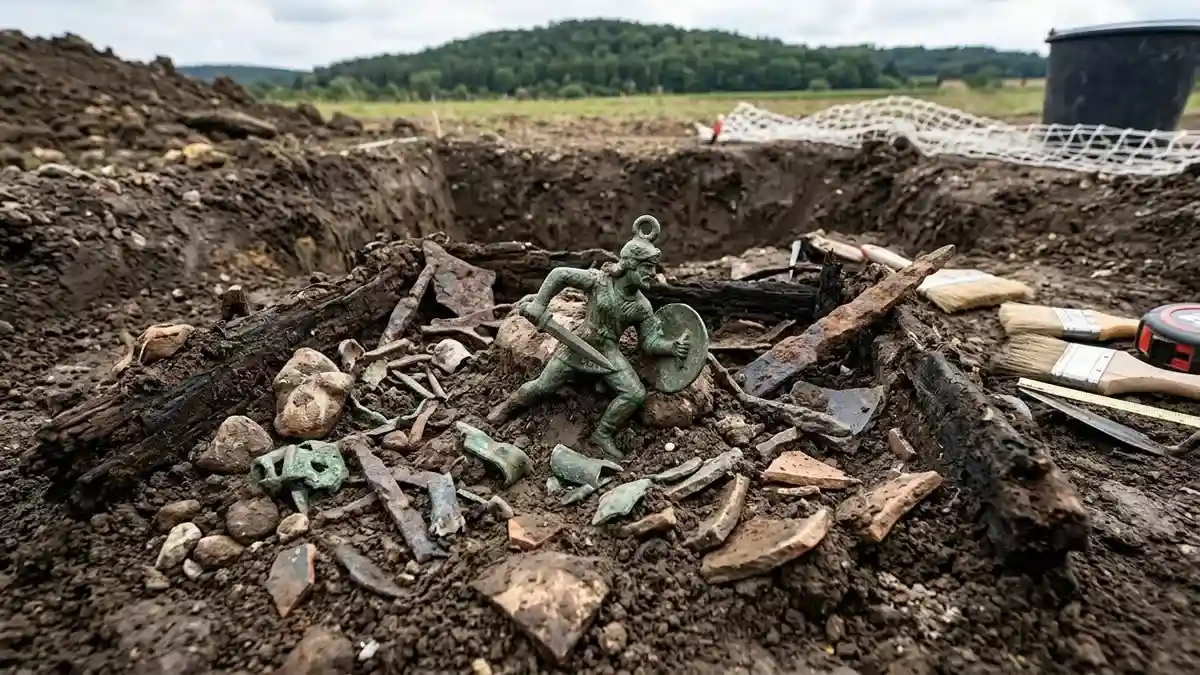
The crown jewel of the entire multi-year excavation is an exquisitely detailed bronze warrior statuette. Measuring a mere 7.5 centimeters (roughly three inches) in height and weighing a scant 55 grams, the pocket-sized combatant is frozen in a dramatic, dynamic lunging posture. The warrior stands defiantly, gripping a sword in one hand and wielding a traditional defensive shield in the other.
A small, integrated metallic loop forged directly onto the top of the figurine’s head indicates that this object did not simply sit on a shelf; instead, it was almost certainly worn as a highly prestigious personal pendant or amulet, suspended from a neck chain or leather cord.
To look beneath the centuries of green copper oxidation and crusty soil without damaging the fragile artifact, specialists at the Bavarian State Office for Monument Preservation subjected the figurine to high-resolution X-ray analysis. The scans confirmed that the statuette was executed via solid bronze casting using the complex lost-wax technique—a highly advanced artistic process where a detailed wax model is sculpted, encased in clay, melted away, and replaced with molten liquid metal. The X-rays revealed breathtaking, hidden structural lines and sharp artistic details that had been obscured from human eyes for over two millennia.
Deciphering the Warrior’s Confusing Attire
The physical appearance of the bronze warrior has quickly turned into a focal point of intense debate among European historians. Detailed observations revealed that the figure is explicitly outfitted with protective body armor covering his upper chest and torso, yet he is depicted as completely naked from the waist down.
This specific combination of partial nudity and armor is exceptionally rare in traditional Celtic artwork, leading some prominent researchers to hypothesize a deep cultural connection with the Mediterranean world. In ancient Greek art and classical philosophy, heroic male nudity was a universal artistic shorthand used to project supreme masculinity, physical perfection, and fearless battlefield courage. Whether this figurine reflects a local Celtic artistic tradition or a stylistic concept borrowed through long-distance trade with Greek merchants remains an open question, leaving scholars to wonder whether the object functioned as an elite personal ornament, a spiritual protective idol, or a central component in localized clan rituals.
Inside Manching: Mapping a Planned City of the Late Iron Age
The broad scope of the excavations, which spanned from 2021 through 2024, covered an immense surface area of more than 6,800 square meters. During this intensive three-year campaign, field teams successfully documented over 1,300 distinct archaeological features embedded within the soil stratigraphy.

Far from being a chaotic, primitive cluster of mud huts, the physical imprints left behind in the earth reveal that Manching was a highly structured, carefully organized, and planned urban center. The excavations exposed clear, distinct zoning laws within the ancient city layout, revealing dedicated residential neighborhoods separated cleanly from busy industrial zones packed with specialized craft workshops, iron foundries, and pottery kilns.
Industrial-Scale Recycling and Advanced Documentation
The sheer volume of metal recovered during the dig underscores Manching’s status as a dominant manufacturing powerhouse north of the Alps. Of the thousands of items recovered, more than 15,000 were individual metallic objects, a massive portion of which consisted of scrap metal fragments, miscast blades, and broken tools gathered together near workshops to be melted down and recycled.
To preserve the fragile context of these industrial workstations, researchers executed an exhaustive digital archiving project, capturing 2,034 highly detailed scans and photographs of the metal groupings before they were cleaned or stabilized. This immense digital library is now allowing material scientists to study the exact manufacturing steps, forging temperatures, and chemical alloying recipes utilized by Iron Age metalsmiths.
Rethinking the Celtic Diet and Agricultural Economics
Beyond the glittering metalwork, the excavation yielded an unexpected biological breakthrough that is completely transforming our understanding of the prehistoric European kitchen. For the very first time in the history of researching this site, archaeologists successfully recovered thousands of microscopic fish bones and delicate fish scales preserved inside ancient trash pits.
This fragile organic evidence definitively proves that the inhabitants of Manching did not rely solely on land-based farming; instead, fresh river fish constituted a regular, stable component of the standard Celtic diet, alongside domesticated staples like beef, pork, and cultivated grains.
Furthermore, the forensic analysis of animal skeletons recovered from the residential sectors has exposed a highly strategic, efficient system of livestock management:
Horses: Equines were never slaughtered for meat while young or prime; instead, they were meticulously cared for until they reached old age, proving they were viewed as invaluable investments for heavy labor, transport, and cavalry purposes.
Sheep and Goats: The age profiles of these smaller ruminants indicate they were raised almost exclusively for secondary products like high-yield wool and daily milk, rather than being raised as primary meat sources.
The Discovery of a Cryptic Iron Age Ritual Box
Among the most dramatic features uncovered during the final phases of the project was an extraordinary ritual deposit contained within the structural outline of a decayed wooden chest or box, dated securely to a window between 120 and 60 BCE.
Inside this single, isolated context, excavation directors uncovered the commingled skeletal remains of at least three human individuals, layered alongside a dense arrangement of butchered animal bones, 32 specialized metal artifacts, and shattered fragments belonging to more than 50 separate ceramic vessels.
The recovery of two nearly complete human skeletons tucked directly into this compact arrangement makes the find an incredible rarity for late Iron Age Central Europe. The purposeful packing of human dead, broken luxury pottery, and animal offerings into a singular domestic container points to a complex, community-wide ritual event, possibly serving as a sacred offering to local deities during a period of severe political anxiety or community transition.
The Rise, Fall, and Modern Tragedies of Manching
To understand the scale of these discoveries, one must look at the historical trajectory of Manching itself. First settled in the late 4th century BCE, the site rapidly evolved. By the 2nd century BCE, it had expanded into a massive, heavily fortified urban center known as an oppidum.
At its absolute imperial peak, the city encompassed an area of 400 hectares and housed a bustling population of up to 10,000 citizens—making this prehistoric Celtic stronghold significantly larger and more populated than the famous German city of Nuremberg would be centuries later during the Middle Ages.
However, by the middle of the 1st century BCE, the great metropolis faced a sharp, mysterious decline, fracturing economically long before Roman military campaigns officially absorbed the region. Despite its fame as one of the most intensively studied prehistoric settlements in all of Central Europe, scientists estimate that a mere 12 percent of Manching’s total footprint has been formally explored by modern science.
The conclusion of this latest excavation brings a sense of relief to the regional heritage community, which was deeply traumatized in late 2022 when an organized gang of thieves broke into a local museum at the site and stole a legendary hoard of 483 Celtic gold coins and a 3.7-kilogram gold ingot originally discovered in 1999. While a European court sentenced the perpetrators to prison terms earlier this year, the gold itself remains missing, with recovered melted fragments suggesting that the historic treasure may be permanently lost to the black-market furnace.
Fortunately, the 40,000 newly excavated treasures have been safely transferred under tight security into permanent state collections, where they will remain protected for future generations of historians to study.
Frequently Asked Questions
What makes the newly discovered bronze warrior figurine so unique?
The 7.5-centimeter statuette is unique due to its dynamic lunging pose and its highly unusual attire—it is armored on the chest but completely naked from the waist down. It was cast using the advanced lost-wax technique and features an integrated loop on its head, meaning it was likely worn as a highly prestigious personal pendant.
What did the Celts of Manching eat according to the new study?
While previous excavations proved the Celts ate beef, pork, and cultivated grains, this specific dig marked the very first time that archaeologists recovered ancient fish bones and scales. This proves that freshwater fishing was a regular, organized part of the local diet.
How large was the ancient city of Manching compared to later historic cities?
At its peak in the 2nd century BCE, the fortified Celtic town of Manching covered 400 hectares and housed up to 10,000 residents. This footprint makes this Iron Age settlement significantly larger than the major German city of Nuremberg would be during the medieval period.
What was found inside the ancient ritual box?
Archaeologists uncovered a highly unusual ritual deposit inside a box structure dating between 120 and 60 BCE. It contained the skeletal remains of at least three human individuals (including two nearly complete skeletons), various animal bones, 32 metal objects, and the smashed fragments of over 50 ceramic containers.
What happened to the famous gold treasure that was previously stolen from the site?
In 1999, archaeologists found a spectacular hoard of 483 gold coins at Manching. Tragically, a gang of thieves stole the entire treasure from a local museum in 2022. Although the thieves were caught and sentenced to prison earlier this year, the gold itself remains missing and is feared to have been melted down.