
Table of Contents
- 1. The Discovery That Baffled Anthropologists
- 2. Inside the Cave: How Uranium-Series Dating Unlocked the Past
- 3. Analyzing the Numbers: A New Timeline for European Prehistory
- 4. Redrawing the Human Evolutionary Tree
- 5. Frequently Asked Questions
- 5.1. Where was the Petralona skull discovered?
- 5.2. Why was it so difficult for scientists to determine the skull’s age?
- 5.3. How does uranium-series dating work?
- 5.4. Is the Petralona skull a Neanderthal or a modern human?
- 5.5. What does this discovery tell us about ancient Europe?
286,000-Year-Old Skull Changes Human Evolution History Forever
The story of human evolution is a complex puzzle, with many missing pieces scattered across continents and deep within ancient geological layers. For more than half a century, one of the most polarizing and mysterious pieces of this puzzle has been a nearly pristine ancient human skull found tucked away in a European cave. Discovered decades ago, this unusual fossil routinely resisted classification, leaving anthropologists to argue over who this individual was and, perhaps more importantly, exactly when they walked the Earth.
Now, a comprehensive technological breakthrough has brought scientists closer than ever to unlocking the truth. By applying state-of-the-art isotopic analysis to the mineral crusts sealing the fossil, an international research team has successfully established a definitive age boundary for this enigmatic skull. The results show that the specimen is far older than many conventional estimates suggested, offering a profound look into a transitional epoch of prehistoric Europe.
286,000-Year-Old Skull Changes Human Evolution History Forever

The Discovery That Baffled Anthropologists
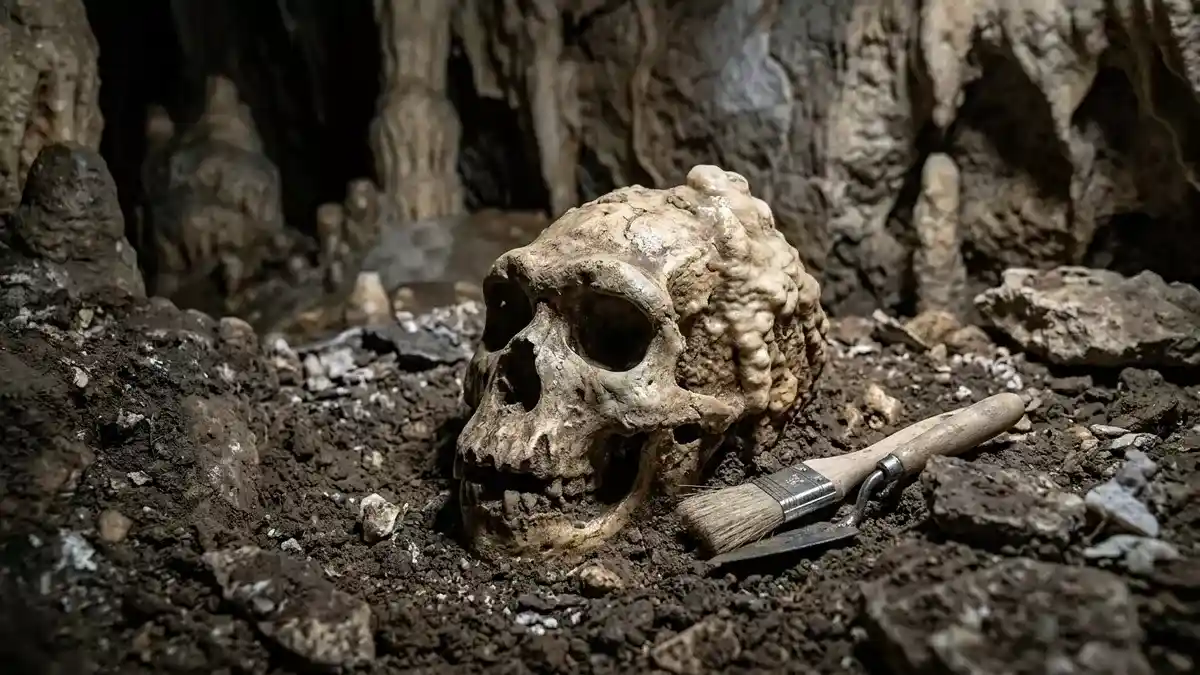
The mystery began in 1960 in the rugged landscape of northern Greece. A resident from a small village located roughly 22 miles southeast of Thessaloniki was exploring the limestone depths of the Petralona Cave when they spotted a bizarre shape protruding from a subterranean wall. Clinging to the stone was a remarkably complete hominin cranium.
When the scientific community arrived to extract the fossil, they immediately realized they were looking at something extraordinary. The skull belonged unquestionably to the genus Homo, yet it possessed a confusing mosaic of physical characteristics. It lacked a lower jaw, but its massive brow ridges, large facial structure, and brain capacity didn’t neatly align with modern humans (Homo sapiens) or our famous extinct cousins, the Neanderthals (Homo neanderthalensis).
Because the skull was found embedded directly within the cave’s natural rock formations without any accompanying tools or clear burial contexts, determining its chronological age became an archaeological nightmare. For decades, academic speculation varied wildly. Some conservative estimates placed the fossil at a relatively recent 170,000 years old, while other, more radical theories pushed its antiquity back to 700,000 years, creating a massive chronological void that made it impossible to place the individual accurately on our family tree.
Inside the Cave: How Uranium-Series Dating Unlocked the Past
To resolve this multi-decade debate, researchers turned away from the bone itself and focused instead on the geological processes of the cave environment. Traditional radiocarbon dating is only effective for organic materials up to roughly 50,000 years old, making it useless for deep-time human fossils. Furthermore, testing open soil deposits can yield corrupted data because external elements constantly shift through the dirt.
Caves, however, function as pristine, closed environments. As groundwater rich in dissolved minerals slowly trickles through limestone roofs and drips into subterranean chambers, it evaporates. This slow chemical process leaves behind layers of calcite, commonly known as speleothems, which form stalactites, stalagmites, and flowstone coatings over everything in their path—including ancient bones.
The research team utilized uranium-series (U-series) dating, a highly sophisticated method that measures the radioactive decay of uranium isotopes into thorium. When a fresh layer of calcite forms inside a cave, it naturally encapsulates trace amounts of water-soluble uranium, but it contains absolutely zero non-soluble thorium. Because uranium decays into thorium at an unchangeable, mathematically precise rate, scientists can measure the ratio of these two elements within a specific mineral sample to calculate exactly when that stone layer first crystallized.
To map out the timeline of the Petralona cave, scientists meticulously sampled the crystalline calcite coating that grew directly over the surface of the skull. They also gathered mineral data from the surrounding cave architecture, focusing intensely on the specific chamber known as the Mausoleum, where the cranium had originally been found cemented to the stone wall.
Analyzing the Numbers: A New Timeline for European Prehistory
The isotopic data delivered a definitive baseline for the fossil’s age. The analysis revealed that the protective layer of calcite sealing the cranium began forming at least 286,000 years ago, carrying a tight statistical margin of error of just 9,000 years.
However, because the skull could have rested in the cave for thousands of years before the calcite crust ever began to grow over it, the study explored multiple geological scenarios based on the cave’s complex stratigraphy (the layering of rock and soil):
The Connected Wall Scenario: If the skull was structurally part of the main wall deposits when it was covered, the individual likely lived and died between 277,000 and 539,000 years ago.
The Detached Floor Scenario: If the cranium was resting independently on the cave floor before being encapsulated by shifting mineral flows, its age likely concentrates between 277,000 and 410,000 years ago.
Even at its absolute minimum age of 286,000 years, this new timeline provides a far more stable and narrow chronological framework than scientists have ever had before, successfully grounding the fossil in the Middle Pleistocene epoch.
Redrawing the Human Evolutionary Tree
Pinpointing the age of the Petralona skull is of monumental importance because it forces anthropologists to rethink who was occupying Europe during a critical, chaotic phase of prehistory.
Morphologically, the skull exhibits highly primitive features that predate the structural specializations seen in late Neanderthals and modern humans. The newly confirmed age range firmly places this hominin in the Middle Pleistocene—a period characterized by extreme ice ages, shifting landscapes, and rapid evolutionary diversification.
This timeline indicates that this mysterious population managed to survive and coexist alongside early, developing Neanderthal lineages across the European continent. Rather than representing a direct, linear ancestor to modern Europeans, the Petralona individual likely belonged to a distinct, parallel human lineage that navigated the harsh, fluctuating climates of ancient Greece before eventually fading into extinction.
While leading geologists and anthropologists caution that a single skull can never be definitively tied to a static ancestral category, this advanced isotopic breakthrough marks a monumental leap forward, converting a legendary archaeological mystery into an invaluable diagnostic tool for mapping the true story of human survival.
Frequently Asked Questions
Where was the Petralona skull discovered?
The skull was discovered in 1960 inside the limestone depths of the Petralona Cave, located in northern Greece, roughly 22 miles southeast of the major city of Thessaloniki.
Why was it so difficult for scientists to determine the skull’s age?
The skull was found missing its lower jaw and completely embedded within a cave wall without any accompanying tools, animal bones, or clear soil layers. Because its physical features looked like a mix of different ancient human species, guesses about its age ranged wildly from 170,000 to 700,000 years for over sixty years.
How does uranium-series dating work?
Uranium-series dating is a geological clock that measures radioactive decay in closed environments like caves. When water evaporates and leaves behind calcite layers on cave walls or bones, it traps trace amounts of uranium. Over time, this uranium transforms into thorium at a fixed, predictable rate. By measuring the ratio of uranium to thorium, scientists can calculate when the stone layer formed.
Is the Petralona skull a Neanderthal or a modern human?
Neither. Morphological studies show that the Petralona skull represents a more primitive population of the genus Homo. It possesses physical characteristics that are older and less specialized than both modern humans (Homo sapiens) and classic Neanderthals.
What does this discovery tell us about ancient Europe?
The new dating proves that this primitive hominin lived during the Middle Pleistocene epoch, at least 286,000 years ago. This confirms that multiple distinct human lineages—including this primitive group and early ancestral Neanderthals—coexisted across the changing European landscape at the same time.