
Table of Contents
- 1. From the Mountains to the Hearth: The Rise of a Shared Icon
- 2. The Divine Feminine: Horns, Birth, and Sacred Conception
- 2.1. Prehistoric European Precedents
- 2.2. The Iranian Bronze Age Continuity
- 3. Masters of the Rain: Enki, Inanna, and Mesopotamian Irrigation
- 3.1. The Water God Enki
- 3.2. The Liturgical Metaphor of Inanna
- 4. The Sacred Canvas of Persian Art
- 4.1. Decorative Masterpieces Across Eras
- 5. The Celestial Goat: How the Ibex Shaped the Zodiac
- 6. Conclusion: The Ultimate Symbol of Life’s Rhythms
- 7. Frequently Asked Questions
- 7.1. Why did ancient cultures associate the ibex with rain and water?
- 7.2. What is the significance of the ibex’s horns in ancient art?
- 7.3. Where was the ibex first domesticated?
- 7.4. How does the ibex relate to modern astrology and the zodiac?
- 7.5. In what types of historical artifacts do we find the ibex motif?
Why Ancient Ibex Carvings Hold the Secret to Cosmic Myths
For thousands of years, long before modern civilizations carved borders into the map, ancient humans looked up at the mountains and saw something divine. Among the rugged crags of Europe, Asia, and North Africa, the ibex—a wild mountain goat characterized by its sweeping, majestic horns—held a status far greater than mere prey. It was viewed as a biological bridge between the earthly realm and the heavens above.
A comprehensive academic analysis published in the journal L’Anthropologie sheds new light on how the ibex (Capra aegagrus) became deeply intertwined with concepts of divine femininity, seasonal fertility, and cosmic order. By analyzing artistic representations spanning from Paleolithic cave art to classical Islamic tile work, researchers have demonstrated that the ibex was an enduring, universal symbol that helped early societies decipher the rhythms of the natural world and their own place within the cosmos.
Why Ancient Ibex Carvings Hold the Secret to Cosmic Myths

From the Mountains to the Hearth: The Rise of a Shared Icon
The relationship between humanity and the ibex began as a matter of survival. Genetic and archaeological records indicate that the wild ibex was first domesticated approximately 10,000 years ago in the rugged terrain of the Zagros Mountains (stretching across modern Iran) and eastern Anatolia. This monumental achievement gave rise to the domestic goat, providing early agrarian communities with a reliable source of life-sustaining milk, high-purity protein, and durable fibers for textiles.
Yet, as the study highlights, the ibex rapidly transcended its practical, economic value. Long before its domestication was complete, the animal’s striking silhouette began appearing on the walls of prehistoric caves, stone carvings, and early pottery designs. What makes this iconography so remarkable is its cross-continental consistency. Whether found in a hidden European rock shelter or painted onto a Bronze Age Iranian vessel, the ibex consistently represented a deeply rooted sacred archetype rather than a casual drawing of local wildlife.
The Divine Feminine: Horns, Birth, and Sacred Conception
One of the most profound and enduring symbolic associations of the ibex is its deep connection to femininity, sexuality, and the miracle of childbirth. This connection is not a localized phenomenon; it is visible across thousands of miles and multiple distinct archaeological eras.

Prehistoric European Precedents
In early European prehistoric sites, researchers have identified a recurring theme linking mountain goats with female reproductive power:
The Venus of Laussel (France): In this world-famous Paleolithic rock carving, a voluptuous female figure holds a curved horn, which many leading anthropologists believe belongs explicitly to an ibex, symbolizing abundance and the crescent moon.
The Mother Ranaldi Panel: This ancient Neolithic rock art composition vividly depicts a group of ibexes and deer gathered in a protective, reverent circle around a human female in the active process of giving birth.

The Iranian Bronze Age Continuity
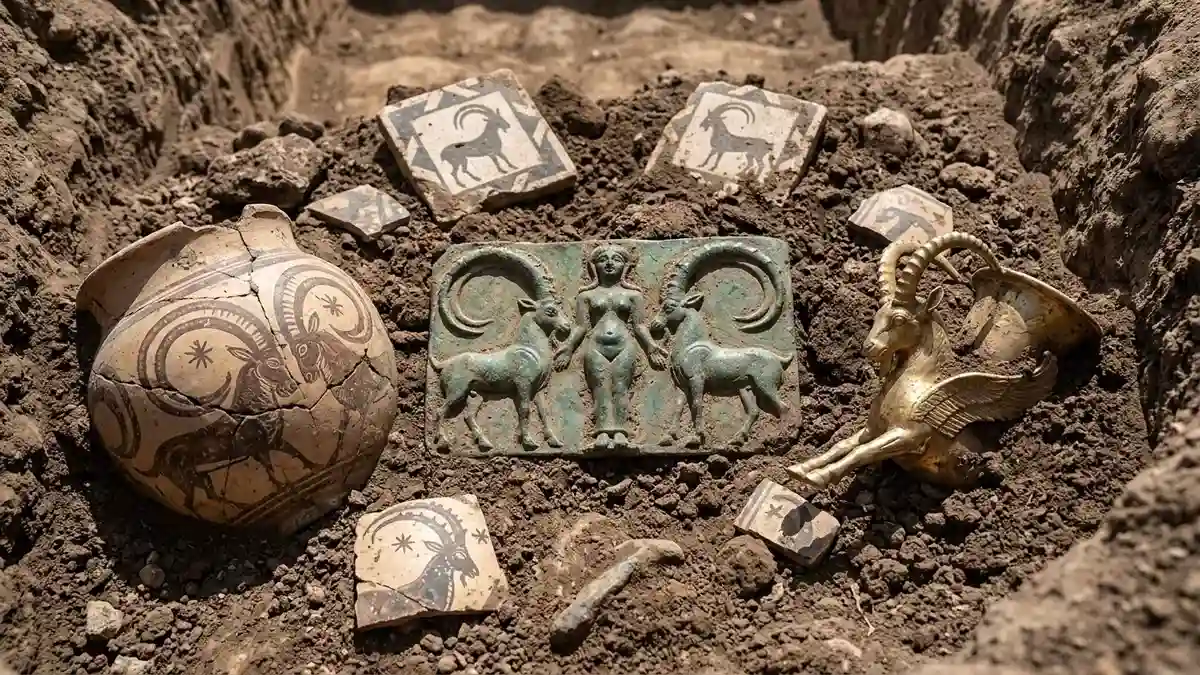
This exact European motif resurfaces with stunning clarity thousands of miles away in the ancient Near East. Among the most remarkable artifacts highlighted in the L’Anthropologie study is an intricate bronze plaque from Lorestan in western Iran, dated between 1500 BCE and 700 BCE.
The artifact features a central figure of a woman giving birth, flanked symmetrically on either side by two stylized ibexes. This striking parallel across vast distances and eras suggests that the sweeping, crescent-shaped horns of the ibex were universally viewed as an ancient cross-cultural symbol of fertility, protection, and the natural cycles of regeneration.
Masters of the Rain: Enki, Inanna, and Mesopotamian Irrigation
As nomadic hunting bands settled down into the massive, literate urban empires of Mesopotamia, the ibex transitioned seamlessly into formal religious mythologies. In the fertile floodplains of the Tigris and Euphrates rivers, the mountain goat became the chosen companion of the high gods.
The Water God Enki
Enki, the powerful Mesopotamian deity of wisdom, subterranean fresh waters, and creation, was consistently depicted alongside rich ibex imagery. Scribes and artists frequently carved the mountain goat directly onto cylinder seals and temple reliefs next to cascading streams of life-giving water.
This association was deeply rooted in the natural behavior of the animal. The mating season of the wild ibex naturally coincided with the arrival of Mesopotamia’s crucial autumn rains. When the wild goats descended from the high cliffs to breed, the rains began to fall, filling the rivers and parched irrigation canals. To the ancient observer, the ibex was not merely reacting to the season—it was the active harbinger and spiritual catalyst of the rains themselves.
The Liturgical Metaphor of Inanna
The connection between the ibex and raw sexuality was so intense that it embedded itself deep into early literature. In ancient Babylonian love poetry and sacred hymns, the goddess of love and warfare, Inanna, explicitly refers to her own vulva as a “horn.” This metaphor directly links the pointed, potent curves of the ibex’s head with the driving forces of fertility, sexual desire, and the perpetuation of human and animal life.
The Sacred Canvas of Persian Art
Nowhere did the cult of the ibex leave a more indelible artistic fingerprint than in ancient Iran. From the dawn of the Neolithic period through successive global empires, Iranian artists treated the wild goat as their primary muse, utilizing its form to decorate everything from everyday cookware to imperial treasures.
Decorative Masterpieces Across Eras
The study traces the uninterrupted evolution of the ibex motif across thousands of years of Iranian cultural history:
Prehistoric Pottery: Exquisite ceramic vessels excavated from ancient sites like Tall-i-Bakun, Tepe Hissar, and the monumental city of Susa showcase highly stylized ibexes, where the horns are often exaggerated into massive, beautiful circles that frame the entire body of the vessel.
Achaemenid Luxury: During the height of the Persian Empire, the ibex was cast in precious metals. Master metalsmiths crafted breathtaking, partly gilded silver vessel handles shaped as winged ibexes resting atop theatrical masks.
Sassanian and Islamic Art: Long after the fall of antiquity, the symbol endured. The ibex continued to grace royal Sassanian silver plates, luxury tattoos worn by nomadic warriors, and eventually, the intricate geometric tile art that decorated medieval Islamic architecture.
The Celestial Goat: How the Ibex Shaped the Zodiac
Beyond its ties to water, soil, and birth, the ibex possessed a cosmic dimension that elevated it into the night sky. Because the animal inhabited the highest, most inaccessible mountain peaks, ancient people naturally assumed it was closer to the gods and inherently connected to the mechanics of the heavens.
In ancient cuneiform texts from Mesopotamia, the ibex is formally referred to by astronomers as si-mul, a term translating directly to “star-horned.” On thousands of Near Eastern artifacts, the goat is deliberately engraved alongside radiant sun discs, crescent moons, and multi-pointed star clusters.
This celestial framing left a permanent mark on modern astrology. The legacy of the ancient mountain goat survives today in the zodiac sign Capricorn. Originally conceptualized in the ancient Near East as a “goat-fish”—a hybrid creature combining the front half of an ibex with the tail of a fish—this constellation was directly tied to the winter solstice, the return of rain, and the seasonal renewal of global fertility. It stands as a profound reminder that our modern map of the stars is drawn from the spiritual anxieties and observations of ancient mountain cultures.
Conclusion: The Ultimate Symbol of Life’s Rhythms
By weaving together the disparate threads of wildlife biology, mythology, and cross-continental archaeology, this recent study demonstrates that the ibex was far more than a simple natural resource or a casual hunting target. To the ancient mind, the mountain goat was a living monument to the interconnectedness of all things. It gracefully connected the biological reality of childbirth with the seasonal arrival of fresh water, and the high peaks of the earth with the turning of the stars, serving as a powerful lens through which early humans sought to understand their own place within a chaotic universe.
Frequently Asked Questions
Why did ancient cultures associate the ibex with rain and water?
Ancient societies noticed that the mating season of the wild ibex occurred at the exact same time as the arrival of the crucial autumn rains in the Near East. Because the goats descended from the high mountains just as the dry seasons ended, people believed the animals were spiritually linked to the water god Enki and acted as natural indicators of rain.
What is the significance of the ibex’s horns in ancient art?
The large, sweeping, crescent-shaped horns of the ibex were often associated with the crescent moon, which was a universal symbol for time, growth, and natural cycles. In art, these horns were frequently paired with themes of female fertility, pregnancy, and abundance, such as the Venus of Laussel holding an ibex horn.
Where was the ibex first domesticated?
Genetic and archaeological evidence points to the Zagros Mountains of modern-day Iran and eastern Anatolia as the primary cradle of ibex domestication roughly 10,000 years ago, a process that ultimately gave rise to the modern domestic goat.
How does the ibex relate to modern astrology and the zodiac?
The ibex is the historical ancestor of the zodiac sign Capricorn. Ancient Near Eastern astronomers called the ibex si-mul (“star-horned”) and created the “goat-fish” constellation to mark the winter solstice, a time deeply tied to rain, water, and the rebirth of nature.
In what types of historical artifacts do we find the ibex motif?
The ibex motif is incredibly long-lived, appearing across a massive variety of mediums including Paleolithic cave paintings, Neolithic rock art panels, Bronze Age bronze plaques, painted ceramics from Susa, luxury Achaemenid Persian silver vessels, and even medieval Islamic tile art.