
Table of Contents
- 1. The Typical Comb Ware Culture and the Ritual of Red Ochre
- 2. Elemental Fingerprinting: Analyzing the Chemistry of Color
- 3. Networks of Earth: Mapping Connections Across 500 Kilometers
- 4. Deliberate Ritual Selection vs. Everyday Use
- 5. A Window Into Prehistoric Memory and Identity
- 6. Frequently Asked Questions
- 6.1. What did the chemical analysis of Finnish red ochre reveal?
- 6.2. What is red ochre and why did ancient people use it?
- 6.3. How did scientists test the ancient ochre without destroying it?
- 6.4. How did burial ochre differ from everyday ochre?
- 6.5. Who belonged to the Typical Comb Ware culture?
6,000-Year-Old Ochre Graves Reveal Long-Distance Stone Age Networks
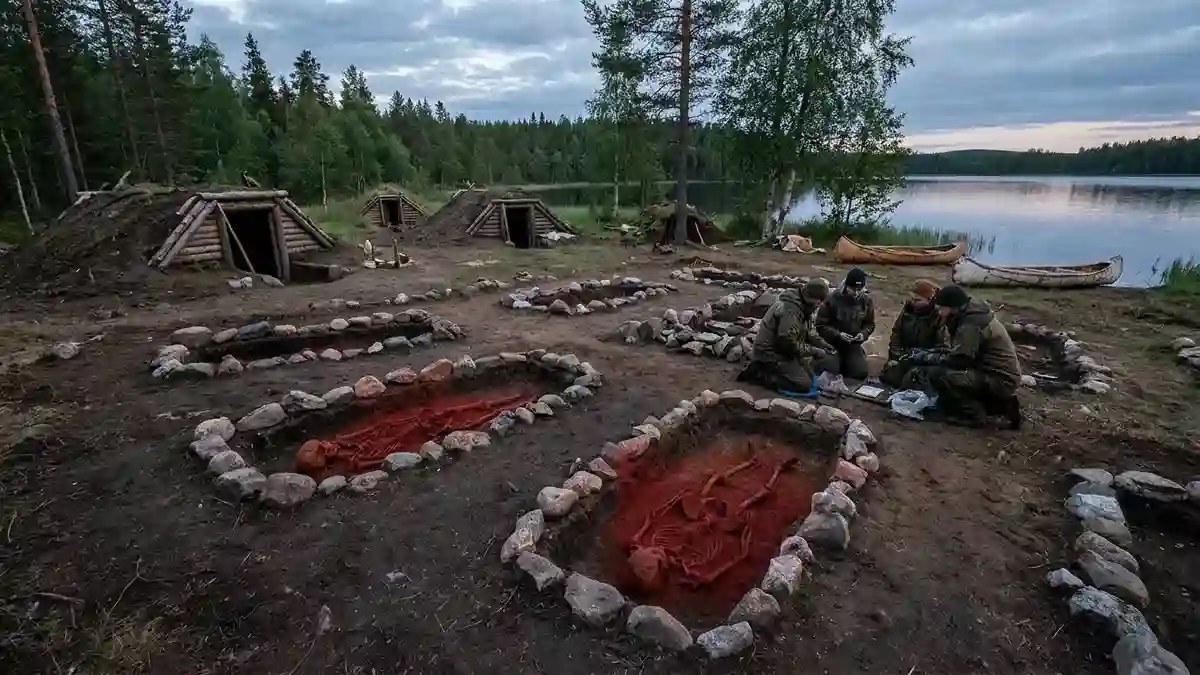
A pioneering geochemical study of prehistoric burial sites across Finland has revealed that Stone Age hunter-fisher-gatherers operated highly complex, long-distance trade and social networks. By tracing the chemical fingerprints of red ochre—a brilliant, iron-rich earth pigment widely used in ancient rituals—scientists have demonstrated that these ancient communities traded precious pigments across hundreds of kilometers to honor their dead.
Published in the Journal of Archaeological Science: Reports, the findings shatter old assumptions that Stone Age communities relied solely on nearby, random resources. Instead, the study proves that prehistoric foragers deliberately selected specific types of ochre based on its geographic origin, using the colored earth as a powerful symbol of identity, status, and far-reaching social alliances.
6,000-Year-Old Ochre Graves Reveal Long-Distance Stone Age Networks

The Typical Comb Ware Culture and the Ritual of Red Ochre
Between 5,500 and 6,000 years ago, the vast waterways and forests of what is now Finland were home to the Typical Comb Ware culture. These resilient populations lived in semi-subterranean houses (pit-houses dug partially into the ground), navigated regional rivers and lakes by watercraft, and sustained themselves through specialized fishing, hunting, and localized foraging.
When members of these communities died, they were laid to rest in graves heavily saturated with red ochre. This striking crimson pigment held deep symbolic and spiritual significance across the prehistoric world, often associated with life, blood, and rebirth.
While archaeologists have long known about these “red ochre graves,” the geographic origins of the pigments themselves remained a mystery until now.
Elemental Fingerprinting: Analyzing the Chemistry of Color
An international research team set out to trace the physical origins of the ancient pigment by analyzing ochre samples recovered from eight prominent archaeological sites across Finland. Crucially, the samples were harvested from two distinctly different contexts: sacred burial grounds and everyday domestic settlements.
To unlock the elemental secrets of the pigment without destroying the irreplaceable prehistoric artifacts, scientists deployed a pair of highly advanced, non-invasive laboratory techniques:
Energy Dispersive X-Ray Fluorescence (ED-XRF): A method that bombards a sample with X-rays, causing it to emit secondary X-rays that reveal its unique elemental composition.
Scanning Electron Microscopy with Energy Dispersive Spectrometry (SEM-EDS): An imaging and chemical analysis tool that provides high-resolution microscopic visuals while mapping the exact chemical elements present in the material.
Networks of Earth: Mapping Connections Across 500 Kilometers
The laboratory results yielded a major surprise. Rather than finding a unique, localized chemical signature at each individual archaeological site, the researchers discovered that the samples fell into three main chemical groups.
Most remarkably, ochre samples sharing identical chemical profiles were found at archaeological sites separated by up to 500 kilometers (roughly 310 miles).
[Ochre Source Region]
       │
       ├─► Distributed to Site A (Local)
       │
       └─► Transported 500 KM ─► Distributed to Site B (Distant)
This geographic spread provides definitive physical proof of long-distance pigment transportation and trade. These vast distribution distances closely mirror established prehistoric trade routes known to have moved other prized prestige items during the same era, including:
Baltic Amber: Fossilized tree resin traded up from the southern Baltic region.
Slate Ornaments: Specialized stone tools and decorative items originating from the distant Lake Onega region in modern-day Russia.
The chemical data confirms that red ochre was not just scooped up from the nearest riverbank; it was a highly valued trade commodity integrated into the same expansive, multi-directional social networks that linked physically isolated communities across northern Europe.
Deliberate Ritual Selection vs. Everyday Use
The study also uncovered a fascinating division between the sacred and the secular. At several of the analyzed sites, the chemical signature of the ochre found in domestic living spaces differed significantly from the ochre discovered inside the graves.
This stark contrast proves that the choice of burial pigment was highly intentional. Rather than randomly grabbing whatever local soil was available, the living selectively sought out specific, often exotic types of ochre exclusively for funerary rituals.
Even within individual cemeteries, the choices were incredibly nuanced:
Neighboring Graves: Individuals buried right next to each other sometimes received ochre originating from completely different chemical groups.
Single Burials: Within a single grave, different skeletal regions or specific grave goods were occasionally treated with pigments sourced from entirely separate geographic locations.
These intricate patterns demonstrate that color alone was not the deciding factor. The true value of the ochre lay in its pedigree—where it came from, the journey required to get it, and the specific social relationships forged to acquire it.
A Window Into Prehistoric Memory and Identity
By successfully merging advanced chemical data with deep archaeological context, this research offers a profound look into how early foraging societies organized their materials, maintained cultural memory, and expressed tribal identity.
The application of non-local ochre to a corpse served as a visible, lasting statement of the deceased person’s social network. It signaled to everyone present at the funeral that the departed possessed alliances, family ties, and trading partnerships that stretched far beyond the boundaries of their immediate village.
Ultimately, these 6,000-year-old crimson graves reveal that even in the deeply distant past, humans used material culture to build relationships, honor their loved ones, and weave complex social safety nets that spanned across the ancient wilderness.
Frequently Asked Questions
What did the chemical analysis of Finnish red ochre reveal?
The analysis revealed that Stone Age hunter-gatherers moved specific types of red ochre across vast distances up to 500 kilometers. This proves that these ancient communities were connected by sophisticated, long-distance trade and social networks rather than living in isolated isolation.
What is red ochre and why did ancient people use it?
Red ochre is a natural, iron-rich earth pigment that produces a vibrant red color. In prehistoric times, it held immense ritualistic and symbolic value and was heavily used in burial practices to cover the deceased, likely symbolizing blood, life, or rebirth.
How did scientists test the ancient ochre without destroying it?
Researchers used non-invasive scientific techniques, specifically Energy Dispersive X-Ray Fluorescence (ED-XRF) and Scanning Electron Microscopy with Energy Dispersive Spectrometry (SEM-EDS). These methods allowed the team to precisely measure the elemental composition of the pigment while keeping the artifacts completely intact.
How did burial ochre differ from everyday ochre?
The study found that the chemical makeup of ochre used in graves was often completely different from the ochre found in nearby domestic living areas. This demonstrates that ancient peoples made highly deliberate, ritualistic choices regarding which pigments were appropriate for the dead, favoring specific or exotic sources for funerals.
Who belonged to the Typical Comb Ware culture?
The Typical Comb Ware culture refers to a population of hunter-fisher-gatherers who inhabited Finland and parts of the Baltic region roughly 5,500 to 6,000 years ago. They are known for their distinct pottery decorated with comb-like impressions, their semi-subterranean homes, and their complex red ochre burial traditions.