
Table of Contents
- 1. The Northeast Acropolis: Sanctuary of the Elite
- 2. Inside the Chamber of the “Tree Branch Rain God”
- 2.1. The Sacred Red Radiance of Cinnabar
- 2.2. Treasures for the Afterlife
- 3. Iconography of Power: Ceramic Masterpieces
- 4. The Teotihuacan Connection: Rewriting the Historical Timeline
- 4.1. Clues Left in the Ashes
- 4.2. Challenging the Old History Books
- 5. Caracol: The Superpower of the Lowlands
- 6. The Future of the Investigation
- 7. Frequently Asked Questions (FAQ)
- 7.1. Who was Te K’ab Chaak?
- 7.2. Why is finding cinnabar in the tomb significant?
- 7.3. How does this discovery change our understanding of Maya history?
- 7.4. What unique items were found inside the founding king’s tomb?
- 7.5. Can tourists visit the site where the tomb was found?
1,600-Year-Old Tomb Uncovers Lost Secrets of a Maya King Today
Deep within the dense, emerald canopy of the Belizean jungle, a groundbreaking archaeological discovery has emerged to challenge our understanding of ancient Mesoamerican history. For the first time in more than forty years of continuous exploration at the ancient metropolis of Caracol, researchers have successfully located and excavated the untouched resting place of a royal ruler.
This sacred chamber belongs to none other than King Te K’ab Chaak, the legendary founding father who established one of the most dominant dynasties in the ancient Maya world. Dated to approximately 350 CE, this monumental find provides an unprecedented look into the origins of royal power, elite spiritual traditions, and early international diplomacy long before the collapse of the classic Maya civilization.
1,600-Year-Old Tomb Uncovers Lost Secrets of a Maya King Today
The Northeast Acropolis: Sanctuary of the Elite
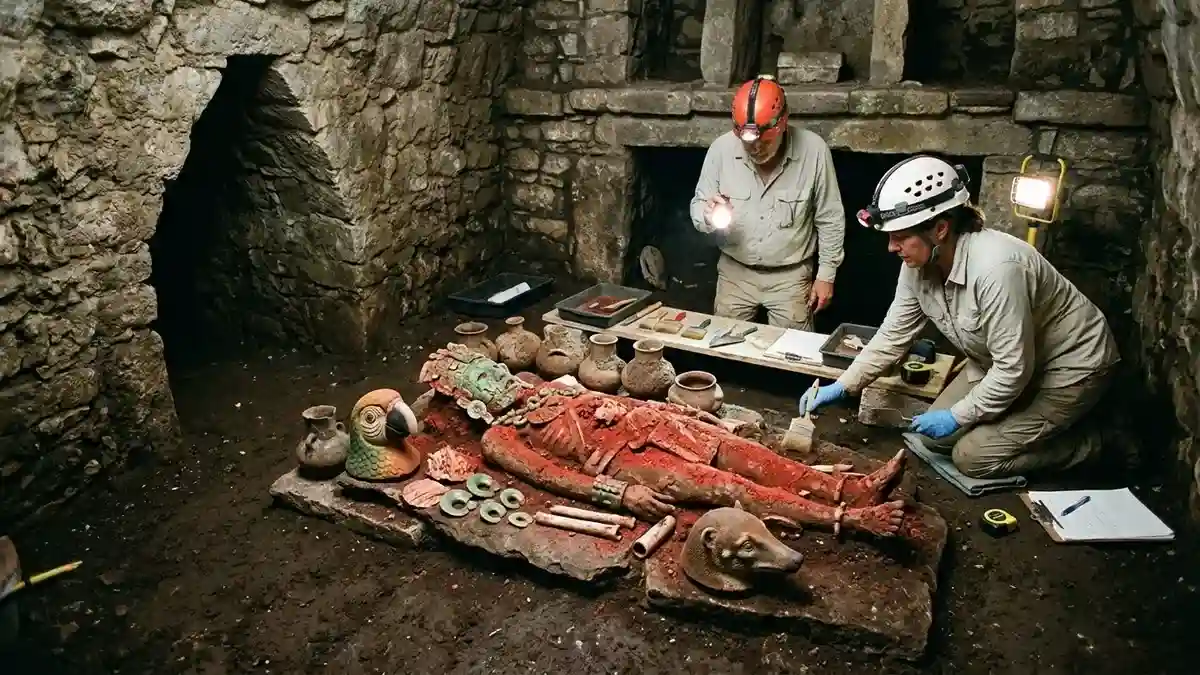
The historic discovery was made by a dedicated research team from the University of Houston, operating in the heart of Caracol—the largest and most expansive archaeological site in modern-day Belize. The royal tomb was carefully carved out beneath a sacred ancestral shrine situated within the Northeast Acropolis.
In Maya urban planning, an acropolis functioned as a restricted ceremonial and residential nucleus reserved exclusively for ruling family members and high-ranking aristocrats. By burying the founding monarch directly beneath a functional shrine within this elite compound, subsequent generations ensured that the spirit of the king remained an active, physical anchor for the city’s political authority and religious devotion.
The excavation marks a career-defining milestone for the husband-and-wife archaeological team of Dr. Arlen F. Chase and Dr. Diane Z. Chase. Together, they have spearheaded scientific investigations at Caracol for over four decades. Finding an identifiable royal burial after forty years of labor highlights both the immense scale of the jungle metropolis and the meticulous patience required to extract secrets from the tropical rainforest floor.
Inside the Chamber of the “Tree Branch Rain God”
Historical inscriptions indicate that the sovereign took the throne in 331 CE, adopting the regal name Te K’ab Chaak, which translates poetically to “Tree Branch Rain God.” His ascension marked the birth of a powerful political lineage that would successfully govern Caracol and shape regional geopolitics for more than 460 years.
When researchers breached the structural seals of the subterranean vault, they stepped into a space frozen in time, heavily saturated with the material markers of extreme wealth and divine status.
The Sacred Red Radiance of Cinnabar
One of the most striking visual aspects of the tomb was the presence of cinnabar. This bright red mercury sulfide mineral was highly prized and incredibly dangerous to harvest. In elite Maya mortuary practices, covering human remains and sacred objects in cinnabar served a dual purpose: it visually simulated the life-giving essence of sacred blood and acted as a protective, preservation agent for the journey through the underworld. The sheer volume of the red pigment used in this specific chamber immediately signaled to researchers that they were gazing upon highest-tier royalty.
 2,500-Year-Old Celtic Chariot Burial With Gold and Etruscan Treasures Discovered in Germany
Treasures for the Afterlife
Surrounding the sovereign’s remains was an extraordinary assemblage of mortuary offerings designed to reflect his earthly power and secure his transition into a deified ancestor:
The Jadeite Mosaic Death Mask: Perhaps the most spectacular artifact recovered, this mask is only the second of its kind ever documented at Caracol. Constructed from interlocking pieces of polished green jadeite, the mask preserved the idealized facial features of the king for eternity, associating his soul with the maize god and agricultural rebirth.
Unusual Jade Earflares: The team recovered three distinct sets of jadeite earflares—circular ornaments worn in elongated earlobes. Finding multiple sets within a single burial is exceptionally rare and points to an accumulation of ceremonial regalia.
Exotic Marine Elements: The inclusion of Pacific Spondylus shells and precisely carved bone tubes showcased the extensive reach of the king’s economic networks, bringing luxury materials from distant oceans to the inland jungle.
Iconography of Power: Ceramic Masterpieces
The tomb contained eleven intact ceramic vessels, each serving as a canvas for complex theological and political storytelling. The pottery featured highly sophisticated iconography that illustrated the king’s personal identity, military achievements, and divine obligations.
Among the vessels was a distinct basal flange-lidded bowl featuring an intricately modeled handle sculpted in the precise shape of a macaw bird’s head. Other ceramic lids were masterfully molded into the likeness of coatimundi heads—a resilient, highly social woodland mammal. Interestingly, later generations of Caracol rulers frequently incorporated the coatimundi into their formal royal names, proving that the artistic and symbolic choices made by Te K’ab Chaak set a cultural precedent that lasted for centuries.
Furthermore, the illustrations on the vessels depicted bound captives alongside explicit representations of Maya deities, including Ek Chuah, the patron god of merchants and cacao. These motifs explicitly linked the founding king to successful warfare, territorial defense, and the lucrative control of regional trade routes.
The Teotihuacan Connection: Rewriting the Historical Timeline
While the treasures of Te K’ab Chaak are inherently valuable, the most revolutionary aspect of the discovery lies in what the tomb reveals about international relations across ancient Mesoamerica.
Artifacts uncovered from the tomb and two closely related burials provide clear evidence of early, direct interaction between Caracol and the massive metropolis of Teotihuacan, located over 1,200 kilometers away in the Valley of Mexico.
Clues Left in the Ashes
Adjacent to the primary royal chamber, archaeologists investigated a unique cremation burial dating to the exact same period around 350 CE. The structural placement of this cremation in the exact center of a residential plaza is completely uncharacteristic of classic Maya funeral traditions, which favored under-floor or vaulted interments. Instead, plaza cremation was a distinct high-status ritual practice native to Teotihuacan.
Inside this plaza burial, scientists found distinct central Mexican military artifacts, including:
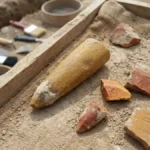
Green Obsidian Blades: Sourced directly from the famous ancient mines of Pachuca in central Mexico, this volcanic glass was highly coveted for its unique color and razor-sharp edges.
Atlatl Projectile Points: These distinct stone points were designed specifically for atlatls (spear-throwers), the signature weapon of Teotihuacano warriors.
Challenging the Old History Books
For decades, mainstream Mesoamerican history asserted that central Mexican powers did not heavily influence the Maya lowlands until a famous historical event known as the entrada in 378 CE, when foreign forces from Teotihuacan reportedly arrived in Tikal to reshape regional leadership.
The data extracted from Caracol’s new tomb completely complicates this narrative. Because these foreign items and non-Maya burial customs are firmly dated to 350 CE, it proves that elite Maya families were actively adapting, mimicking, or directly hosting central Mexican traditions nearly three decades earlier than previously assumed. It suggests a fluid network of royal marriages, diplomatic alliances, and elite trade rather than a sudden military invasion.
Caracol: The Superpower of the Lowlands
To fully appreciate the gravity of Te K’ab Chaak’s tomb, one must understand the sheer scale of the empire he set in motion. At its zenith during the sixth and seventh centuries, Caracol grew into an urban superpower.
The city expanded across more than 68 square miles, housing a thriving population of over 100,000 residents. Through a highly advanced network of agricultural terraces, paved causeways, and decentralized marketplaces, Caracol achieved a level of urban sustainability that rivaled modern cities.
The architectural crown jewel of the site remains the Caana (“Sky Place”) pyramid palace complex. Rising an imposing 43.5 meters (approximately 143 feet) above the plaza floor, Caana was the political and spiritual heart of the city. Remarkably, despite centuries of modern construction across the nation, the ancient pyramid of Caana remains one of the tallest man-made structures in Belize today. Although Caracol eventually entered a period of terminal decline around 900 CE along with the rest of the Southern Maya Lowlands, the sturdy foundations laid by its first king preserved its legacy beneath the jungle soil for 1,600 years.
The Future of the Investigation
Though the physical excavation phase of the tomb is complete, the scientific exploration of Te K’ab Chaak’s life is only just beginning. In the controlled setting of university laboratories, conservators are working to clean, stabilize, and fully reconstruct the fragments of the mosaic jadeite death mask.
Concurrently, physical anthropologists are preparing to run ancient DNA (aDNA) sequencing and stable isotope analysis on the recovered skeletal remains. Isotope testing of the tooth enamel will track the specific water and food consumed during the king’s childhood, definitively revealing whether the monarch was native to the Belizean lowlands or an immigrant prince from a distant kingdom.
The comprehensive findings are slated to be presented at a specialized international conference hosted by the Santa Fe Institute, focusing entirely on the complex geopolitical interactions between the Maya and Teotihuacan.
Frequently Asked Questions (FAQ)
Who was Te K’ab Chaak?
Te K’ab Chaak was the founding monarch of the ancient Maya city-state of Caracol in Belize. Taking the throne in 331 CE, his name translates to “Tree Branch Rain God,” and he initiated a royal dynasty that held uninterrupted political power for more than four and a half centuries.
Why is finding cinnabar in the tomb significant?
Cinnabar is a bright red mineral that was exclusively used in the burials of the highest-ranking Maya royalty. It symbolized sacred blood, vitality, and immortality, while its chemical properties helped preserve the grave goods, acting as an immediate indicator of elite status to archaeologists.
How does this discovery change our understanding of Maya history?
The tomb contains central Mexican style weapons and green obsidian alongside a Teotihuacano-style plaza cremation dating to 350 CE. This proves that deep cultural, economic, or political ties existed between the Maya lowlands and Teotihuacan decades before the historically famous 378 CE entrada, revealing a much more complex history of early Mesoamerican diplomacy.
What unique items were found inside the founding king’s tomb?
The tomb contained eleven highly decorated ceramic vessels (including lids shaped like coatimundi and macaw heads), three sets of rare jadeite earflares, bone tubes, exotic Pacific Spondylus sea shells, and a magnificent mosaic death mask crafted entirely from polished jadeite.
Can tourists visit the site where the tomb was found?
Yes, Caracol is an active archaeological site located within the Chiquibul Forest Reserve in western Belize and is open to eco-tourists and history enthusiasts. Visitors can explore the massive Caana pyramid, though specific royal tombs and delicate artifacts are kept secure in research laboratories for conservation and analysis.