
Table of Contents
- 1. Unlocking the Secrets of Adaïma: A Pre-Dynastic Turning Point
- 2. The Stars and the Solstice: Three Extraordinary Tombs
- 2.1. Tomb S166: Cosmic Alignment and Ritual Severance
- 2.2. Tomb S837: The Roots of the Pyramid Texts
- 2.3. Tomb S874: Shifting Focus to the Summer Solstice
- 3. Cultural Tipping Points: How Common Graves Became Sacred Shrines
- 4. From Farming Folklore to Pharaonic Myth: The Osiris Connection
- 5. Conclusion: The Grassroots Foundation of the Nile Civilization
- 6. Frequently Asked Questions
- 6.1. What makes the Adaïma cemetery so important to Egyptian history?
- 6.2. Why did ancient Egyptians ritually sever arms or limbs in early burials?
- 6.3. How does this discovery connect to the famous myth of Isis and Osiris?
- 6.4. What is the heliacal rising of Sirius, and why did it matter to early Egyptians?
- 6.5. How did researchers use artificial intelligence in this study?
Ancient Rural Burials in Egypt Shape Legendary Myths of Isis and Osiris
For generations, the prevailing narrative of ancient Egyptian history suggested that the complex tapestry of pharaonic religion, cosmic mythology, and state ideology was engineered from the top down. Historians often assumed that powerful kings, elite nobles, and an organized priesthood designed the sacred order to control and unify the early state.
However, a groundbreaking archaeological study is turning this long-standing theory entirely on its head.
New research focused on a massive prehistoric cemetery in southern Egypt indicates that the bedrock of pharaonic religion actually germinated from the grassroots level. Centuries before the very first pyramids rose along the horizon, ordinary rural communities were already developing complex astral rituals, agricultural mythologies, and symbolic funerary practices.
When the centralized Egyptian state eventually emerged, it did not invent a new religion from scratch. Instead, it co-opted, formalized, and weaponized the deeply ingrained spiritual traditions of its common citizens.
Ancient Rural Burials in Egypt Shape Legendary Myths of Isis and Osiris
Unlocking the Secrets of Adaïma: A Pre-Dynastic Turning Point
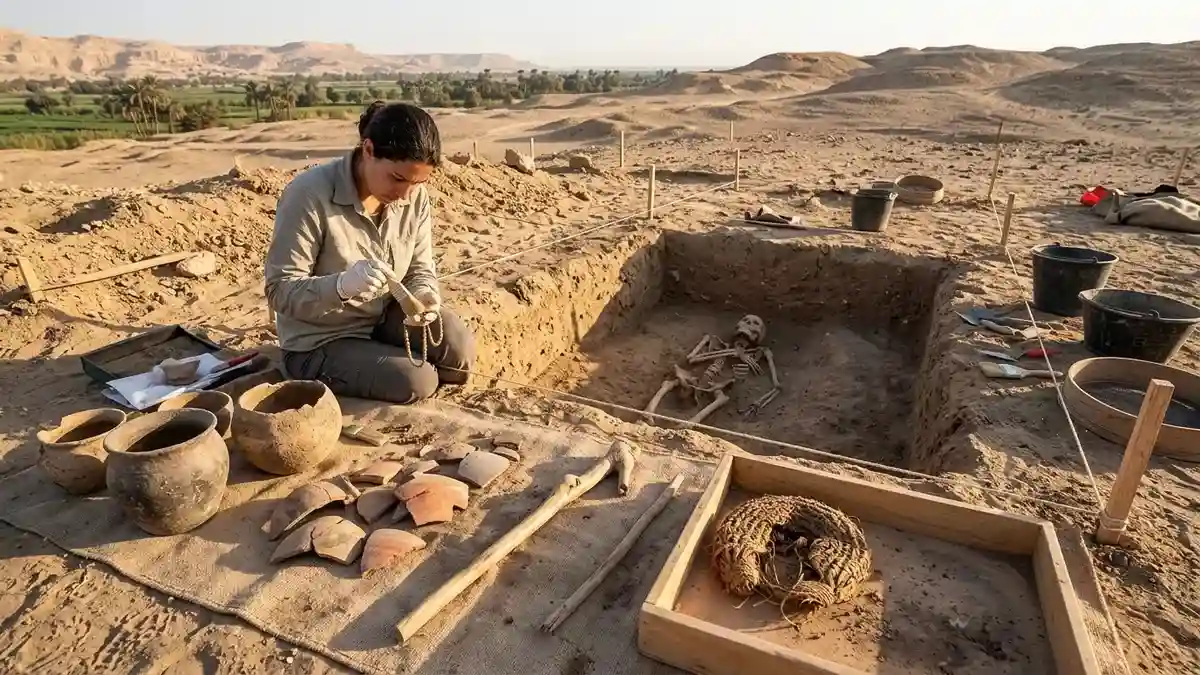
The focal point of this revolutionary perspective is the ancient burial ground of Adaïma, a sprawling 30-hectare archaeological site situated in the fertile Nile Valley of Upper Egypt. This extensive cemetery was actively utilized by local populations between roughly 3300 and 2700 BCE, a critical formative era spanning the late Predynastic period through the Early Dynastic Period.
Published in the Journal of Archaeological Method and Theory, the study was spearheaded by lead researcher Ameline Alcouffe from the University of Toulouse, alongside an international team of scientists. By conducting a forensic re-examination of more than 500 individual tombs, the research group set out to map how local, everyday mortuary traditions gradually transformed over centuries into the core spiritual doctrines of the pharaohs.
+-------------------------------------------------------------+
|                     ADAÏMA CEMETERY PROFILE                 |
+-------------------------------------------------------------+
|  Location:           Upper Egypt (Southern Nile Valley)      |
|  Total Area:         30 Hectares                            |
|  Chronology:         3300 – 2700 BCE (Pre-Pyramid Era)      |
|  Dataset Analyzed:   Over 500 individual tombs              |
+-------------------------------------------------------------+
Rather than finding random or simplistic graves, the team discovered a highly sophisticated system of celestial alignments, deliberate bodily manipulations, and symbolic grave goods that perfectly mirrored the natural rhythms of the Nile landscape.
The Stars and the Solstice: Three Extraordinary Tombs
Among the hundreds of resting places excavated at Adaïma, three specific burials stood out to researchers as profound cultural and religious milestones. These graves were not hidden away in royal complexes; they belonged to everyday members of a working agricultural community, yet they featured cosmic alignments of astonishing precision.
Tomb S166: Cosmic Alignment and Ritual Severance
This remarkable tomb held the skeletal remains of a prehistoric teenage girl. Strikingly, her left arm had been ritually severed at the mid-section of the humerus and forearm, then intentionally draped directly over her chest cavity.
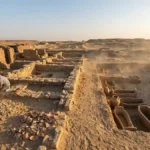
Beyond this physical manipulation, her entire burial environment was synchronized with the cosmos:
Solar Alignment: Her body was placed along a precise axis matching the path of the setting sun during the winter solstice.
Astral Alignment: Her outer wooden coffin was perfectly aligned with the heliacal rising of Sirius—the brightest star in the night sky.
       [ HELIACAL RISING OF SIRIUS ] ----> Aligned with Coffin
                     │
                     ▼
[ RITUAL SEVERANCE OF TEENAGER'S ARM ]
                     ▲
                     │
        [ WINTER SOLSTICE SUNSET ] -------> Aligned with Body Axis
In ancient Egypt, the return of Sirius to the morning sky directly coincided with the annual flooding of the Nile, a vital event that deposited nutrient-rich silt across the parched fields. The deliberate arrangement of Tomb S166 demonstrates that early rural communities were intertwining human mortality with the celestial cycles of agricultural rebirth long before the first dynasty was established.
Tomb S837: The Roots of the Pyramid Texts
In another sector of the cemetery, researchers identified the grave of an adult woman interred with an array of finely crafted personal jewelry and a single, intentionally broken ceramic vessel. The practice of breaking objects during a funeral to symbolically “kill” them so they could accompany the deceased into the afterlife is a concept that resonates deeply with the magical spells recorded centuries later in the royal Pyramid Texts.
Tomb S874: Shifting Focus to the Summer Solstice
A third conspicuous grave contained a woman laid to rest alongside a ceremonial wooden staff and an expertly woven plant-fiber wig. Unlike Tomb S166, this particular burial shifted its celestial focus entirely toward the summer solstice, indicating that the community meticulously mapped multiple distinct solar and stellar events throughout the changing seasons.
Cultural Tipping Points: How Common Graves Became Sacred Shrines
To comprehend how these unique burial practices spread throughout the population, the research team utilized cutting-edge artificial intelligence and advanced network analysis. By inputting the physical characteristics, structural orientations, and artifact layouts of the 500 graves into a digital framework, the AI mapped out the evolutionary trajectory of the cemetery over hundreds of years.
The data revealed something fascinating: these highly innovative, astronomically aligned tombs were initially distinct anomalies, completely disconnected from the traditional, simpler burial styles around them. However, the network analysis showed that over successive generations, newer graves began to tightly cluster directly around these original innovative burials.
Over decades and centuries, these specific rural resting places came to be revered as sacred landmarks or neighborhood shrines. The innovative ideas introduced by a few families at Adaïma eventually rippled outward, transforming localized mourning customs into dominant cultural traditions that a wider community adopted.
From Farming Folklore to Pharaonic Myth: The Osiris Connection
The implications of the Adaïma study extend far beyond simple changes in burial styles; they provide a tangible evolutionary lineage for some of Egypt’s most famous mythologies. The researchers argue that the shocking ritual of symbolic dismemberment practiced in these early rural cemeteries laid the direct conceptual groundwork for the classic myth of Isis and Osiris.
The Mythological Evolution: In later pharaonic lore, the god Osiris is betrayed, murdered, and hacked into multiple pieces by his envious brother, Set. His mourning wife, Isis, searches the Nile Valley to gather his scattered limbs, using her powerful magic to reconstruct his body and resurrect him as the Lord of the Underworld.
The physical evidence from Adaïma reveals that this grand state myth was not an abstract creation of royal speechwriters. Instead, it was an elevated, literary adaptation of a tangible, prehistoric funerary custom that common farmers had been practicing for centuries to process their grief and symbolize the cycle of life, decay, and regeneration.
Similarly, the celestial observation of Sirius—which began as a vital practical cue for early farmers to prepare their fields for the annual floodwaters—was absorbed by the emerging state. The pharaohs transformed this seasonal agricultural marker into a divine portent of cosmic fertility, eternal rebirth, and royal legitimacy, effectively using popular memory to consolidate centralized political control.
Conclusion: The Grassroots Foundation of the Nile Civilization
The extensive excavations and data-driven analysis at the Adaïma cemetery provide a profound, transformative lesson about the birth of human civilizations. Long before the first pharaoh held a scepter or wore a double crown to govern a unified Egypt, ordinary communities had already built the foundational scaffolding of the nation’s spiritual life.
Their everyday funerals, carefully timed by the shifting positions of the stars and the turning of the seasons, became the literal seeds from which the grand state religion eventually grew. By anchoring their royal authority to the ancient, trusted cosmic rituals of the common people, Egypt’s earliest rulers ensured their civilization would endure for millennia.
Frequently Asked Questions
What makes the Adaïma cemetery so important to Egyptian history?
The Adaïma site is crucial because it dates between 3300 and 2700 BCE, an era that predates the construction of the pyramids and the centralization of pharaonic power. By studying its 500-plus graves, archaeologists can see exactly how religious ideas evolved among ordinary people before the pharaohs took control of Egyptian society.
Why did ancient Egyptians ritually sever arms or limbs in early burials?
In prehistoric rural communities like Adaïma, symbolic dismemberment or manipulation of the body was likely linked to concepts of agricultural cycles, fertility, and cosmic rebirth. Breaking or separating elements allowed people to mirror the natural world, where a seed must break apart and decay in the earth before it can grow into new life.
How does this discovery connect to the famous myth of Isis and Osiris?
The pharaonic myth details how the god Osiris was dismembered and his pieces gathered by Isis to grant him eternal life. The discovery of ritually severed limbs in 4,500-year-old rural graves indicates that this state myth was adapted directly from prehistoric folk rituals practiced by ordinary farmers centuries earlier.
What is the heliacal rising of Sirius, and why did it matter to early Egyptians?
The heliacal rising occurs when the star Sirius becomes visible on the eastern horizon just before sunrise after a period of invisibility. For early Nile Valley farmers, this astronomical event was a critical seasonal marker that directly heralded the annual, life-giving flooding of the Nile River, making it a natural symbol for fertility and resurrection.
How did researchers use artificial intelligence in this study?
The international research team used AI and digital network analysis to track the relationships, orientations, and timeline of more than 500 graves. The technology revealed that astronomically aligned tombs acted as cultural “tipping points,” where innovative local practices gradually became sacred landmarks that influenced the layout of all subsequent burials.