
Table of Contents
- 1. Decades of Discovery at Turlojiškė
- 1.1. Modern Forensics and Collaborative Science
- 2. Forensic Evidence of Prehistoric Combat
- 3. Reconstructing a Lost Ecosystem
- 4. Mapping the Scale of Bronze Age Warfare
- 5. Frequently Asked Questions
- 5.1. What makes the Turlojiškė site different from a normal cemetery?
- 5.2. How do scientists know the bodies were buried at the same time?
- 5.3. How did the environment help preserve the bones?
- 5.4. What kind of weapons were used in the battle?
- 5.5. Why is this discovery important for Baltic history?
3,000-Year-Old Baltic Battlefield Mass Grave Identified in Lithuanian Bog
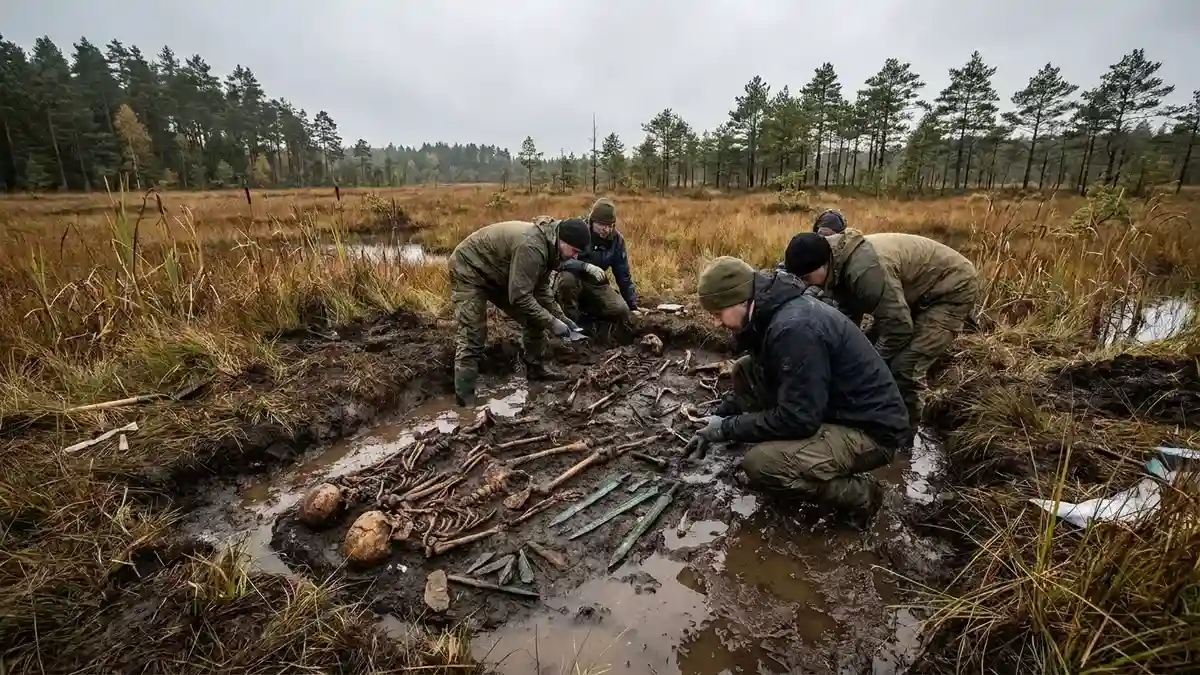
A groundbreaking multi-disciplinary study in southern Lithuania has uncovered definitive evidence of a violent prehistoric conflict, rewriting the history of warfare in the eastern Baltic region. Through advanced radiocarbon dating, geological modeling, and forensic analysis of skeletal remains, researchers have identified a Late Bronze Age mass grave within the Turlojiškė peat bog. The site preserves a single, catastrophic event from roughly 3,000 years ago, during which a group of young men fell in battle and were deposited into a shallow, silting lake.
The discovery places Turlojiškė among an elite handful of European prehistoric battlefield sites. It challenges long-held historical assumptions that Bronze Age societies in northern and eastern Europe engaged only in small-scale tribal skirmishes, providing physical proof of organized, lethal warfare.
3,000-Year-Old Baltic Battlefield Mass Grave Identified in Lithuanian Bog
Decades of Discovery at Turlojiškė
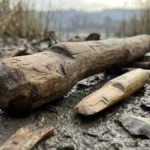
The marshy landscape of Kalvarija eldership has teased archaeologists for nearly a century. The site first gained attention in 1930 when laborers straightening the Kirsna River discovered a human skull alongside tools crafted from bone, antler, and flint. Over the following decades, peat cutting and agricultural work occasionally brought more ancient bones to the surface.
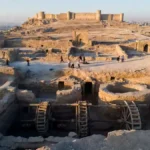
The first systematic scientific approach began between 1996 and 1933, when archaeologist Algimantas Merkevičius unsealed the first official excavation trenches. His team identified the footprints of a prehistoric lakeside settlement and rescued additional skeletal elements. However, the true nature of the human remains—and their connection to a single violent event—remained a mystery.
Modern Forensics and Collaborative Science
The breakthrough came when fieldwork resumed under the direction of archaeologist Mantas Daubaras, working alongside Vilnius University and specialized research institutions in Poland. The team reopened sections of the bog, extracted fresh sediment cores, and located another individual preserved in the peat.
Critically, the team pulled archival bones out of storage at the Faculty of Medicine of Vilnius University, subjecting them to modern forensic scrutiny. By pairing decades-old discoveries with freshly excavated material, the researchers built a comprehensive profile of the victims.
Timeline of Turlojiškė Excavations:
├── 1930: Accidental river discovery of skull and bone tools
├── 1996–2003: Systematic excavation reveals an ancient lakeside settlement
└── 2025–2026: Interdisciplinary project identifies the battlefield mass grave
Forensic Evidence of Prehistoric Combat
The osteological profile of the bones points directly to warfare rather than a traditional community cemetery. The skeletal assembly consists exclusively of young men. Had the site been a standard burial ground for the adjacent settlement, the demographic footprint would include women, children, and the elderly.
Furthermore, the bones bear clear evidence of perimortem trauma—injuries inflicted at or very near the exact time of death. Forensic specialists documented sharp-force and blunt-force wounds consistent with combat weapons.
The physical trauma on the bone is matched by the weapons recovered from the exact same geological layers. Excavators recovered:

Piercing flint arrowheads
Distinctive stone battle-axes
Specialized bronze axes designed for close-quarters combat
The combination of an all-male demographic, severe weapon trauma, and discarded armaments in a single stratigraphic layer solidifies the interpretation of Turlojiškė as a battlefield mass deposition.
Reconstructing a Lost Ecosystem
To understand how these bodies were preserved, geologists and zoologists reconstructed the ancient environment. The team executed an intensive sub-surface survey, drilling 640 boreholes across the vast peat bog. This dense network of data points allowed researchers to map the ancient topography and construct high-fidelity two-dimensional and three-dimensional digital models of the basin.
Evolution of the Turlojiškė Basin:
[15,000 Years Ago] Post-Ice Age glacial lake forms; sapropel mud deposits begin.
[3,000 Years Ago]  Lake grows shallow, muddy, and marshy; conflict occurs.
[Modern Era]       Vegetation decays into a protective, anaerobic peat bog.
Data shows that a muddy sapropel layer began forming at the bottom of the basin more than 15,000 years ago, shortly after the retreat of the last Ice Age glaciers. By 3,000 years ago, the lake had grown shallow and highly susceptible to silting.
To verify this timeline, zoologists from the Tadas Ivanauskas Zoological Museum analyzed biological remains locked within the sediment layers. They identified specific prehistoric mollusk species that thrive exclusively in shallow, closing aquatic ecosystems. It was into this murky, weed-choked environment that the bodies of the defeated warriors were cast or fell, where they were rapidly sealed away from oxygen, preserving their secrets for three millennia.
Mapping the Scale of Bronze Age Warfare
The discovery at Turlojiškė fills a critical geographic gap in European prehistory. For generations, the European Bronze Age was viewed through a romanticized lens of trade, metallurgy, and agricultural expansion. That perception shattered with the excavation of the Tollense Valley in northeastern Germany, where thousands of bones revealed a massive conflict involving hundreds of warriors around 1200 BCE. A similar large-scale sacrifice of defeated warriors was documented at Alken Enge in Denmark.
Major European Bronze Age Conflict Sites:
├── Tollense Valley (Germany): Massive river-valley battle site
├── Alken Enge (Denmark): Post-battle mass sacrifice in wetland environments
└── Turlojiškė (Lithuania): First definitive battlefield mass grave in the Eastern Baltic
Until now, such organized scale of conflict was undocumented along the eastern shores of the Baltic Sea. Turlojiškė provides concrete evidence that the communities of modern-day Lithuania were plugged into the same systemic geopolitical tensions, military structures, and violent regional rivalries seen further west.
Frequently Asked Questions
What makes the Turlojiškė site different from a normal cemetery?
Unlike standard ancient cemeteries, which contain individuals of all ages and genders, the human remains at Turlojiškė belong exclusively to young men. The bones show severe weapon-inflicted injuries, and they were buried directly alongside weapons in a former lakebed, indicating a combat event rather than a peaceful burial.
How do scientists know the bodies were buried at the same time?
Specialists at the Center for Physical Sciences and Technology used Accelerator Mass Spectrometry (AMS) radiocarbon dating on multiple sets of skeletal remains. The results confirmed that at least 11 individuals died simultaneously during a narrow window in the Late Bronze Age.
How did the environment help preserve the bones?
The bodies ended up in a shallow, silting lake that eventually transitioned into a peat bog. Peat bogs feature highly unique anaerobic (oxygen-poor) conditions that slow down organic decay, sealing bone, wood, and environmental data away from the destructive forces of open-air decomposition.
What kind of weapons were used in the battle?
Archaeologists excavated flint arrowheads, heavy stone axes, and cast-bronze axes within the same mud layers as the fallen warriors, showcasing a mixture of stone and metal weapons common during the transition periods of the Late Bronze Age.
Why is this discovery important for Baltic history?
It provides the first definitive, well-dated evidence of large-scale, organized warfare in the eastern Baltic region during the Bronze Age. It links the prehistory of Lithuania to broader European patterns of conflict previously seen only in places like Germany and Denmark.