
Table of Contents
**Roman York Babies Buried in Rare Purple and Gold Cloth**
Archaeologists have uncovered compelling evidence of wealth and deep parental devotion in ancient Roman Britain. Two infants laid to rest nearly 1,700 years ago in what is now York were wrapped in textiles dyed with Tyrian purple—one of the most luxurious and expensive fabrics in the Roman world. This remarkable discovery highlights how elite families honored their youngest members, even in an era marked by high child mortality.
The findings come from a research project examining preserved burial casings at the York Museums Trust. Using advanced scientific analysis, experts identified traces of the rare dye on fabrics that had been protected for centuries inside hardened gypsum layers.
Roman York Babies Buried in Rare Purple and Gold Cloth

### The Extraordinary Preservation of Roman Burial Practices
Roman funerals in Britain sometimes involved a unique technique: pouring liquid gypsum over clothed bodies placed in coffins. As the material set, it created a protective shell that captured impressions of textiles, preserved tiny fabric fragments, and even locked in chemical residues of dyes.
This method proved crucial for the two infant burials from the late third or early fourth century CE. One child was placed in a stone sarcophagus alongside two adults. The other rested alone in a lead coffin. Both showed clear evidence of Tyrian purple, but the lead coffin burial offered the most detailed insights.
 Under the Layers of Deception: High-Tech Scans Reveal Hidden Nazi Symbols Beneath Postwar Painting
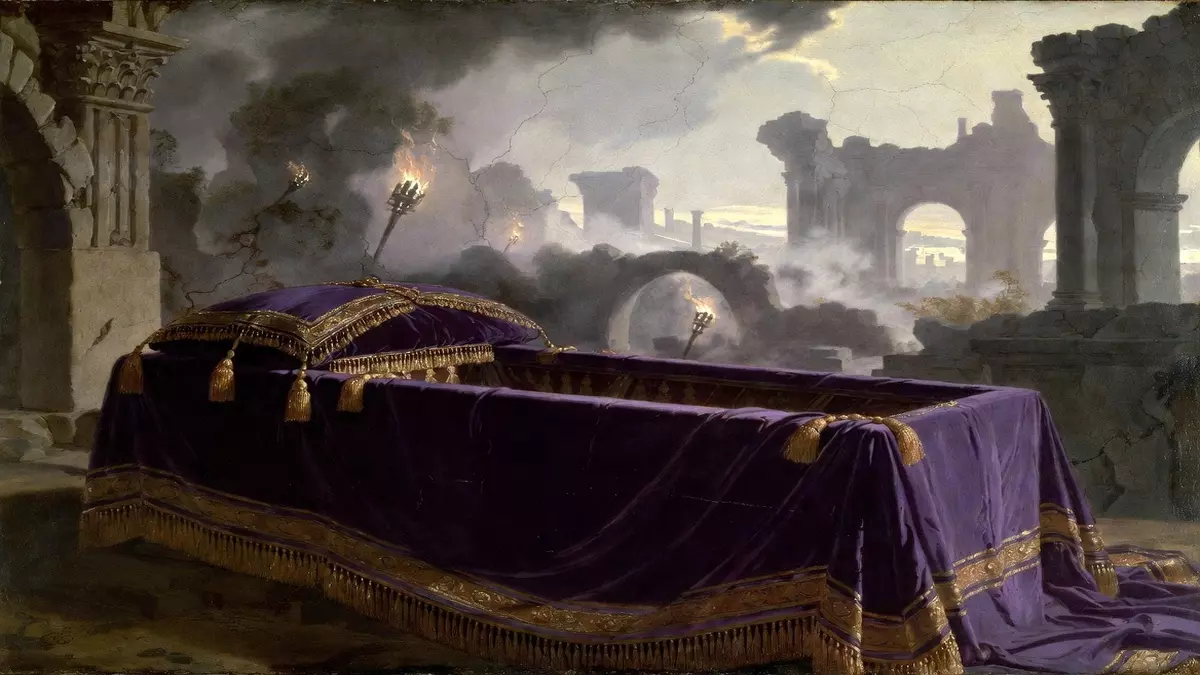
Researchers observed at least two distinct textile layers in the lead coffin. A tasseled cloak or shawl lay closest to the body, overlaid by a finer outer fabric woven with gold threads and dyed in the iconic purple hue. This luxurious layer would have been visible during the funeral procession before the coffin was sealed, serving as a final, public display of status and care.
### What Made Tyrian Purple So Exclusive?
Tyrian purple, also known as imperial purple, held immense cultural and economic significance across the Roman Empire. Produced primarily in the Phoenician city of Tyre (in modern-day Lebanon), the dye came from the secretions of murex sea snails harvested from Mediterranean waters.
The extraction process was extraordinarily labor-intensive. Workers collected thousands of mollusks, crushed their shells, or carefully removed the dye-producing glands. The resulting pigment required precise processing to achieve its vibrant, colorfast shade. This made it one of the priciest commodities of the ancient world.
Emperor Diocletian’s famous price edict from 301 CE illustrates its value: one pound of Tyrian-dyed silk cost 150,000 denarii—equivalent to about three pounds of gold. Sumptuary laws eventually restricted its use, associating the color strongly with emperors, high-ranking officials, and the ultra-wealthy. Wearing purple became a powerful symbol of authority, wealth, and social standing.
In Britain, finds of genuine Tyrian purple on textiles are exceptionally rare. This discovery in York represents the first confirmed instance, underscoring the city’s connections to long-distance trade networks and the presence of affluent residents who could afford such imports.
### Infant Mortality and Family Grief in Roman Times
Life in Roman Britain was challenging, particularly for the youngest. Historical estimates suggest that around 30 percent of infants died before their first birthday. High mortality rates often meant limited formal public mourning for very young children, leading some historians to assume emotional detachment.
However, these purple-wrapped burials challenge that view. Families invested significant resources—importing costly fabrics from across the empire—to give their babies dignified, high-status send-offs. The effort reflects profound grief and a desire to honor children who may have lived only a few months.
**H3: Layers of Meaning in the Burials**
The combination of purple dye and gold threads placed these textiles among the most prestigious available. One burial also featured pinkish residues consistent with aged Tyrian purple, along with visible gold elements. Such details suggest careful preparation and emotional investment that went far beyond basic funerary customs.
These practices align with broader Roman traditions while highlighting local variations in York, a major military and civilian center known as Eboracum. The city attracted people from across the empire, including merchants and officials with access to luxury goods.
### Broader Implications for Roman York Archaeology
This research, part of the “Seeing the Dead” project at the University of York, opens new avenues for understanding daily life and death in Roman Britain. Gypsum casings from other sites may hold similar hidden treasures, offering more windows into the past through preserved organic materials.
The findings add nuance to discussions about social hierarchy, trade, and family dynamics. They demonstrate that even remote provinces like Britain participated in the empire’s luxury economy. More importantly, they humanize the past, showing parents who mourned deeply and spared no expense for their lost children.
Future sampling of additional gypsum burials in York and surrounding areas could reveal even more about these practices. Each new analysis helps paint a richer picture of how Romans balanced everyday hardships with expressions of love, status, and ritual.
### Why This Discovery Matters Today
In an age when we often romanticize ancient empires through grand monuments and military conquests, stories like these remind us of the personal dimensions of history. These infants, though they lived briefly, were laid to rest with the same honors afforded to society’s elite. Their burials speak to universal human experiences: the pain of losing a child, the comfort found in ritual, and the enduring desire to provide the best possible farewell.
Archaeologists continue to use cutting-edge techniques—from chemical analysis to digital imaging—to extract stories from seemingly unremarkable remains. The gypsum casings, once overlooked, now serve as time capsules revealing details invisible to earlier generations of scholars.
This find not only enriches our understanding of Roman York but also connects modern readers to the emotional lives of people who walked these streets nearly two millennia ago.
## FAQ: Roman Infant Burials and Tyrian Purple
**Q: What exactly is Tyrian purple, and why was it so valuable?**
A: Tyrian purple is a dye extracted from Mediterranean murex sea snails. Its production was extremely time-consuming and expensive, making it a status symbol reserved primarily for emperors and the wealthy. In Roman times, it could cost three times its weight in gold.
**Q: How were the infant burials preserved so well?**
A: Liquid gypsum poured over the clothed bodies hardened into protective casings. This sealed in fabric impressions, dye traces, and textile fragments that would otherwise have decayed over centuries.
**Q: Were these the only known purple textile finds in Roman Britain?**
A: While rare, these represent the first confirmed Tyrian purple on textiles from York. Similar high-status finds elsewhere in Britain are uncommon, highlighting the exceptional nature of these discoveries.
**Q: What do these burials tell us about Roman attitudes toward infant death?**
A: They suggest that, despite high mortality rates and limited formal mourning customs, some families deeply grieved their children and honored them with lavish burials, contradicting notions of emotional indifference.
**Q: Where can I see these artifacts today?**
A: The burials are part of the collections at York Museums Trust. Ongoing research through projects like “Seeing the Dead” continues to study and share these important finds with the public.
**Q: How does this discovery change our view of Roman York?**
A: It illustrates the city’s integration into empire-wide trade networks and the presence of elite families willing to invest heavily in personal rituals, adding depth to our knowledge of provincial Roman life.
These ancient burials continue to captivate researchers and history enthusiasts alike. They bridge the gap between past and present, revealing timeless aspects of human nature through the lens of archaeology. As more studies emerge, we gain fresh appreciation for the rich, complex society that once thrived in Roman York. (Word count: 1,248)