
Table of Contents
**Ancient Belgian Grave Reveals Post-Roman Trade Secrets**
Archaeologists in Belgium have uncovered compelling evidence of how everyday commerce adapted after the Roman Empire’s monetary system collapsed in northwestern Europe. A 5th-century grave at the Roman coastal fort of Oudenburg contained a remarkable purse assemblage of old bronze coins and scrap metal, shedding new light on the practical solutions communities developed when small change disappeared.
This discovery, detailed in a recent study published in *Britannia*, offers a fascinating glimpse into the transitional economy of early medieval Europe during a time of profound change.
Ancient Belgian Grave Reveals Post-Roman Trade Secrets

### The Discovery at Oudenburg
The Oudenburg site, located along Belgium’s coast, began as a Roman military fort in the late 2nd century CE. It remained occupied through the turbulent final years of Roman control in the region, with activity continuing into the early to mid-5th century. Excavations first revealed Graveyard A in 1964, and burial A-104 stood out among dozens of graves from the 4th and 5th centuries.
The grave belonged to an adult male buried with typical personal items of the period: a crossbow brooch, belt plaque, knife, ceramic jug, glass vessels, and most importantly, the remains of a purse. Although the organic material of the purse had largely decayed, archaeologists recovered a complete assemblage of objects that had been stored inside.

### Inside the Purse: Coins and Hackbronze
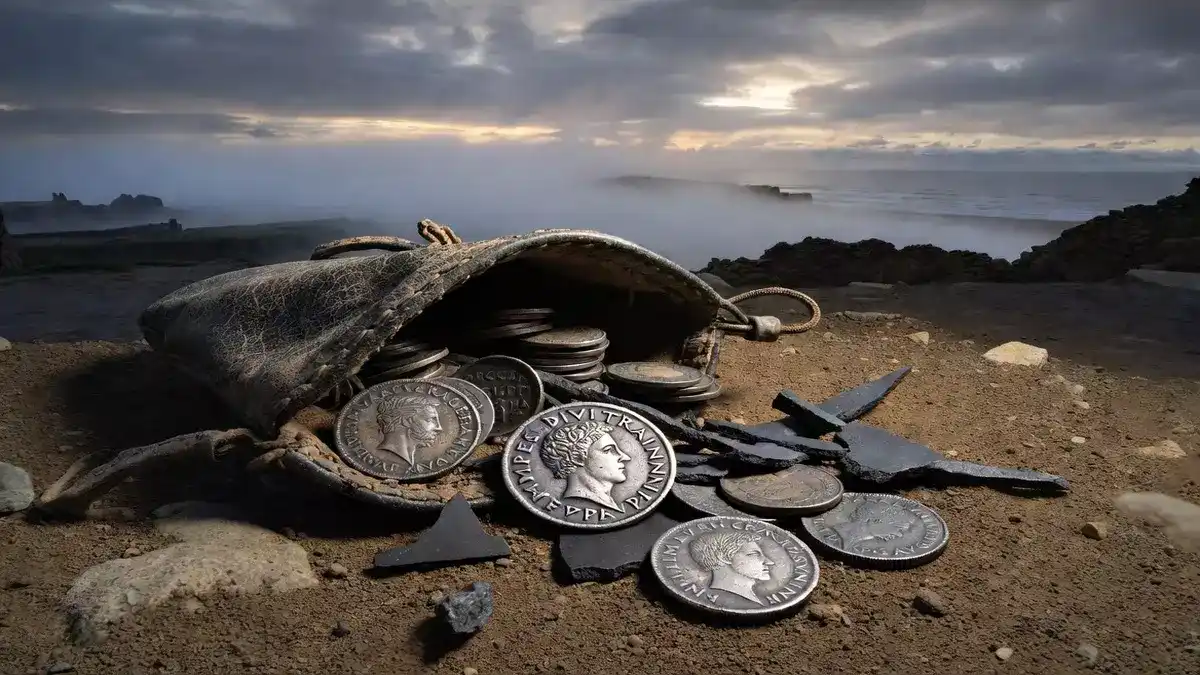
The purse contained an intriguing mix of artifacts: an iron fire striker, six pieces of flint, two belt hooks, a brooch pin, several small metal fragments, and four bronze coins. Three coins were found directly within the purse remains, while a fourth lay nearby, likely part of the same set.
What makes this find significant is the composition and dating of the coins:

– Two coins minted during the reign of Emperor Trajan (98–117 CE)
– One coin from Emperor Hadrian (138 CE)
– One later coin from Emperor Valentinian II (388–402 CE)
The wide time span between these coins is unusual for a single context. Rather than viewing the older pieces as random intrusions, researchers argue they were intentionally collected and carried together.
The total weight of the four coins measures approximately 56.77 grams — remarkably close to two Roman *unciae*, a standard Roman weight unit. This precision suggests the coins were no longer primarily valued for their face value or as official currency, but instead for their intrinsic bronze content and weight.
Accompanying the coins were numerous broken bronze fragments, often referred to as “hackbronze.” These damaged pieces, broken beyond practical use as tools or jewelry, appear to have served as raw material or bullion for small-scale transactions.
### The End of Roman Bronze Coinage
By around 400 CE, the supply of base-metal (bronze) coins to northern Gaul and the surrounding regions had effectively ceased. While gold and silver coins continued to circulate among elites, they were far too valuable for everyday purchases like food, tools, or small services. This created a significant gap in the monetary system that ordinary people needed to fill.
The contents of burial A-104 may represent one creative local solution. Instead of relying solely on barter, residents began using weighed collections of old coins and scrap metal as a form of informal currency. This “hackbronze” system allowed for flexible, weight-based exchanges that bridged the gap left by the collapsing Roman economy.
### Broader Economic Changes After Rome
The fall of the Western Roman Empire brought massive disruptions to trade networks, manufacturing, and state infrastructure across Europe. Without consistent imperial minting and distribution of small-denomination coins, communities had to innovate.
Similar purse assemblages appear in other early medieval graves, particularly from the Merovingian period. For example, a burial at Tongeren contained 47 bronze coins whose combined weight aligned with ten Roman *solidi*. However, the Oudenburg find stands out due to its early 5th-century date and the clear combination of coins with scrap metal fragments.
Later examples from sites like Kaiseraugst in Switzerland show this practice becoming more widespread. The Oudenburg burial potentially captures an early transitional phase — one of the first clear archaeological snapshots of how people adapted to the new economic reality.
### What This Means for Understanding Daily Life
This discovery provides rare insight into the lives of ordinary individuals during a period often described as the “Dark Ages.” Far from complete economic collapse, the evidence points to flexible, community-driven systems that kept local trade functioning.
Researchers emphasize that the metal fragments were deliberately included alongside the coins, supporting the idea of a bullion-based exchange system. While the study stops short of declaring hackbronze as formal currency, it strongly suggests these collections served practical purposes in daily transactions.
The excellent contextual preservation at Oudenburg — with the purse contents found largely undisturbed — makes this one of the clearest examples available to archaeologists studying post-Roman economies.
### Historical Significance and Future Research
Burial A-104 highlights the importance of careful excavation and detailed analysis of seemingly modest graves. What might have been dismissed as random junk in the past is now recognized as valuable evidence of economic resilience and adaptation.
The study, authored by Flückiger, Van Thienen, and Vanhoutte, calls for more comprehensive weight analyses of similar purse assemblages to better understand the prevalence and development of these practices across regions.
This find adds to a growing body of evidence showing continuity and innovation rather than total breakdown in the decades following Rome’s withdrawal from northern Europe. It demonstrates how communities maintained trade through practical, low-value exchange methods while larger political structures shifted dramatically.
As more sites from this transitional period are examined with modern techniques, our understanding of how European economies evolved from Roman to medieval systems continues to deepen.
### A Window into Resilience
The man buried at Oudenburg around the early 5th century carried tools for daily life — fire-starting equipment, personal adornments, and a purse containing his practical “money.” His grave preserves not just objects, but a snapshot of human ingenuity in the face of systemic change.
This Belgian discovery reminds us that history is often written in the smallest details: the weight of old coins, the careful collection of scrap metal, and the quiet adaptations that allowed societies to endure.
**FAQ**
**What was found in the 5th-century grave at Oudenburg?**
Archaeologists discovered a purse assemblage containing four bronze coins from different Roman emperors, along with broken bronze fragments (hackbronze), fire-starting tools, and personal items.
**Why are the coins in the Oudenburg burial significant?**
The coins span over 300 years and their combined weight matches Roman measurement units, suggesting they were used as bullion based on metal content rather than face value after official bronze coin supplies ended.
**When did Roman bronze coins stop circulating in northern Europe?**
By approximately 400 CE, base-metal coins were no longer being supplied to the region, creating challenges for everyday small transactions.
**What is hackbronze?**
Hackbronze refers to broken or damaged bronze objects and fragments valued for their metal content and weight, used similarly to scrap bullion in post-Roman exchange systems.
**How does this discovery change our view of the post-Roman economy?**
It shows communities developed flexible weight-based systems using old coins and scrap metal to facilitate daily trade, demonstrating resilience and continuity rather than total economic collapse.
**Where was the Oudenburg fort located?**
The site is a former Roman coastal fort in modern-day Belgium, strategically positioned along the North Sea coast and occupied from the late 2nd to mid-5th century CE.
**Will more research be conducted on similar finds?**
Yes, the researchers recommend further weight analyses of purse assemblages from other sites to better understand how widespread these adaptive practices became during the early medieval period.