
Table of Contents
- 1. The Mystery of the Grotta del Romito Double Burial
- 1.1. Redefining Romito 1 and Romito 2
- 2. Decoding the Ancient Genome: The Discovery of Acromesomelic Dysplasia
- 2.1. A Mother-Daughter Bond
- 2.2. The NPR2 Gene Mutation
- 3. Belonging to the Villabruna Genetic Cluster
- 4. Stone Age Compassion: Evidence of Prehistoric Social Care
- 5. How Ancient DNA Informs Modern Medicine
- 6. A New Frontier in Paleogenomics
- 7. Frequently Asked Questions
- 7.1. What is the significance of the Grotta del Romito DNA discovery?
- 7.2. What genetic disorder did the prehistoric teenager have?
- 7.3. How do scientists know the two individuals were mother and daughter?
- 7.4. What does this discovery tell us about Stone Age society?
- 7.5. What is the Villabruna genetic cluster?
12,000-Year-Old DNA Reveals Rare Dwarfism in Prehistoric Teenager
An extraordinary breakthrough in paleogenomics has bridged the gap between ancient history and modern medicine. By analyzing skeletal remains found in southern Italy, an international team of scientists has successfully documented the earliest known genetic diagnosis in an anatomically modern human.
The breakthrough centers on a prehistoric teenage girl who lived more than 12,000 years ago during the Stone Age. Through advanced DNA sequencing, researchers discovered that she suffered from a rare form of dwarfism. Beyond the medical revelation, the discovery offers an emotional window into the past, revealing profound insights into compassion, family bonds, and social care in hunter-gatherer communities.
12,000-Year-Old DNA Reveals Rare Dwarfism in Prehistoric Teenager
 Ancient Mollusk Shells Discovered in Saqqara Unlocking Secrets of Egyptian Rituals and Daily Life
The Mystery of the Grotta del Romito Double Burial
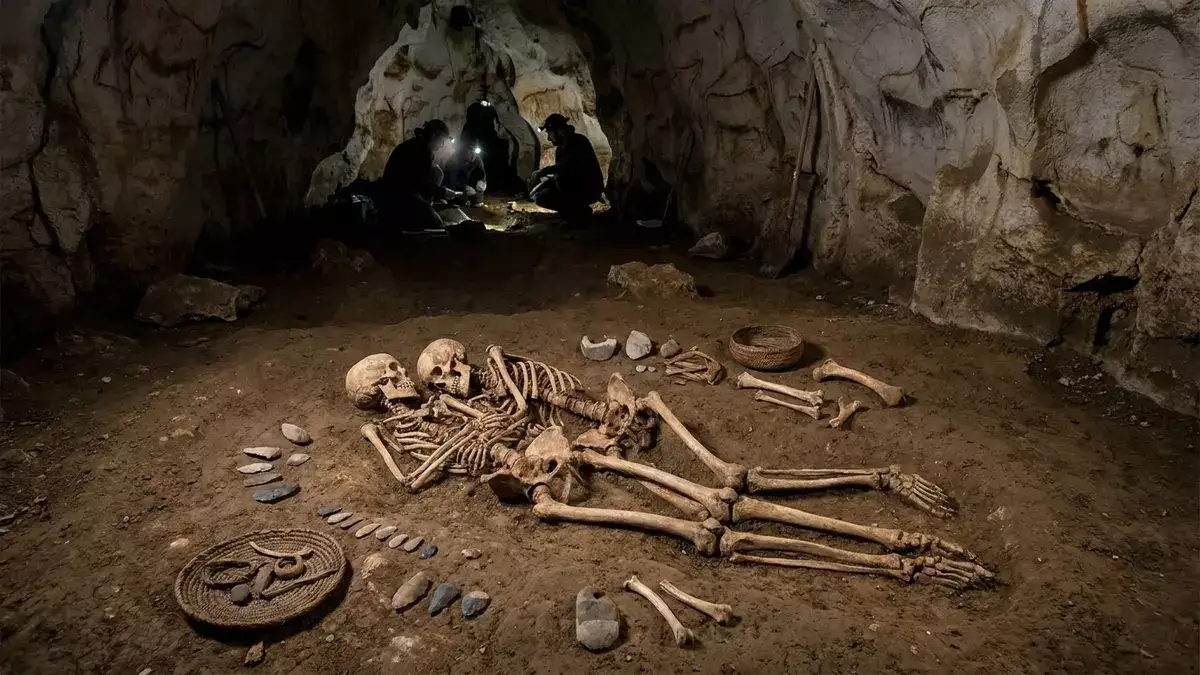
The journey to this discovery began in 1963 inside Grotta del Romito, a limestone cave located in Calabria, southern Italy. Archaeologists excavating the site uncovered a poignant double burial containing two individuals interred in a tender embrace.
For decades, the exact nature of their relationship and physical conditions remained a subject of debate. Initial assessments misidentified one of the individuals as male. However, a new comprehensive analysis has rewritten their story.
Redefining Romito 1 and Romito 2
The shorter of the two individuals, historically cataloged as Romito 2, was actually an adolescent girl. Her skeletal remains presented a striking physical profile:

Severe Limb Shortening: Her long bones were disproportionately short.
Diminutive Stature: She stood just 110 centimeters tall—approximately 3 feet, 7 inches.
No Signs of Trauma: Her bones bore no evidence of violence or fatal injury, indicating she died of natural causes.
Buried alongside her was Romito 1, an adult who measured 145 centimeters (about 4 feet, 9 inches) tall. While taller than the teenager, Romito 1 was still noticeably shorter than the average height expected for adults living during the Late Pleistocene epoch.
Decoding the Ancient Genome: The Discovery of Acromesomelic Dysplasia
To uncover the underlying cause of their short stature, scientists extracted ancient DNA from the dense petrous bone located in the inner ear of both skeletons. The genetic data yielded definitive answers that physical anthropology alone could never provide.
A Mother-Daughter Bond
First, the genetic analysis corrected the historical record regarding their biological sex and relationship. The data confirmed that both Romito 1 and Romito 2 were female. Furthermore, they shared a first-degree biological relationship, establishing that they were almost certainly mother and daughter.
The NPR2 Gene Mutation
The most groundbreaking revelation came from the specific genetic coding of the adolescent girl. The paleogenomics team identified a homozygous mutation in her NPR2 gene.
This specific genetic marker confirms a clinical diagnosis of acromesomelic dysplasia, Maroteaux type, an incredibly rare inherited skeletal disorder characterized by severe dwarfism and short limbs.
In modern clinical medicine, acromesomelic dysplasia is an autosomal recessive condition. This means an individual must inherit two copies of the mutated gene—one from each parent—to manifest the severe physical traits. The genetic profile of the mother, Romito 1, perfectly supported this framework: she carried just a single copy of the mutated NPR2 gene. This single mutation explains her moderately reduced height without the severe limb shortening seen in her daughter.
Belonging to the Villabruna Genetic Cluster
The genetic profiles also allowed researchers to map the ancestral roots of this prehistoric family. Both individuals were linked to the Villabruna genetic cluster.
This specific population group represents hunter-gatherers who underwent a major geographic expansion roughly 14,000 years ago, moving from southern Europe into central and western parts of the continent as the last ice age began to recede. Finding these individuals in southern Italy provides crucial data regarding the migration patterns and genetic diversity of European hunter-gatherers during the Epigravettian cultural period.
Stone Age Compassion: Evidence of Prehistoric Social Care
Beyond the obvious scientific value to evolutionary biology, the diagnosis provides a rare, humanizing look at daily life in the Stone Age.
Living with acromesomelic dysplasia in a late-glacial environment would have presented monumental challenges. The physical limitations associated with severely shortened limbs would have restricted Romito 2’s mobility, making it impossible for her to participate in traditional hunter-gatherer activities like tracking game, foraging over long distances, or fleeing from predators.
Despite these severe physical vulnerabilities, Romito 2 did not die in infancy. She survived well into her teenage years. This survival trajectory serves as undeniable proof of community-driven social support.
Food Sharing: The group must have actively shared gathered resources and hunted meat with her.
Mobility Support: Family and community members likely assisted her in moving between seasonal camp locations.
Social Inclusion: Her burial in a deliberate, loving embrace with her mother indicates she was a deeply valued member of her family structure, rather than an outcast.
This evidence of prehistoric healthcare and social cooperation challenges older, primitive stereotypes of Paleolithic survival-of-the-fittest dynamics. Instead, it demonstrates that empathy and mutual aid are deeply ingrained human traits that date back millennia.
How Ancient DNA Informs Modern Medicine
The successful extraction and analysis of this 12,000-year-old genome highlight a growing synergy between physical anthropology and modern clinical genetics. The study relied on a collaborative effort involving experts from the University of Vienna in Austria, Sapienza University of Rome in Italy, and the Liège University Hospital Centre in Belgium.
Dr. Adrian Daly, a co-author of the study based at the Liège University Hospital Centre, emphasized the contemporary relevance of these findings. His daily clinical work focuses on diagnosing and treating abnormal growth variations in modern patients.
According to Dr. Daly, this discovery serves as a reminder that rare genetic conditions are not modern anomalies caused by industrial lifestyles or synthetic environments. They are intrinsic components of the human evolutionary journey.
The study underscores that while patients with severe short or tall stature continue to face physical and social hurdles today, modern science is making rapid progress. Innovative therapeutic treatments targeting mutations in the NPR2 gene and related growth pathways are currently emerging, offering hope to individuals living with similar conditions today.
A New Frontier in Paleogenomics
The identification of acromesomelic dysplasia in a 12,000-year-old skeleton sets a new benchmark for historical medical research. As paleogenomic tools continue to advance in sensitivity and precision, scientists will increasingly be able to identify a wide array of rare, inherited, and congenital diseases that have remained hidden within the global fossil record.
By analyzing the DNA of those who came before us, researchers are not only uncovering the ancient roots of human disease but are also revealing the timeless history of human compassion.
Frequently Asked Questions
What is the significance of the Grotta del Romito DNA discovery?
This discovery represents the earliest confirmed genetic diagnosis of a rare skeletal disorder in an anatomically modern human. By identifying a specific gene mutation in a 12,000-year-old skeleton, scientists have proven that rare genetic conditions have always been a part of human history.
What genetic disorder did the prehistoric teenager have?
The teenager, known as Romito 2, was diagnosed with acromesomelic dysplasia, Maroteaux type. This is a rare, inherited skeletal condition caused by a homozygous mutation in the NPR2 gene, resulting in severe short stature and disproportionately shortened limbs.
How do scientists know the two individuals were mother and daughter?
DNA extracted from the petrous bone in the inner ear revealed that both individuals were biologically female and shared a first-degree genetic relationship. Combined with their burial arrangement and shared genetic mutation, researchers concluded they were almost certainly mother and daughter.
What does this discovery tell us about Stone Age society?
The teenager’s survival into adolescence despite severe physical limitations proves that her hunter-gatherer community practiced advanced social care. The group provided her with food, protection, and mobility assistance, highlighting a sophisticated level of empathy and social cooperation in prehistoric families.
What is the Villabruna genetic cluster?
The Villabruna cluster refers to a specific genetic population of prehistoric hunter-gatherers. Around 14,000 years ago, this group migrated and expanded from southern Europe into central and western Europe, playing a significant role in shaping the genetic landscape of post-glacial Europe.