
Table of Contents
- 1. The Royal Proclamation at Canopus
- 2. Anatomy of the Sandstone Stela
- 3. Leap Years, Tax Breaks, and Living Gods
- 3.1. 1. The Leap Year Mandate
- 3.2. 2. Economic Relief
- 3.3. 3. Star-Driven Festivals & Deification
- 4. Re-establishing the Importance of Tell El-Fara’in
- 5. Frequently Asked Questions
- 5.1. What is the Canopus Decree?
- 5.2. Why is this new discovery significant?
- 5.3. Where exactly was the stela found?
- 5.4. How did the decree change the ancient calendar?
- 5.5. What does the imagery on top of the stela mean?
Complete Copy of the Canopus Decree Unearthed in Egypt After 150 Years
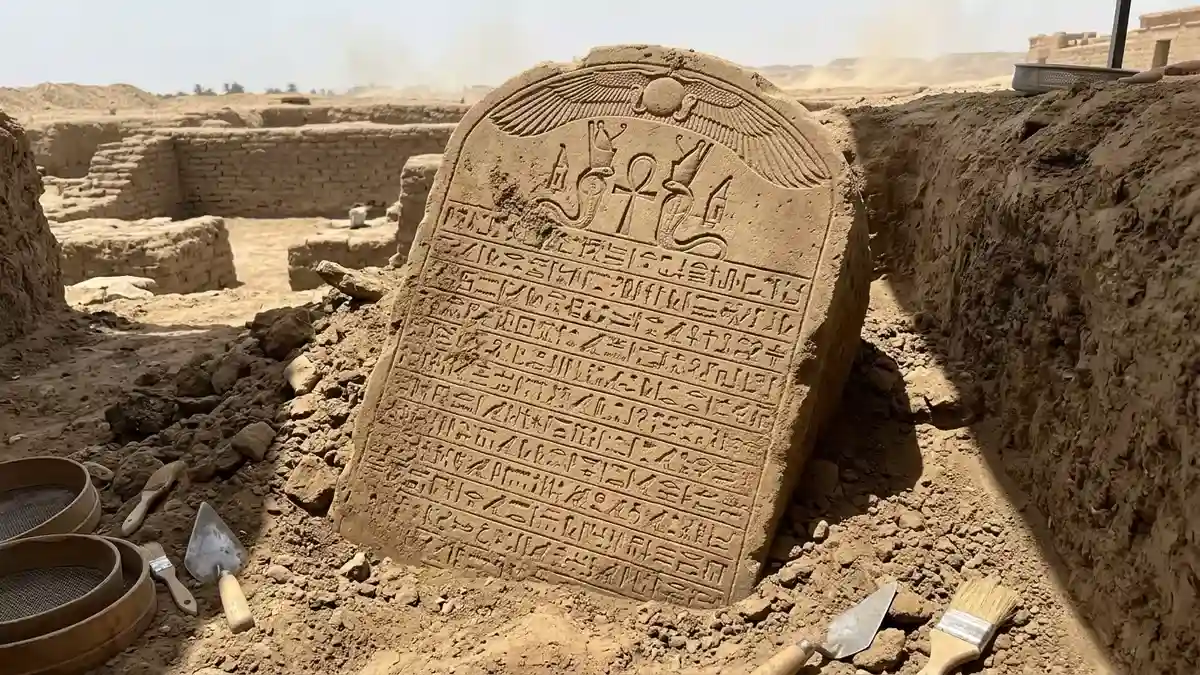
In a major archaeological breakthrough, an Egyptian research team has discovered a previously unknown and perfectly intact copy of the historic Canopus Decree, a royal edict dating back to 238 BCE. The stela was unearthed during excavations at the Tell El-Fara’in site, located in the city of El-Husseiniya within the Sharqia Governorate of the eastern Nile Delta.
This spectacular find marks the first time in over 150 years that a complete copy of this specific decree has been pulled from the Egyptian soil. It provides modern historians with an invaluable, unedited record of the political strategies, calendar reforms, and religious propaganda used by the Greek pharaohs to rule over ancient Egypt.
Complete Copy of the Canopus Decree Unearthed in Egypt After 150 Years
The Royal Proclamation at Canopus
The Canopus Decree was originally issued by King Ptolemy III Euergetes during a grand assembly of high-ranking priests in the ancient Mediterranean port city of Canopus, which today lies submerged just east of modern-day Alexandria. The decree was engineered to formally praise the king, his queen Berenice II, and their young daughter, celebrating their military victories, domestic political successes, and deep devotion to the native Egyptian gods.
 Ancient Protein Analysis Reveals All Homo naledi Skeletons From Rising Star Cave May Be Female
To ensure the entire population understood the message, copies of the text were ordered to be carved onto monumental stone slabs and erected in every top-tier temple across the length of Egypt.
                  [Ptolemy III Issues Edict at Canopus]
                                    │
       ┌────────────────────────────┴────────────────────────────┐
       ▼                                                         ▼
[Honor Royal Family Achievements]                         [Enforce Empire-Wide Calendar Reform]
       │                                                         │
       └────────────────────────────┬────────────────────────────┘
                                    ▼
                     [Carved onto Stone Stelae]
                                    │
                                    ▼
                     [Distributed to Major Temples]
                        (e.g., Tell El-Fara’in)
Prior to this discovery, archaeologists had uncovered only six complete or fragmented copies of the decree from historic sites such as Kom El-Hisn, San El-Hagar, and Tell Basta. However, those older discoveries are famous for being trilingual—written in Egyptian Hieroglyphs, everyday Demotic script, and ancient Greek (mirroring the linguistic layout of the later Rosetta Stone).
The newly discovered Tell El-Fara’in stela is completely unique: it is inscribed entirely in hieroglyphs. This uniform text gives linguists and epigraphers a pristine opportunity to study Ptolemaic court administration, religious theology, and language evolution from a purely native Egyptian perspective, free from Greek translations.
Anatomy of the Sandstone Stela
Carved from a solid block of dense sandstone, the newly recovered monument features impressive structural dimensions:
Height: 127.5 centimeters (approximately 4.2 feet)
Width: 83 centimeters (approximately 2.7 feet)
Thickness: Approximately 48 centimeters (approximately 1.5 feet)

The craftsmanship of the stone carving is moderate in quality, yet the characters remain exceptionally sharp and highly legible. The rounded top of the stela features a classic piece of Egyptian religious iconography: a beautifully sculpted winged solar disk. Flanking the disk are two uraei—royal cobras—wearing the iconic White and Red Crowns representing the unified territories of Upper and Lower Egypt.
Inscribed precisely between the two cobras are the hieroglyphic symbols for “Di Ankh”, which translates literally to “He who gives life”. Spilling down directly beneath this protective heavenly crest are 30 neat lines of deeply etched hieroglyphic text detailing the exact terms of the royal decree.
Leap Years, Tax Breaks, and Living Gods
The text of the Canopus Decree provides a vivid look into how the Ptolemaic court blended administrative logic with divine authority. The 30 lines of text document several major imperial actions:
1. The Leap Year Mandate
The decree enforces one of the earliest documented leap-year systems in human history. To prevent the traditional 365-day Egyptian civil calendar from drifting out of alignment with the natural solar seasons and critical religious festivals, the decree commanded that a single extra day be added to the calendar every four years.
2. Economic Relief
The text solidifies the pharaoh’s popularity among the working class by documenting generous royal donations to local temples and detailing sweeping tax cuts and debt remissions distributed during years when the annual Nile River inundation failed to flood the agricultural fields.
3. Star-Driven Festivals & Deification
It outlines the creation of an elaborate new religious festival centered around the heliacal rising of the star Sirius (known to the Egyptians as Sopdet). Furthermore, the decree officially deifies King Ptolemy III, Queen Berenice II, and their deceased daughter, elevating them to the status of living gods and establishing an entirely new branch of the priesthood dedicated exclusively to their worship.
Re-establishing the Importance of Tell El-Fara’in
The discovery site itself, Tell El-Fara’in, was anciently known as Imet. It served as a vital geopolitical hub during the Middle Kingdom and retained its immense strategic value centuries later under the Ptolemaic pharaohs.
Previous excavations at the site have exposed the foundations of monumental stone temples and elite aristocratic residences, including a sprawling temple complex dedicated to Wadjet, the ancient cobra goddess and primordial protector of Lower Egypt.
The discovery of this pristine copy of the Canopus Decree at Tell El-Fara’in proves that even during the late Greek-ruled eras of Egyptian history, this Nile Delta outpost remained an influential powerhouse of political administration and religious authority. It expands the rare global corpus of Ptolemaic decrees and offers modern scholars an unparalleled window into one of the ancient world’s most complex, cosmopolitan empires.
Frequently Asked Questions
What is the Canopus Decree?
The Canopus Decree is an ancient royal edict issued in 238 BCE by Pharaoh Ptolemy III Euergetes. It was created to praise the achievements of the royal family, secure the loyalty of the powerful Egyptian priesthood, and implement major administrative changes across the empire.
Why is this new discovery significant?
This is the first complete copy of the Canopus Decree found in more than 150 years. Unlike previously discovered copies, which were written in three different scripts (Hieroglyphic, Demotic, and Greek), this new stela is carved entirely in Egyptian hieroglyphs, providing an unedited look at the native language of the era.
Where exactly was the stela found?
The monument was unearthed by an Egyptian archaeological team at the Tell El-Fara’in site (anciently known as Imet), located in the city of El-Husseiniya within the Sharqia Governorate of the eastern Nile Delta.
How did the decree change the ancient calendar?
The decree introduced one of the world’s first formal leap-year corrections. It ordered that an extra day be added to the traditional 365-day calendar every four years, ensuring that seasonal agricultural cycles and religious holidays remained perfectly synced with the solar year.
What does the imagery on top of the stela mean?
The top of the sandstone slab features a winged solar disk and two royal cobras wearing the traditional crowns of Upper and Lower Egypt. It also features the hieroglyphic inscription “Di Ankh” (“He who gives life”), which served to legitimize the pharaoh’s divine right to rule.