
Table of Contents
- 1. Science in the Foundry: The Multi-Proxy Approach
- 2. Mapping the Bronze Age Supply Chain
- 2.1. The Copper Sourcing
- 2.2. The Tin Conundrum
- 3. Biography of a Statuette: Continuous Melting and Mixing
- 4. Horned Helmets and Scandinavian Connections
- 5. Frequently Asked Questions
- 5.1. What are Nuragic bronzetti?
- 5.2. How did scientists determine where the metals came from?
- 5.3. Where did the copper and tin originate?
- 5.4. Did the Nuragic people trade with the Middle East for metal?
- 5.5. Why do these figurines look similar to artifacts found in Scandinavia?
Sardinian Figurines Reveal Bronze Age Metal Trade and Wide Connections
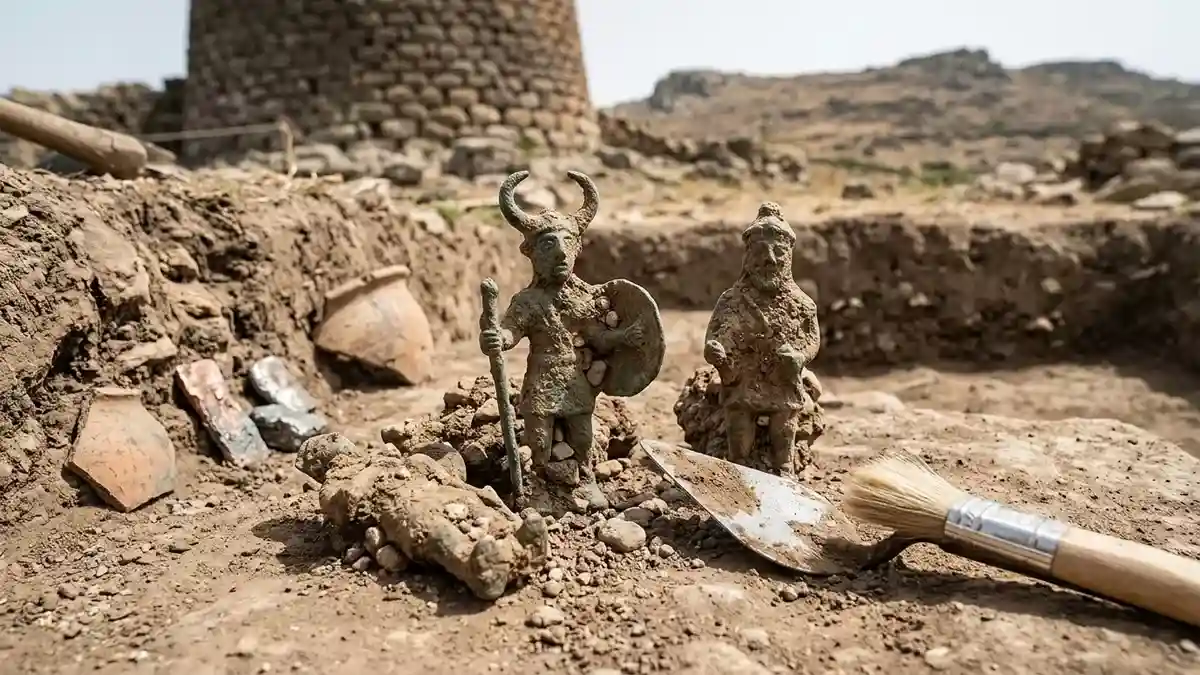
The ancient Mediterranean was far more connected than standard histories often suggest. During the early first millennium BCE, the mysterious Nuragic civilization of Sardinia left behind an landscape dotted with over 7,000 massive stone towers called nuraghi. Yet, alongside these architectural giants, they crafted delicate, 10-centimeter-tall bronze statuettes—known as bronzetti—depicting horned warriors, chieftains, animals, and gods.
For decades, the exact source of the metals used to cast these iconic figurines remained a fierce archaeological debate. Now, a groundbreaking international study published in the journal PLOS ONE has finally tracked the molecular origins of the artifacts.
By employing an innovative multi-isotope testing method, an interdisciplinary research team has proven that Sardinia was not a remote outpost, but rather a bustling, highly influential metallurgical hub. The island actively gathered raw materials from across Europe and the Iberian Peninsula, weaving together global trade networks that stretched all the way to Scandinavia.
Sardinian Figurines Reveal Bronze Age Metal Trade and Wide Connections
Science in the Foundry: The Multi-Proxy Approach
To solve the metallurgical mystery of the bronzetti, scientists analyzed 48 figurines recovered from prominent Nuragic sanctuaries, including Abini, Santa Vittoria, and Su Monte. Previous studies struggled to pinpoint where the metals were mined because ancient smiths frequently melted down and recycled old scrap metal, blending different chemical signatures together.
To cut through this confusion, the Curt-Engelhorn Center for Archaeometry in Germany developed a cutting-edge “multi-proxy” approach. Instead of relying on basic chemical testing, researchers combined standard analysis with a highly complex matrix of isotope ratios, tracking four distinct elements simultaneously:
Copper ($\text{Cu}$) and Lead ($\text{Pb}$) isotopes to map regional Mediterranean mines.
Tin ($\text{Sn}$) isotopes to track the elusive sourcing of bronze hardening agents.
Osmium ($\text{Os}$) isotopes, applied here for the absolute first time in bronzetti research.
The inclusion of osmium acted as a definitive geological fingerprint. It allowed the team to completely rule out popular alternative theories that suggested the Nuragic people were importing their copper from wealthy Levantine mining hubs like Timna in Israel or Faynan in Jordan.
Mapping the Bronze Age Supply Chain
The isotopic data exposed a highly organized, dual-sourcing strategy. The Nuragic artisans relied heavily on their own rich island resources while simultaneously managing volatile, long-distance maritime trade routes to fulfill their industrial demands.
The Copper Sourcing
The vast majority of the copper used to cast the figurines originated locally within southwest Sardinia, extracted from the historic Sa Duchessa mine in the Iglesiente-Sulcis district. However, the tests also detected a significant secondary copper stream flowing straight from the Iberian Peninsula—specifically from the Alcudia Valley and Linares mining districts of modern-day Spain.
The Tin Conundrum
While copper is easily found on Sardinia, turning it into durable bronze requires mixing it with roughly 10% tin. Remarkably, even though Sardinia possesses its own natural tin and lead veins, the tested figurines showed absolutely zero traces of local Sardinian tin.
[Iberian Peninsula / Cornwall Mines] ──► Imported Tin ──┐
                                                       ├──► Nuragic Foundries ──► Crafted Bronzetti
[Local Sa Duchessa Mine, Sardinia]  ──► Local Copper ──┘
Instead, every single milligram of tin used to create the bronzetti had to be imported from distant foreign shores. The chemical signatures point directly to mining operations in the Iberian Peninsula, with strong secondary links suggesting trades reaching as far as Cornwall in Great Britain, the Saxon-Bohemian Erzgebirge mountains of Central Europe, or even deep territorial deposits in Egypt.
Biography of a Statuette: Continuous Melting and Mixing
The research went beyond geographic tracking, revealing the intimate “fabrication biographies” of the individual figurines. The data shows that the bronzetti were rarely cast in single, uniform batches of freshly mined ore.
Instead, Nuragic metalworkers were continuously mixing distinct batches of copper and tin over long periods. In many instances, a single figurine contains metals from multiple different geographic origins blended together.
This continuous blending may have been a deliberate metallurgical choice, as adding specific ratios of foreign metals allowed smiths to alter the final color, fluidity, and durability of the molten bronze. Alternatively, it reflects the realities of a bustling local marketplace, where artisans simply melted down whatever recycled bronze scrap, foreign coins, or imported ingots were readily available on any given day.
Horned Helmets and Scandinavian Connections
The far-reaching metal trade networks highlighted by the study mirror a fascinating cultural phenomenon: striking stylistic parallels between Nuragic art and the cultures of northern Europe.
The bronzetti frequently depict warriors sporting distinct, elongated horned helmets and executing an open, welcoming hand gesture. This exact visual iconography appears dynamically in Late Bronze Age rock carvings and large bronze artifacts discovered thousands of miles away in southern Scandinavia—most famously exemplified by the iconic twin horned helmets unearthed at Viksø, Denmark.
These shared symbolic motifs suggest that the maritime trade routes fueling Sardinia’s foundries weren’t just moving heavy blocks of raw metal. They were active information superhighways, carrying deep spiritual beliefs, war fashions, and shared cultural mythologies across the entire expanse of prehistoric Europe.
Frequently Asked Questions
What are Nuragic bronzetti?
Bronzetti are small bronze statuettes, typically around 10 centimeters tall, crafted by the Nuragic civilization of Sardinia during the early first millennium BCE. They depict a wide array of subjects, including chieftains, warriors with horned helmets, animals, and various deities.
How did scientists determine where the metals came from?
An international research team used a advanced “multi-proxy” isotopic analysis at the Curt-Engelhorn Center for Archaeometry. By testing the specific isotope ratios of copper, tin, lead, and osmium within the bronze, they were able to match the metal directly to specific ancient mining regions.
Where did the copper and tin originate?
The copper was primarily mined locally in southwest Sardinia at the Sa Duchessa mine, though some was imported from Spain. Surprisingly, all of the tin used to harden the copper into bronze was imported from foreign sources, including the Iberian Peninsula, Cornwall in Britain, or Central Europe.
Did the Nuragic people trade with the Middle East for metal?
No. The innovative use of osmium isotope testing allowed researchers to completely rule out the Levant (modern-day Israel and Jordan) as a copper source, disproving older theories that suggested a heavy reliance on Middle Eastern mines.
Why do these figurines look similar to artifacts found in Scandinavia?
Sardinian bronzetti feature warriors wearing horned helmets that closely match spectacular Bronze Age discoveries found in Denmark and Sweden. This suggests that the extensive trade routes used to move metal also facilitated the exchange of cultural ideas, religious symbols, and artistic styles across Europe.