
Table of Contents
- 1. The Turbulent Journey of the Margaret Island Remains
- 2. Overcoming the “Freshwater Reservoir Effect”
- 3. The Genetic Fingerprint of Two Power Dynasties
- 4. Forensic Reconstruction of a Political Ambush
- 5. Frequently Asked Questions
- 5.1. Who was Béla, Duke of Macsó?
- 5.2. Where were his remains originally found?
- 5.3. Why did scientists think the bones were lost?
- 5.4. What is the “freshwater reservoir effect” mentioned in the study?
- 5.5. How did forensics prove he was assassinated?
DNA Identifies Assassinated 13th-Century Duke, Solving Royal Cold Case
A fascinating combination of advanced genomics, forensic pathology, and historical detective work has finally solved a century-old mystery in Eastern European history. An international team of scientists has officially confirmed the identity of skeletal remains discovered more than 100 years ago on Budapest’s Margaret Island.
The bones belong to Béla, Duke of Macsó, a prominent 13th-century aristocrat who carried the royal bloodlines of both the Hungarian Árpád dynasty and the Eastern European Rurik dynasty. Published in the journal Forensic Science International: Genetics, the interdisciplinary study not only puts a definitive name to a long-lost skeleton but also reconstructs the terrifying, brutal reality of his politically motivated assassination.
DNA Identifies Assassinated 13th-Century Duke, Solving Royal Cold Case

The Turbulent Journey of the Margaret Island Remains
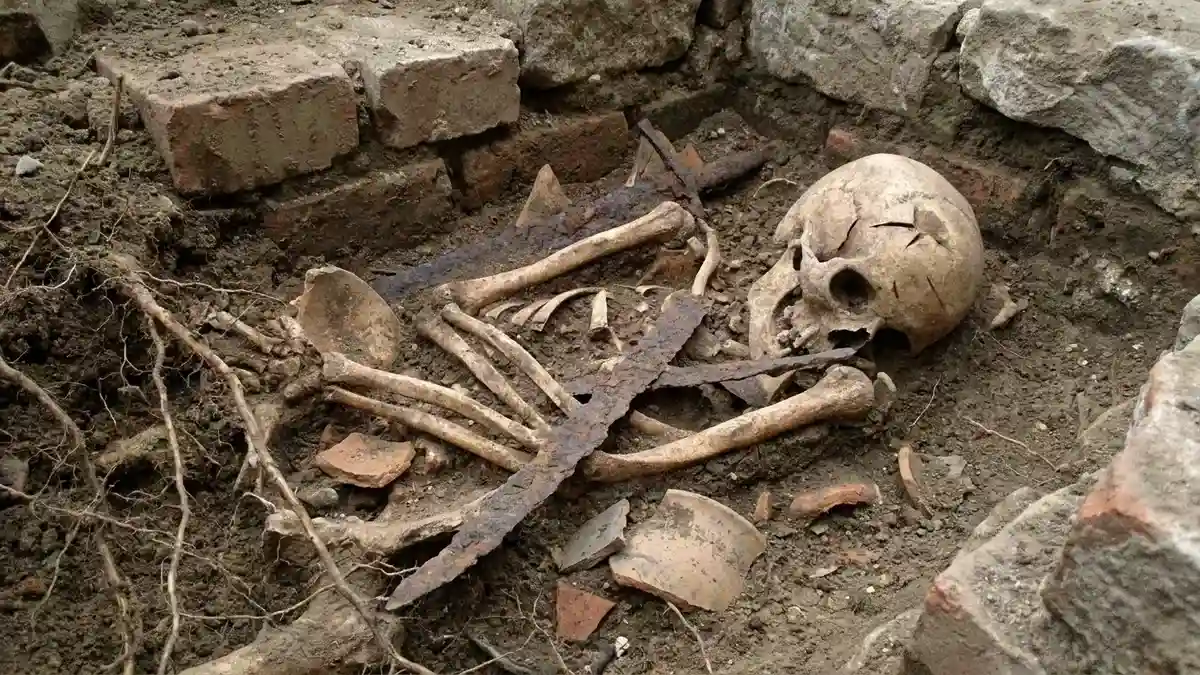
The path to identifying Duke Béla has been nearly as chaotic as his short life. His skeletal remains were first unearthed in 1915 during archaeological excavations at the ruins of a 13th-century Dominican monastery on Margaret Island.
[1915: Discovery] ──> [WWII: Missing/Lost] ──> [2018: Rediscovered] ──> [2026: Identification]
Early 20th-century researchers immediately suspected the bones belonged to the infamous Duke Béla, who historical chronicles noted was brutally murdered in 1272 at the young age of 25. However, before advanced scientific testing could be performed, the bones were archived, left unstudied for decades, and eventually cataloged as completely lost during the destruction of World War II.
The cold case was unexpectedly blown wide open in 2018 when the mislabeled skeletal elements suddenly resurfaced across various university and museum storage collections. This miraculous rediscovery prompted a massive, multi-institutional investigation uniting geneticists, anthropologists, dentists, and radiocarbon dating experts.
Overcoming the “Freshwater Reservoir Effect”
When scientists first subjected the bones to standard radiocarbon dating, the results returned a timestamp significantly older than the duke’s recorded 1272 death. Rather than discarding the skeleton, the team analyzed the chemical signatures preserved within the bone matrix using stable isotope analysis.
The testing revealed that the young duke enjoyed an incredibly high-status, luxury diet packed with freshwater fish and aquatic proteins harvested from the Danube River. This heavy seafood intake introduced what archaeologists call the freshwater reservoir effect—a phenomenon where old carbon from aquatic ecosystems incorporates into human bone tissue, artificially inflating its radiocarbon age. Once the team mathematically corrected for this dietary distortion, the timeline aligned perfectly with the mid-13th century.
       [DIETARY AND ISOTOPIC PROFILE OF THE DUKE]
                           │
   ┌───────────────────────┴───────────────────────┐
   ▼                                               ▼
Dental Tartar Analysis                  Stable Isotope Mapping
• Microscopic wheat particles           • Early childhood spent in
• Fine barley and semolina flour          modern Serbia and Croatia
• Reflects an elite medieval diet       • Matches historical Macsó Banat
Further confirmation of his elite lifestyle came from microscopic dental tartar analysis. Trapped within his teeth were thousands of ancient food particles, revealing a refined medieval diet rich in specialized wheat, barley, bread, and semolina. Furthermore, geographical isotope mapping proved the individual spent his earliest childhood years in the region of modern-day Serbia and Croatia—the exact territory of the historical Macsó Banat—before relocating to the central Hungarian royal courts just as family records indicated.
The Genetic Fingerprint of Two Power Dynasties
The absolute definitive proof of identity came down to pioneering whole-genome sequencing. The geneticists successfully extracted clean ancient DNA from the centuries-old bones, mapping both sides of the individual’s family tree.
| Lineage Axis | Genetic Signature | Historical Link |
| Paternal Ancestry | Significant Scandinavian Component | Matches the Rurik Dynasty of Eastern Europe |
| Maternal Ancestry | Direct Y-Chromosome / Nuclear Line | Confirmed descendant of King Béla III of Hungary |
This dual genetic match conclusively proves the skeleton’s royal identity, making Duke Béla one of only a small handful of medieval European nobles in history to be completely and irrefutably identified through modern archaeogenetics.
Forensic Reconstruction of a Political Ambush
With his identity secured, forensic pathologists turned their attention to the skeleton’s extensive trauma to reconstruct the duke’s final moments. The physical evidence written into his bones reveals an incredibly high-intensity, personal, and coordinated assault.
Forensic teams mapped a total of 26 distinct sharp-force injuries inflicted across the skull and skeleton right at the time of death. The varying shapes and depths of the cut marks prove that the duke was simultaneously ambushed by at least three separate assailants wielding different classes of specialized swords.
                  [THE ANATOMY OF A MEDIEVAL HIT]
                                  │
                                  ▼
                     1. DEFENSIVE WOUNDS ON ARMS
                  (Duke fights back against ambush)
                                  │
                                  ▼
                   2. HEAVY SYSTEMIC BLOWS TO BODY
                     (Victim is overwhelmed & falls)
                                  │
                                  ▼
                   3. OVERKILL STRIKES TO HEAD/FACE
                 (Assailants finish the political hit)
The location of several deep cuts on his arm bones shows that Béla attempted to defend himself, parrying the initial waves of sword strikes. However, once he was overwhelmed and knocked to the stone floor, the killers showed no mercy. The team identified an extreme pattern of “overkill” focused entirely on his face and cranium, with multiple fatal blows delivered to crush his head after he was already incapacitated.
The sheer violence and coordination of the attack perfectly corroborate medieval written chronicles, which described the young duke’s death not as a casual brawl, but as a meticulously planned, cold-blooded political assassination designed to eliminate a powerful claimant to the throne. This landmark study bridges the gap between historical literature and biological reality, bringing vibrant clarity to a royal murder plot executed over 700 years ago.
Frequently Asked Questions
Who was Béla, Duke of Macsó?
Béla was a prominent 13th-century medieval noble related to two of Eastern Europe’s most powerful ruling lines: the Hungarian Árpád dynasty and the Scandinavian-rooted Rurik dynasty. He was assassinated in 1272 at approximately 25 years of age.
Where were his remains originally found?
His bones were first discovered in 1915 during excavations of a ruined 13th-century Dominican monastery located on Margaret Island in Budapest, Hungary.
Why did scientists think the bones were lost?
Following their discovery in 1915, the bones remained unstudied. During the disruptions and destruction of World War II, the remains were misplaced and officially considered lost until they unexpectedly resurfaced in various museum and university collections in 2018.
What is the “freshwater reservoir effect” mentioned in the study?
It is a chemical anomaly that occurs when an individual consumes large amounts of river fish or aquatic proteins. The old carbon present in the water system gets absorbed into the bones, causing standard radiocarbon dating tests to make the skeleton appear centuries older than it actually is.
How did forensics prove he was assassinated?
Forensic analysis revealed 26 sharp-force sword wounds across the skeleton. The tool marks indicate at least three separate attackers using different swords struck him simultaneously, continuing to deliver brutal, fatal blows to his face and skull even after he had fallen to the ground.