
Table of Contents
- 1. The Discovery of Zimapán Man
- 1.1. The Natural Mummification Process
- 1.2. An Elite Otopame Funerary Bundle
- 2. Decoding the Ancient Microbiome via 16S rRNA Sequencing
- 2.1. Modern Matches and Andean Connections
- 2.2. A Historic Milestone: Finding Romboutsia hominis
- 3. Disproving Contamination and Mapping the Ancient Diet
- 3.1. Reconstructing a Hunter-Gatherer Menu
- 4. Culturing the Past: Why This Mummy Matters
- 5. Frequently Asked Questions
- 5.1. Who was the Zimapán man?
- 5.2. How did his body become a mummy?
- 5.3. What is 16S rRNA-gene sequencing?
- 5.4. What did the mummy’s gut bacteria reveal about his diet?
- 5.5. What is Romboutsia hominis and why is its discovery important?
1,000-Year-Old Mesoamerican Mummy Sheds Light on the Ancient Human Gut
Deep within a dry, isolated cave in central Mexico, the naturally preserved remains of a man who lived a millennium ago have provided scientists with an extraordinary look into the past. This isn’t just a story about ancient bones and funerary wrappings; it is a breakthrough that reveals the ancient human microbiome—the intricate community of bacteria that once thrived inside his digestive tract.
The groundbreaking study, published in the scientific journal PLOS ONE, offers an unprecedented glimpse into the inner biological world of pre-Hispanic Mesoamericans centuries before European contact. By studying these microscopic hitchhikers, researchers are beginning to understand how human health, diet, and biology have co-evolved over the last thousand years.
1,000-Year-Old Mesoamerican Mummy Sheds Light on the Ancient Human Gut
The Discovery of Zimapán Man
The mummy, affectionately dubbed the “Zimapán man” (and historically referred to as Hna Hnu), was discovered in the arid region of Zimapán, Mexico. This unique geographic zone marks the ancient ecological borderlands between Mesoamerica—known for its grand agricultural civilizations—and Aridoamerica, a harsher, dryer region dominated by nomadic hunter-gatherers.
The Natural Mummification Process
Unlike the artificial embalming techniques practiced in ancient Egypt, the Zimapán man became a mummy entirely through natural processes. The cave’s exceptionally dry, stable, and sheltered climate caused his body tissues to dehydrate rapidly after death, halting the typical process of decomposition. This natural preservation locked his physical features, internal organs, and even his last meals in place for ten centuries.
An Elite Otopame Funerary Bundle
The physical context of the burial suggests that the Zimapán man was a highly respected member of his society, likely belonging to the Otopame culture—an ancient group of hunter-gatherers and semi-nomadic peoples who managed the border zones.
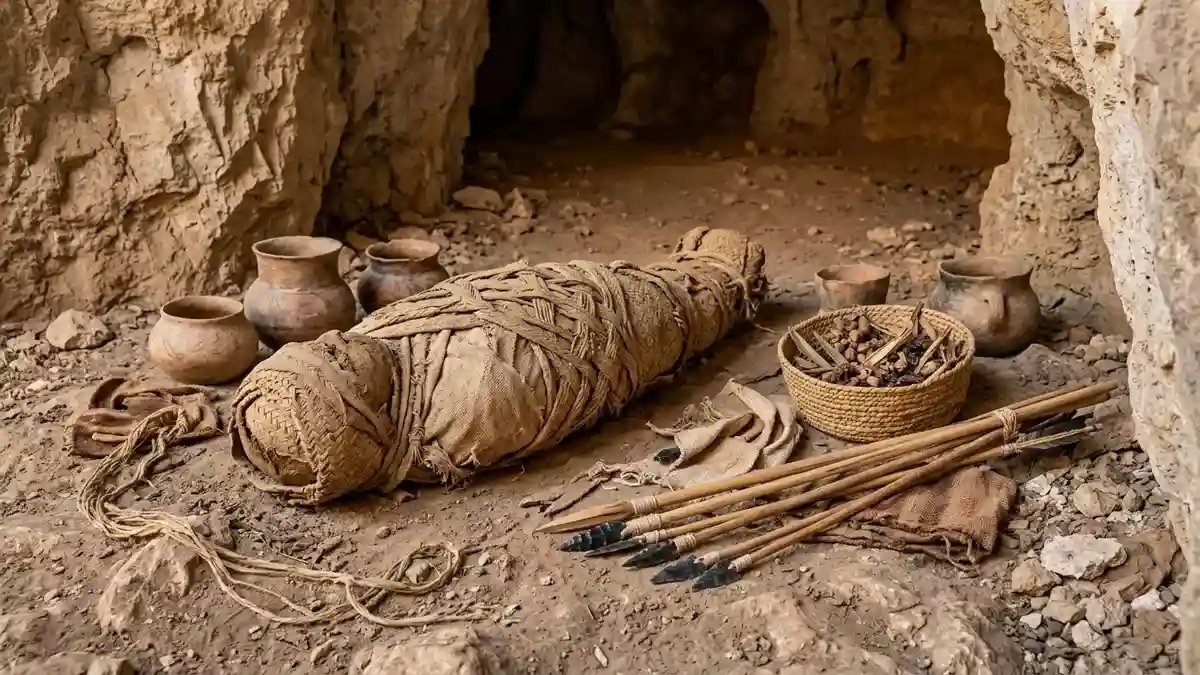
His community prepared his body with immense ritual care, wrapping him in an elaborate, mathematically knotted funerary bundle. The body was carefully enveloped in multiple layers of thick maguey fiber mats and finely woven cotton textiles. This high level of craftsmanship and investment of resources reflects a deep sense of respect and ceremonial honor surrounding his passing.
Decoding the Ancient Microbiome via 16S rRNA Sequencing
To peer inside the mummy’s digestive system, a research team led by Santiago Rosas-Plaza from the National Autonomous University of Mexico utilized advanced genetic technology. They extracted and analyzed samples from both the mummy’s internal intestinal tissue and preserved fossilized feces, known scientifically as paleofeces.
The team deployed a cutting-edge laboratory technique called 16S rRNA-gene sequencing. This powerful method acts as a genetic scanner, reading and identifying fragmented bits of bacterial DNA left behind in the ancient tissues. By cataloging these genetic barcodes, the scientists were able to reconstruct an accurate census of the exact microbial families that inhabited the man’s gut during his lifetime.

Modern Matches and Andean Connections
The genetic results revealed a fascinating mix of the familiar and the evolutionary. The Zimapán mummy’s gut contained several major bacterial families that remain incredibly common in modern human digestive tracts today, including:
Peptostreptococcaceae
Enterobacteriaceae
Enterococcaceae
Clostridiaceae
Interestingly, the high prevalence of Clostridiaceae closely mirrors the microbiome profiles found in ancient mummies excavated thousands of miles away in the Andean regions of South America. This cross-continental similarity suggests that ancient pre-Hispanic populations shared similar environmental exposures or basic dietary structures.
A Historic Milestone: Finding Romboutsia hominis
The absolute highlight of the genetic analysis was the identification of Romboutsia hominis. While this specific bacterial species is a known resident in the intestines of living, modern humans, it had never before been detected in an ancient microbiome sample.
Finding Romboutsia hominis in a 1,000-year-old mummy provides crucial data for the study of microbial evolution. It proves that this specific bacterium has maintained a continuous, unbroken partnership with the human body for at least a millennium, surviving massive shifts in global human history, diets, and environments.
Disproving Contamination and Mapping the Ancient Diet
Whenever scientists study ancient DNA, the threat of modern contamination is a major concern. Microbes from the surrounding cave soil, handling by excavators, or modern compost could easily skew the results.
To ensure absolute accuracy, the research team conducted rigorous multivariate statistical comparisons. They tested the bacterial composition of the mummy against soil samples taken from the immediate burial environment. The results showed that the Zimapán man’s microbiome was completely distinct from the cave dirt, confirming that the genetic data belonged uniquely to the ancient individual’s biology.
Reconstructing a Hunter-Gatherer Menu
While the exact medical cause of the Zimapán man’s death remains unknown, his inner microbes provided vivid clues about his daily diet. Several of the dominant bacteria identified in his gut are specialized agents responsible for breaking down tough plant fibers and chitin—the crunchy structural material that forms insect exoskeletons.
Based on this microbial signature, scientists can deduce that his diet relied heavily on:
Fibrous Wild Plants: Local flora such as agave, yucca, and prickly pear cactus.
Insect-Based Protein: Various regional insects, which provided a reliable, dense source of protein and fat.
This specific digestive profile aligns perfectly with the seasonal, semi-nomadic hunter-gatherer lifestyle that archaeologists have long mapped out for the ancient peoples of Aridoamerica.
Culturing the Past: Why This Mummy Matters
This study stands as the very first detailed, high-resolution reconstruction of an ancient microbiome from this specific region of Mexico, and it is one of only a handful available for the broader Mesoamerican continent.
By adding the Zimapán man’s genetic data to the global database—which currently includes famous specimens like Ötzi the Tyrolean Iceman from the European Alps and elite ancient Incan mummies from Peru—scientists can trace the grand timeline of human internal evolution. It helps highlight how the modernization of our diets, the rise of industrial agriculture, and the introduction of antibiotics have radically altered the internal ecosystems of modern humans compared to our ancestors.
Simultaneously, ongoing museum restoration efforts are working to stabilize and preserve the delicate maguey fibers and cotton textiles of the mortuary bundle. Soon, the physical garments of the Zimapán man will be put on public display, offering modern audiences a tangible connection to a human life, a unique culture, and an internal microbial world that survived in the total silence of a Mexican cave for a thousand years.
Frequently Asked Questions
Who was the Zimapán man?
The Zimapán man was an individual who lived approximately 1,000 years ago along the borderlands of Mesoamerica and Aridoamerica in modern-day central Mexico. He is believed to have belonged to the Otopame culture, a group of semi-nomadic hunter-gatherers.
How did his body become a mummy?
His body was mummified naturally due to the dry, stable, and sheltered climate conditions inside the cave where he was buried. The environment rapidly dehydrated his tissues before bacteria could cause decomposition.
What is 16S rRNA-gene sequencing?
It is an advanced molecular biology technique used by scientists to identify and catalog different types of bacteria. By sequencing a specific region of bacterial DNA, researchers can determine exactly which microbial species are present in a sample.
What did the mummy’s gut bacteria reveal about his diet?
The presence of specific bacteria that break down tough plant fiber and insect tissues indicates that he survived on a classic hunter-gatherer diet. This likely included regional desert plants like agave, yucca, and prickly pear, supplemented by insects for protein.
What is Romboutsia hominis and why is its discovery important?
Romboutsia hominis is a type of bacterium found in modern human intestines. Its discovery inside the Zimapán mummy marks the first time it has ever been found in ancient human remains, proving that this microbe has lived symbiotically inside humans for at least 1,000 years.