
Table of Contents
**4,000-Year-Old Kerma Burial Discovered in Sudan**
Archaeologists working in Sudan’s remote Bayuda Desert have uncovered a remarkably preserved 4,000-year-old grave from the powerful Kerma civilization, offering fresh insights into ancient Nubian life, death rituals, and environmental conditions along the Nile. This significant find, dating to around 2000 BCE, illuminates the daily realities and spiritual beliefs of a man who lived during the height of one of Africa’s earliest complex societies.
The discovery highlights the resilience of Kerma culture, a Nubian kingdom that flourished between 2500 and 1500 BCE, rivaling early Egyptian influence in the region. Polish researchers have been steadily revealing these hidden stories through systematic excavation.
4,000-Year-Old Kerma Burial Discovered in Sudan
### A Window into Ancient Nubian Society
The Kerma period represents a golden age for Nubian civilization in what is now Sudan. Centered along the Nile, these communities developed sophisticated social structures, advanced pottery traditions, and strong economic ties based on trade, herding, and agriculture. While much attention has focused on larger royal tombs and temples, individual burials like this one provide intimate details about ordinary people who formed the backbone of the kingdom.
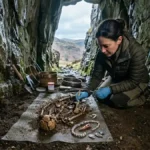
This particular grave comes from ongoing fieldwork by a team led by Henryk Paner of the Polish Centre of Mediterranean Archaeology at the University of Warsaw. For over six years, the researchers have conducted intensive surveys and excavations in central Sudan, building on limited earlier work from the mid-20th century. Their latest results, published in *Azania: Archaeological Research in Africa*, add valuable data to our understanding of funerary practices during this dynamic era.
 20 Interesting Books About Archaeology
### The Man in the Grave: Life of Hard Work
Osteological examination reveals the deceased was a man between 30 and 40 years old at the time of death. Standing slightly over 164 centimeters (about 5 feet 4 inches) tall, he possessed a robust, muscular build shaped by demanding physical activity. Bone stress markers indicate years of heavy labor, likely involving herding livestock, manual construction, or agricultural work in the challenging semi-desert environment.
Animal remains found at the site suggest close daily interaction with cattle and other livestock, a cornerstone of Kerma economy. His limited diet, inferred from skeletal evidence, reflects the realities of life on the edge of the Nile Valley—where resources could be unpredictable despite the river’s proximity.

Such details humanize the past, showing that even in a prosperous kingdom, many individuals endured physically taxing lives to support their communities.
### Unique Burial Customs of the Kerma Period
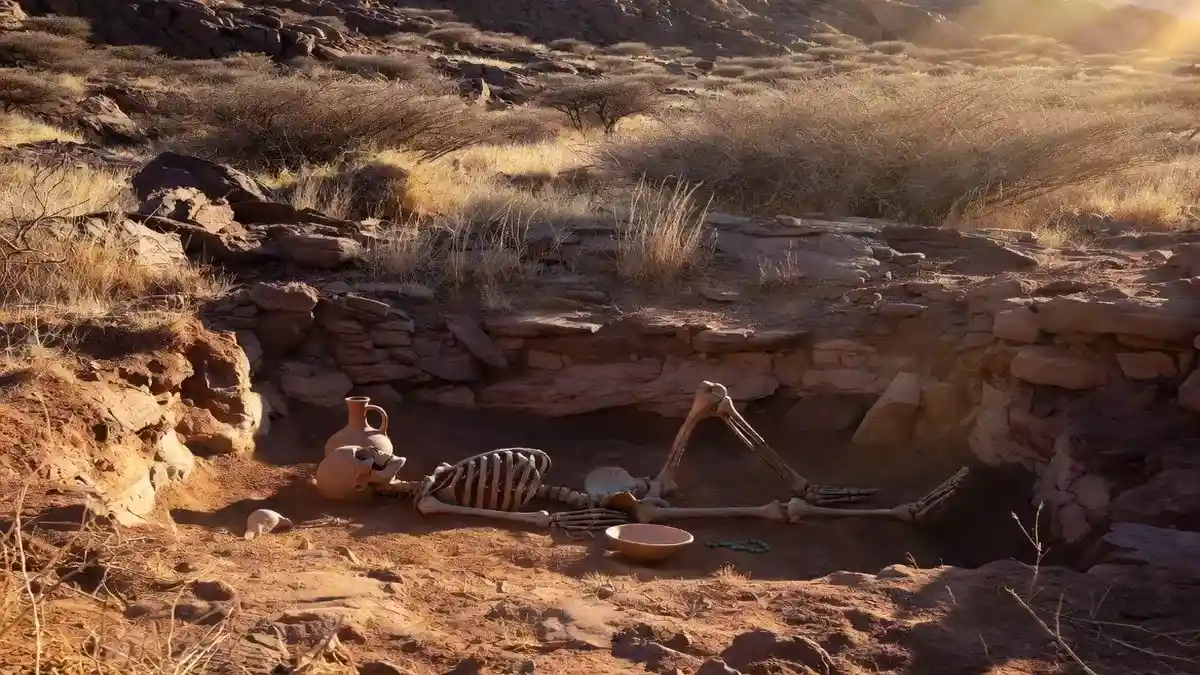
The grave itself was a shallow, roughly oval pit shaped by the rocky terrain. The body was positioned on its back, with the head oriented toward the east and slightly north—a direction possibly linked to solar symbolism or ancestral beliefs common in Nubian traditions. His legs were sharply bent and turned to the right, with feet resting near the pelvic area. This distinctive flexed posture appears in other Kerma burials, indicating standardized ritual practices.
This careful arrangement suggests respect for the deceased and adherence to long-established customs. In Kerma society, how someone was buried reflected both personal status and broader cultural values. The choice of location on a cemetery hill further implies intentional placement within a recognized ancestral landscape.
**Tumulus from the Kerma period**, similar to structures associated with burials in the region, showcasing the architectural traditions of ancient Nubia.
### Rich Grave Goods and Ritual Offerings
Archaeologists recovered several meaningful artifacts placed with the body. Behind the deceased lay two handmade ceramic vessels: a medium-sized jug with a spout positioned near ground level and an inverted bowl. Near the neck area, 82 small faience beads—likely remnants of a necklace—were found, suggesting personal adornment for the afterlife.
The jug’s contents proved especially revealing. Inside were charred plant remains, fragments of animal bone, coprolites (fossilized dung), and beetle parts. Notably, the vessel itself showed no signs of burning, indicating the materials were collected from a hearth or fire after a ritual meal and deliberately deposited. The animal bones probably represent leftovers from a funeral feast shared by mourners before portions were symbolically offered to the dead.
Such practices reveal the social importance of pottery in Kerma burials. Vessels served not only as containers for food and drink offerings but also as symbols of identity and transition. Inverting a bowl or ritually damaging pottery may have signified the end of its earthly use, dedicating it exclusively to the deceased. These actions helped mourners process grief while reinforcing community bonds through shared ceremony.
### Environmental Context: A Greener Ancient Landscape
Today, the Bayuda Desert presents a harsh, open arid environment. However, environmental analysis of sediments and landscape features indicates that around 2000 BCE, the area supported a more hospitable savannah-like setting. Grasses, low shrubs, and scattered trees likely covered parts of the region, providing better grazing for livestock and supporting a richer ecosystem than exists today.
This climatic insight helps explain how Kerma communities sustained themselves and thrived. Gradual aridification over subsequent centuries would have posed increasing challenges, influencing migration patterns, economic strategies, and settlement decisions across Nubia.
By combining archaeological finds with paleoenvironmental data, researchers can reconstruct not just individual lives but entire landscapes and how people adapted to them.
### The Broader Significance for Nubian Archaeology
This single burial exemplifies the value of detailed, context-rich excavations. While royal Kerma tombs often capture public imagination with their scale and treasures, everyday graves like this one fill critical gaps in knowledge about non-elite members of society. They reveal labor patterns, dietary habits, ritual behaviors, and connections to the natural world that defined daily existence.
The Polish team’s long-term commitment to the Bayuda Desert is transforming our picture of ancient Sudan. Systematic research in the 21st century has moved beyond sporadic explorations, uncovering patterns across multiple sites and time periods. Each new find contributes to a more nuanced view of Nubia as a dynamic cultural powerhouse rather than a mere periphery of Egypt.
Kerma civilization’s influence extended far along the Nile, with sophisticated metallurgy, pottery production, and trade networks reaching into Africa and beyond. Understanding burials helps trace social hierarchies, gender roles, and belief systems that sustained this kingdom for over a millennium.
### Challenges of Working in the Bayuda Desert
Excavating in Sudan’s desert environments demands resilience. Extreme temperatures, remote locations, and shifting sands create logistical hurdles. Yet these conditions also preserve materials in ways that more humid regions cannot. The careful osteological and artifact analysis conducted in this project demonstrates the high standards of modern field archaeology.
Future studies may incorporate ancient DNA, isotopic analysis for mobility and diet, or advanced imaging to extract even more information from these remains and objects.
### Connecting Past and Present in Sudan
Discoveries like this 4,000-year-old grave strengthen cultural heritage awareness in Sudan and internationally. They remind us of Africa’s central role in human history and the sophisticated societies that developed independently along the Nile. For local communities, such finds foster pride and support efforts to protect archaeological sites from threats like development or climate change.
Globally, they contribute to discussions about early state formation, human adaptation to arid environments, and the diversity of ancient ritual practices. In an era when we face our own environmental challenges, insights from Kerma resilience offer perspective on sustainability and cultural continuity.
**Conclusion**
The excavation of a 4,000-year-old Kerma burial in Sudan’s Bayuda Desert provides a compelling portrait of ancient Nubian life, from the physical demands of daily labor to the spiritual rituals surrounding death. This well-documented grave, with its distinctive posture, ceramic offerings, and evidence of funeral feasts, enriches our knowledge of a remarkable civilization that shaped the Nile Valley for centuries.
Polish archaeologists continue to uncover these hidden chapters, proving that even a single burial can illuminate broader patterns of work, belief, and adaptation. As research expands, the people of ancient Kerma emerge not as distant figures but as relatable humans who navigated their world with ingenuity and reverence for tradition.
This discovery stands as a testament to the enduring power of archaeology to connect us across time, revealing the shared humanity that links past and present across continents.
**FAQ**
**Q: How old is the Kerma burial found in Sudan?**
A: The grave dates to approximately 4,000 years ago, around 2000 BCE, during the flourishing period of the Kerma civilization in ancient Nubia.
**Q: Who was buried in the grave?**
A: A man aged 30 to 40 who had a strong, muscular build from heavy physical labor. He stood about 164 cm tall and lived in close contact with livestock.
**Q: What artifacts were found with the body?**
A: Two ceramic vessels (a spouted jug and an inverted bowl), plus 82 faience beads from a necklace. The jug contained remains of a possible funeral meal.
**Q: What do the burial practices reveal about Kerma culture?**
A: They show standardized rituals including specific body positioning, pottery offerings, and symbolic acts like inverting vessels, highlighting the social and spiritual importance of funerals.
**Q: How did the ancient environment differ from today?**
A: Around 2000 BCE, the Bayuda Desert area was a greener savannah with grasses, shrubs, and trees, supporting herding and human settlement more easily than the current arid landscape.
**Q: Why is this discovery important for Nubian history?**
A: It provides rare details about non-elite individuals, labor, diet, and rituals, complementing knowledge from larger sites and demonstrating the value of systematic desert archaeology.
**Q: Who is leading the research in the Bayuda Desert?**
A: A Polish team from the University of Warsaw’s Polish Centre of Mediterranean Archaeology, led by Henryk Paner, conducting long-term fieldwork in central Sudan.
This important find continues to expand our appreciation for the complexity and achievements of ancient African civilizations along the Nile.