
Table of Contents
- 1. The Long Excavation of Heaning Wood Bone Cave
- 2. Pushing Back the Glacial Timeline
- 3. One Sacred Cave, Three Distinct Eras
- 4. Artifacts of the Stone and Bronze Ages
- 5. Moving Populations, Stationary Traditions
- 6. Frequently Asked Questions
- 6.1. What was life like for a child in Britain 11,000 years ago?
- 6.2. Why did the archaeologists name her the “Ossick Lass”?
- 6.3. How do scientists extract DNA from bones that are 11,000 years old?
- 6.4. What is Collared Urn pottery?
- 6.5. Can I visit Heaning Wood Bone Cave?
11,000-Year-Old Ice Age Girl Identified as Northern Britain’s Oldest Burial
A profound ancient DNA analysis has rewritten the prehistoric timeline of the British Isles, identifying the oldest human remains ever discovered in northern Britain. Genetic testing has revealed that a collection of fragmented bones found inside a remote Cumbrian cave belonged to a young girl who lived more than 11,000 years ago.
Dating to between 9290 and 8925 BCE, this child lived during the Early Mesolithic period (the Middle Stone Age)—an era when pioneering bands of humans were cautiously migrating back into the freezing wilderness of northern Europe following the retreat of the last massive Ice Age glaciers.
The interdisciplinary study, published in the Proceedings of the Prehistoric Society, provides an unprecedented glimpse into childhood, survival, and deep-seated spiritual traditions at the dawn of modern British history.
11,000-Year-Old Ice Age Girl Identified as Northern Britain’s Oldest Burial
The Long Excavation of Heaning Wood Bone Cave
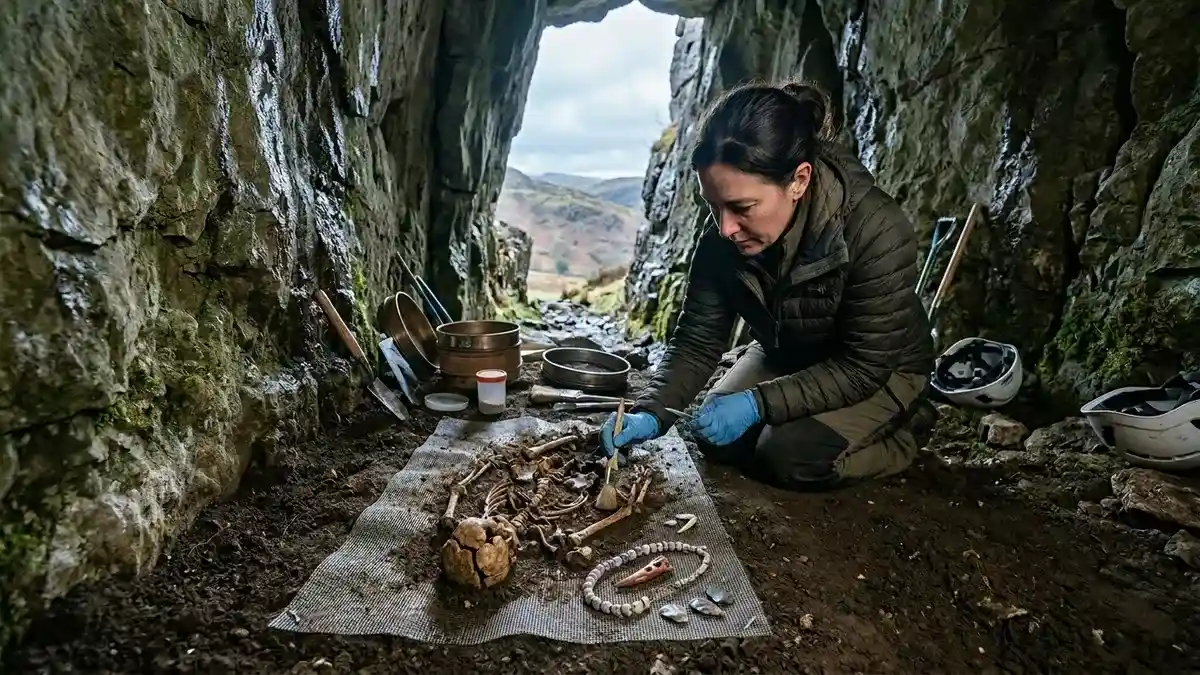
The discovery is the culmination of a decade of meticulous fieldwork. In 2016, local archaeologist Martin Stables began a careful, independent excavation of Heaning Wood Bone Cave, a narrow limestone fissure located near Great Urswick in Cumbria, England.
[Heaning Wood Bone Cave Profile]
├── Location: Great Urswick, Cumbria, UK
├── Discoverer: Martin Stables (Excavations began 2016)
├── Geography: Steep, vertical-entry limestone fissure
└── Significance: Oldest human burial site in Northern Britain
Sifting through centuries of dense sediment, Stables uncovered an array of human bones that spanned wildly different prehistoric eras. Recognizing the monumental value of the skeletal material, an international research team led by the University of Central Lancashire stepped in to extract and sequence ancient DNA trapped within the oldest fragments.
The genetic results were a revelation. The oldest individual was a biological female, aged between just 2.5 and 3.5 years old at her time of death. In a warm nod to local heritage, researchers and residents of the Cumbria region affectionately named her the “Ossick Lass”—using the traditional Cumbrian dialect word for a young girl from Urswick.
Pushing Back the Glacial Timeline
While earlier Ice Age and Mesolithic burials have occasionally been documented in the warmer climates of southern England and Wales, northern Britain’s archaeological record is famously sparse. During the height of the last Ice Age, massive moving walls of glacial ice scoured the northern English landscape, crushing prehistoric caves and grinding older fossil evidence into dust.
+-------------------------------------------------------------+
|            NORTHERN BRITAIN'S AGE REVOLUTION                |
+----------------------+--------------------------------------+
| Archaeological Site  | Confirmed Age of Human Remains       |
+----------------------+--------------------------------------+
| Kent’s Bank Cavern   | ~10,000 Years Old (Previous Record)  |
| Heaning Wood Cave    | ~11,000 Years Old (New Record Holder)|
+----------------------+--------------------------------------+
Prior to the sequencing of the Ossick Lass, the oldest verified human remains in the north belonged to a 10,000-year-old individual found at Kent’s Bank Cavern. By pushing the baseline back by an entire millennium, the Heaning Wood discovery proves that human hunting bands successfully reclaimed the rugged valleys of northern England far earlier than scientists previously deemed possible.
One Sacred Cave, Three Distinct Eras
One of the most striking revelations from the genomic study is that Heaning Wood Bone Cave was not a random emergency grave. Instead, it served as an intentional, highly revered communal burial site that was reused across thousands of years by entirely different cultures.
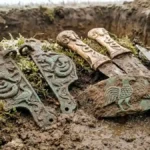
Skeletal forensic testing revealed that at least eight separate individuals were systematically interred inside the cave during three distinct, widely separated historical windows:
[The Three Historical Burial Windows of Heaning Wood]
├── Phase 1: Early Mesolithic (~11,000 Years Ago) ──> 1 Young Girl (Ossick Lass)
├── Phase 2: Early Neolithic  (~5,500 Years Ago)  ──> 4 Individuals (Farming Pioneers)
└── Phase 3: Early Bronze Age (~4,000 Years Ago)  ──> 2 Individuals (Pottery Craftsmen)
Intriguingly, out of all the successfully sampled individuals across all three eras, all but one were biologically female.
The physical layout of the bones indicates a continuous, shared approach to honoring the dead. Rather than digging up or scattering the old bones of previous generations, successive groups across thousands of years climbed the steep ridge to drop their recently deceased loved ones straight down into the cave’s vertical shaft entrance, allowing them to rest alongside the ancestors who came before.
Artifacts of the Stone and Bronze Ages
The physical items left behind inside the dark cave chambers perfectly mirror the distinct chapters of human migration passing through Cumbria.
+-------------------------------------------------------------+
|             THE ARTIFACT STRATIGRAPHY OF THE CAVE           |
+----------------------+--------------------------------------+
| Material Artifact    | Associated Era / Cultural Context    |
+----------------------+--------------------------------------+
| Perforated Periwinkle| Early Mesolithic (~11,000 years old) |
| Shell Beads          | Strung as jewelry for the young girl |
+----------------------+--------------------------------------+
| Pierced Deer Tooth   | Early Mesolithic hunter-gatherer     |
| Pendant              | status symbol or protective amulet   |
+----------------------+--------------------------------------+
| Flaked Flint Tools   | Early Neolithic (~5,500 years old)   |
|                      | Land-clearing agricultural axes      |
+----------------------+--------------------------------------+
| Collared Urn Pottery | Early Bronze Age (~4,000 years old)  |
| Shards               | Ceremonial vessels for cremation/burial|
+----------------------+--------------------------------------+
Buried in the exact same deep sediment layer as the Ossick Lass, archaeologists uncovered a series of tiny, delicate periwinkle sea shell beads that had been meticulously holed, alongside a beautifully pierced red deer tooth. Direct radiocarbon dating of these organic ornaments returned an age of 11,000 years, confirming they were worn as jewelry or protective charms by the little girl when she was laid to rest.
Moving Populations, Stationary Traditions
Large-scale ancient DNA projects across the United Kingdom have already demonstrated that Britain experienced two monumental demographic turnovers during these timeframes. Around 4000 BCE, the original Mesolithic hunter-gatherers were genetically replaced by incoming Neolithic farmers moving from continental Europe. Later, around 2500 BCE, another massive migration wave brought Bronze Age Bell Beaker populations into the islands.
The true magic of Heaning Wood Bone Cave lies in this contradiction. Although three entirely different genetic populations occupied the Cumbrian landscape over a 7,000-year span, the sacred functionality of the landscape remained identical.
Generation after generation, culture after culture, humans recognized this specific cave as a holy portal to the afterlife. The tiny Ossick Lass stands as the foundational pioneer of this beautiful, multi-millennial chain of memory, providing rare and precious evidence of the deep emotional lives of Britain’s earliest ancestors.
Frequently Asked Questions
What was life like for a child in Britain 11,000 years ago?
During the Early Mesolithic, Britain was still physically connected to continental Europe via a low-lying land bridge known as Doggerland. The climate was cold, damp, and rapidly changing as ecosystems adapted to the end of the Ice Age. Children grew up in small, highly mobile nomadic family groups that followed migrating herds of red deer and gathered wild resources along the expanding coastal rivers.
Why did the archaeologists name her the “Ossick Lass”?
The name is a playful blend of local geography and traditional northern English dialect. “Ossick” is a historic colloquial abbreviation for a resident of Great Urswick, the Cumbrian village where the cave is situated. “Lass” is a classic Cumbrian and broader northern British term for a young girl or daughter.
How do scientists extract DNA from bones that are 11,000 years old?
Geneticists locate dense skeletal elements, such as the petrous bone (a hard bone inside the inner ear) or tooth roots, which protect biological material from environmental contamination. Technicians drill a microscopic amount of bone powder, dissolve the mineral matrix, isolate the surviving strands of ancient DNA, and use high-throughput sequencing machines to reconstruct the individual’s full genetic map.
What is Collared Urn pottery?
Collared Urns are a highly distinct style of ceramic pottery characteristic of the British Early Bronze Age (roughly 2000 to 1500 BCE). These large, thick-walled clay vessels feature a prominent, heavy overhanging heavy ceramic band or “collar” around the upper rim, heavily decorated with geometric cord impressions. They were manufactured almost exclusively to hold cremated human remains within community cemeteries or barrows.
Can I visit Heaning Wood Bone Cave?
No, the cave is located on restricted territory and is structurally hazardous due to its steep, narrow vertical entrance shaft. To protect the integrity of the ongoing archaeological research and ensure public safety, the site is closed to visitors. However, the recovered shell beads and scientific findings are managed by academic institutions and are featured in regional prehistoric museum displays.