
Table of Contents
- 1. Tunnug 1: Opening a Portal into the Valley of the Kings
- 2. The Birth of Style: Simple Ornaments on Practical Gear
- 3. A Four-Species Palette: The Early Steppe Spiritual Connection
- 4. Overturning Old Theories: A Central Asian Origin
- 5. Conclusion
- 6. Frequently Asked Questions
- 6.1. What exactly is the “Scythian Triad”?
- 6.2. Why did it take so long for archaeologists to excavate Tunnug 1?
- 6.3. Were any gold artifacts found at the Tunnug 1 site?
- 6.4. What is an “ovicaprid” and why was it depicted by ancient artists?
- 6.5. How does Tunnug 1 prove where Scythian culture started?
Ancient Burial Mound Reveals the True Beginnings of Scythian Animal Art
For centuries, the spectacular gold treasures of the Scythians have mesmerized historians, museum curators, and the public alike. This ancient network of nomadic horse warriors, who dominated the vast Eurasian steppe from the borders of China to the shores of the Black Sea, left behind a legacy of breathtakingly intricate art. Known to scholars as the “Scythian animal style,” this tradition is famous for its swirling, highly stylized depictions of predators, mythical beasts, and prey cast in gleaming gold and polished bronze.
Yet, a fundamental question has long haunted archaeology: Where did this complex visual language actually begin? For decades, the origins of this iconic style remained shrouded in mystery because most discovered artifacts lacked secure, well-preserved archaeological contexts.
Now, a pioneering study published in the journal Antiquity has finally cracked the code. Led by Dr. Timur Sadykov, an international research team has analyzed a treasure trove of pristine artifacts from a monumental burial mound in Siberia. Their findings show that before it became an elite status symbol wrapped in gold and mythology, Scythian animal art began humbly—carved into simple, functional everyday tools.
Ancient Burial Mound Reveals the True Beginnings of Scythian Animal Art
Tunnug 1: Opening a Portal into the Valley of the Kings
The critical breakthrough occurred at Tunnug 1, a massive, ancient burial mound (known locally as a kurgan) situated deep within the swampy terrain of the Uyuk Valley in the Republic of Tuva, Russia. This remote geographic region is affectionately referred to by archaeologists as the “Valley of the Kings” due to its dense concentration of monumental royal tombs.
+----------------------+-------------------------------------------------------+
| Site Attribute       | Tunnug 1 Archaeological Details                       |
+----------------------+-------------------------------------------------------+
| Geographic Location  | Uyuk Valley ("Valley of the Kings"), Tuva, Russia     |
| Precise Date Range   | Between 833 and 800 BCE (Late Ninth Century BCE)     |
| Cultural Context     | Earliest known phase of Scythian-type material culture |
| Key Discoveries      | Human remains, massive horse sacrifices, "Scythian Triad"|
+----------------------+-------------------------------------------------------+
Although Tunnug 1 was initially spotted by scouts back in 1980, its highly unstable, waterlogged environment made excavation incredibly dangerous, causing it to be abandoned for nearly forty years. When modern teams finally returned with specialized equipment, they found that the permafrost and marshy mud had acted as a miraculous natural freezer, perfectly preserving an unparalleled collection of artifacts, human remains, and ritualistic horse sacrifices.
Using precise radiocarbon dating and tree-ring analysis, scientists pinned the construction of Tunnug 1 to between 833 and 800 BCE. This makes it one of the absolute oldest Scythian-type burial sites ever found on Earth, containing the earliest complete example of the famous “Scythian Triad”—the defining cultural footprint of their civilization consisting of specialized weaponry, distinct horse riding gear, and animal-style artwork.

The Birth of Style: Simple Ornaments on Practical Gear
What makes the art at Tunnug 1 so revolutionary to researchers is its striking simplicity. Unlike later Scythian tombs filled with massive gold sheets, complex mythical battles, and fantastical monsters, the artistic expression here is grounded entirely in the real world.
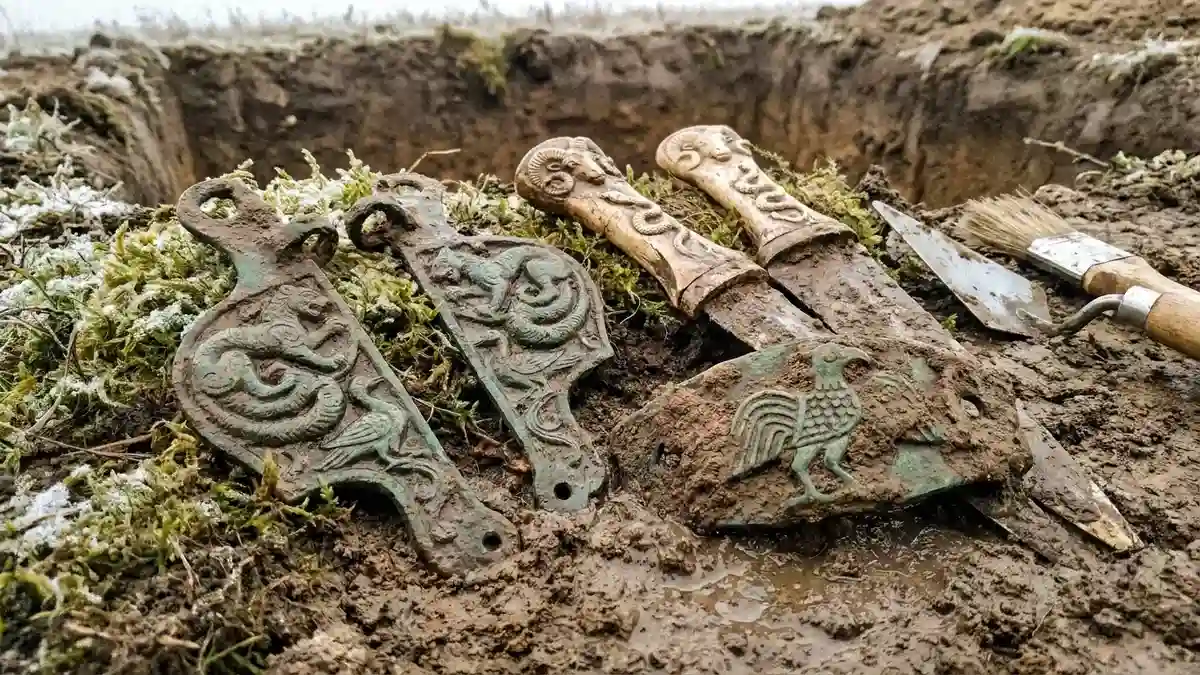
Instead of gold, the artisans of Tunnug 1 worked almost exclusively in rugged bronze and polished animal bone. Furthermore, they did not create standalone art pieces; instead, they integrated their designs directly into functional, daily equestrian and military equipment:
                    EARLY SCYTHIAN ART INTEGRATION

     [ Animal Motif ] =======> Carved Directly Into ======> [ Utility Object ]
     * Felines                                              * Horse Cheekpieces
     * Water/Land Birds                                     * Harness Appliqués
     * Coiling Snakes                                       * Dagger & Knife Handles
     * Argali Wild Sheep
This structural choice proves that the animal style did not start as a luxury fashion dictated by a royal court. Instead, it evolved organically as an everyday visual language. By stamping or carving animals into the very tools they relied on for survival, these mobile pastoralists were embedding their identity, values, and beliefs directly into their physical gear.

A Four-Species Palette: The Early Steppe Spiritual Connection
The narrow artistic repertoire found at Tunnug 1 provides an intimate glimpse into the mind of the early nomadic hunter-gatherer. Rather than a vast, imaginative menagerie, the craftsmen of this early era restricted themselves to just four distinct animal types, each carrying an intense spiritual or environmental significance:
Felines: Representing power, stealth, and apex predatory hunting prowess.
Birds: Symbolic of the sky, keen vision, and rapid movement across the horizon.
Snakes: Tied directly to the earth, stealth, and transition or rebirth.
Ovicaprids (Wild Argali Sheep): Highlighting the vital, everyday connection to the mountain herbivores that sustained life on the steppe.
Scholars believe this hyper-focused iconographic range demonstrates that early Scythian art was not about telling grand, complicated mythological stories. Instead, it focused heavily on wild animals as pure spiritual symbols of nature, capturing the core elements of the surrounding Siberian wilderness.
Overturning Old Theories: A Central Asian Origin
Beyond its immense artistic value, the excavation at Tunnug 1 has dealt a decisive blow to long-standing historical paradigms regarding how nomadic cultures migrated.
For generations, a popular academic theory claimed that Scythian culture was the byproduct of a gradual, eastward diffusion—suggesting that advanced metallurgical technologies and artistic styles developed near the Black Sea or Europe and slowly drifted east into Asia.
Tunnug 1 completely flips this narrative on its head. Because this highly sophisticated, early Iron Age site is securely dated to the late ninth century BCE and sits firmly in South Siberia, it proves that the Scythian cultural phenomenon actually originated deep within Central and Inner Asia. The artistic style developed indigenously among early eastern steppe populations, evolving organically over centuries before eventually radiating outward across thousands of miles to the borders of Europe.
Conclusion
The pioneering discoveries at Tunnug 1 provide an invaluable cornerstone for reconstructing the dawn of the Iron Age. They remind us that the masterworks of human history rarely appear out of thin air. Before the Scythians could forge their legendary gold crowns and heavily ornamented armor, they spent generations carving their relationship with nature into the bone handles of their knives and the bronze clasps of their horse reins. By studying these humble, functional beginnings, we can finally appreciate the true roots of a shared artistic vocabulary that would eventually define an entire continent for a millennium.
Frequently Asked Questions
What exactly is the “Scythian Triad”?
The Scythian Triad is a distinct three-part archaeological blueprint used by historians to identify Scythian-type cultures across the Eurasian steppe. It consists of: (1) a specific style of bronze and iron weaponry, (2) advanced, specialized horse-harness gear, and (3) the iconic “animal-style” artistic motifs.
Why did it take so long for archaeologists to excavate Tunnug 1?
Although the site was originally discovered in 1980, it is located in an incredibly isolated, swampy region of Tuva. The treacherous mud and freezing permafrost made traditional archaeological digging impossible for decades, requiring modern advancements in logistics, preservation, and winter fieldwork to safely extract the artifacts.
Were any gold artifacts found at the Tunnug 1 site?
Unlike later, classic Scythian royal burials which are famous for kilograms of beaten gold jewelry, the artifacts recovered from Tunnug 1 are made almost entirely of functional bronze, animal bone, and horn. This lack of precious metals highlights the early, formative nature of the society that built it.
What is an “ovicaprid” and why was it depicted by ancient artists?
“Ovicaprid” is a scientific umbrella term used by biologists and archaeologists to describe members of the sheep and goat families. In the context of Tunnug 1, these depictions almost certainly represent the wild Argali sheep, a massive, horned mountain animal that early steppe nomads encountered, hunted, and deeply respected as a symbol of endurance and natural bounty.
How does Tunnug 1 prove where Scythian culture started?
Because Tunnug 1 is securely dated to the late ninth century BCE (between 833 and 800 BCE), it stands as one of the oldest known Scythian sites in existence. Its geographic location in South Siberia demonstrates that the core elements of Scythian technology and art were already fully formed in Central Asia centuries before they appeared in western regions like the Black Sea, proving an indigenous eastern origin.