
Table of Contents
- 1. Breaking the Sacred Rules: Cremation vs. Intact Inhumation
- 2. The Victims of Cerro de las Cabezas: A Forensic Breakdown
- 2.1. Individual A: The Maimed Traveler
- 2.2. Individual B: The Decapitated Youth
- 3. The Cryptic Symbolism of Red Deer Antlers
- 4. Isotopic Clues: Diet, Origin, and Lifestyle
- 5. Deciphering the “Bad Death”: Justice, Ritual, or Public Warning?
- 6. Frequently Asked Questions
- 6.1. What makes this burial unique compared to other Iberian finds?
- 6.2. Where is Cerro de las Cabezas located?
- 6.3. How did the two men die?
- 6.4. What did the deer antlers signify in this context?
- 6.5. Were these men foreign invaders or enemies?
Decapitated Man and Antlers Confirm Grim Ancient Ritual
The discovery of a bizarre, violent burial outside the walls of an ancient Spanish settlement is providing historians with an unprecedented look into the dark side of Iron Age justice. Uncovered at the archaeological site of Cerro de las Cabezas in central Spain, the remains of two men who died under exceptionally brutal circumstances have challenged long-held assumptions about pre-Roman Iberian culture.
Dating back more than 2,200 years, this unique deposit departs completely from the standard funerary customs of the era. By combining forensic osteology (the study of bones) with advanced chemical analysis and symbolic artifacts, researchers have pieced together a narrative of execution, ritual punishment, and social isolation that has no known parallel in the Iberian archaeological record.
Decapitated Man and Antlers Confirm Grim Ancient Ritual
Breaking the Sacred Rules: Cremation vs. Intact Inhumation
To understand why this discovery is so shocking to archaeologists, one must first understand how the ancient Iberians typically treated their dead. Between the 6th and 1st centuries BCE, cremation was the universal norm across the Iberian Peninsula.
When a member of the community died, their body was systematically burned on a funeral pyre. The remaining ashes and bone fragments were then carefully collected, placed into ceramic urns, and buried within designated community cemeteries alongside personal belongings, weapons, or pottery. This structured process was designed to honor the deceased and ensure their transition into the afterlife.
The find at Cerro de las Cabezas shattered this established pattern entirely. Discovered just outside the settlement’s southern defensive wall, the two men were left fully intact. They were not granted a formal grave, a burial structure, or a single item of funeral property. Instead, their bodies were deposited rapidly on the bare ground and immediately covered with earth, effectively banishing them from the community’s sacred landscape.
 10th-Century Bronze Cross Found in Germany Reveals Early Christian Influence on Slavic Tribes
The Victims of Cerro de las Cabezas: A Forensic Breakdown
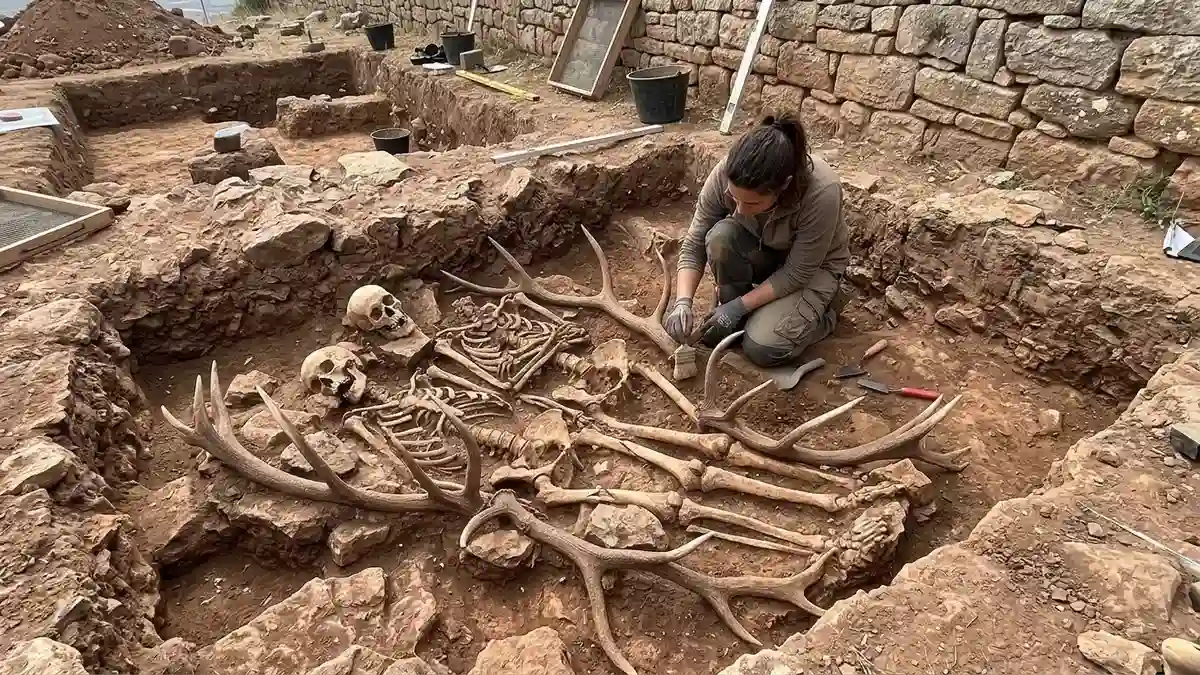
The physical remains of the two men, designated by researchers as Individual A and Individual B, tell a gruesome story of their final moments. Both skeletons were found in perfect anatomical alignment, proving they were buried immediately after their deaths before decomposition or scavengers could disturb the remains.
Individual A: The Maimed Traveler
Estimated to have been between 35 and 45 years old at the time of his death, Individual A was no stranger to violence. Forensic analysis of his skull revealed a severe, deep fracture on his forehead. Remarkably, this injury had occurred several weeks prior to his demise and had already begun to heal, indicating he had survived an initial violent encounter.
His ultimate cause of death, however, came from a massive strike to his lower body. A sharp, heavy weapon—likely an iron sword or axe—was swung with such immense force that it sliced deep into his right femur (thigh bone). The blow cut through major blood vessels, causing him to rapidly bleed to death. Microscopic damage to the bone indicates that the weapon actually became wedged in his thigh before his attacker violently yanked it free.
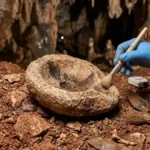
Individual B: The Decapitated Youth
The fate of Individual B, who was approximately 40 to 59 years old, was arguably even more severe. He was subjected to complete decapitation, executed either immediately before or shortly after his death.
When the burial took place, his skull, jaw, and upper neck vertebrae were still bound together by muscle and soft tissue. In a highly deliberate gesture, his severed head was placed roughly 40 centimeters away from his torso, left to rest directly on top of his own left arm at the apex of the deposit. Archaeologists emphasize that this positioning could not have occurred naturally through soil shifting; it was a conscious, physical choice made by those who buried him.
The Cryptic Symbolism of Red Deer Antlers
What elevates this grim discovery from a mere ancient crime scene to a complex ritual deposit is the presence of six massive red deer antlers, some of which measured over one meter in length.
The arrangement of the deposit followed a strict, calculated sequence:
A layer of large deer antlers was laid directly onto the earth.
Individual A was placed flat on top of these antlers.
Individual B was positioned next, partially overlapping the first man.
Additional antlers were stacked directly over the bodies.
Finally, the severed head of Individual B was placed on top of the pile.
In Iron Age Europe, red deer antlers carried heavy symbolic weight. They were frequently used to fashion tools, weapons, and prestige items for the elite. In neighboring Celtic and Celtiberian territories, archaeologists have found antlers buried beneath the foundations of homes and defensive gates, where they functioned as protective or luck-bringing offerings to the gods.
However, prior to the excavations at Cerro de las Cabezas, antlers had never been found explicitly linked to human corpses in Iberian territory. The integration of these animal parts suggests a complex ritual dimension designed to bind the dead men to the defensive wall.
Isotopic Clues: Diet, Origin, and Lifestyle
To determine whether these men were hated foreign invaders or local citizens, the research team analyzed stable isotopes preserved within their teeth and bones. By measuring ratios of carbon, nitrogen, and oxygen, scientists can reconstruct an ancient individual’s long-term diet and geographic origin.
| Individual | Age Range | Dietary Profile | Geographic Profile |
| Individual A | 35–45 Years | Highly consistent, rich in animal proteins from youth to death. | Drank water matching local/regional sources; not an outsider. |
| Individual B | 40–59 Years | Standard Iron Age diet with mixed agricultural inputs. | Drank water with a distinct signature from Individual A, but still within the local region. |
The oxygen isotope data indicates that while the two men grew up drinking water from different micro-regions or water sources, both fell squarely within the baseline range for central Spain. Neither man was a distant foreigner.
Furthermore, structural changes in the leg bones of Individual A revealed a life of intense physical activity, specifically long-distance walking over rugged terrain. Combined with his high-protein diet, researchers hypothesize that he may have worked as a pastoral herder, moving livestock across the Iberian landscape before his life came to a violent end.
Deciphering the “Bad Death”: Justice, Ritual, or Public Warning?
Why would a community take two local men, execute them with terrifying violence, deny them their sacred cremation rites, and bury them with protective animal symbols against the settlement’s outer wall?
The authors of the study suggest the find represents a textbook example of a “bad death.” In many ancient societies, individuals who died by suicide, suffered sudden violent executions, or committed severe violations of social norms were barred from entering the standard communal cemetery. Denying them cremation was the ultimate social punishment, stripping them of their identity and condemning them in the afterlife.
Placing the bodies directly against the southern defensive wall during the final decades of Cerro de las Cabezas points to two distinct possibilities:
The Public Warning: The uncremated, exposed bodies could have been left near the settlement’s entrance as a stark, visible deterrent to warn residents and visitors of the brutal consequences of breaking local laws.
The Apotropaic Ritual: In times of severe political instability or warfare, the community may have used the bodies and the protective deer antlers as a form of ritual magic to spiritually fortify the settlement’s walls against impending doom.
By separating the question of how these men died from why they were buried so abnormally, this discovery opens a rare window into the rigid systems of social control, criminal justice, and spiritual anxiety that governed the Iberian world just before it was swallowed by the Roman Empire.
Frequently Asked Questions
What makes this burial unique compared to other Iberian finds?
Standard Iberian funerary practice during the Iron Age required cremation, with the ashes placed inside an urn within a formal cemetery. This find is completely unique because the two bodies were kept intact, buried without grave goods, placed outside the settlement walls, and explicitly integrated with massive red deer antlers.
Where is Cerro de las Cabezas located?
Cerro de las Cabezas is an ancient Iron Age archaeological site (an oppidum, or fortified town) located near the modern town of Valdepeñas, in the province of Ciudad Real, central Spain.
How did the two men die?
Individual A died from severe blood loss after a sharp weapon sliced deeply into his right femur, severing major blood vessels. Individual B was executed via complete decapitation, with his severed head placed deliberately on his left arm.
What did the deer antlers signify in this context?
While antlers were traditionally used as protective or foundation offerings underneath buildings in Celtic cultures, their placement here suggests an apotropaic ritual—a spiritual practice intended to ward off evil or fortify the settlement’s defensive walls using the bodies of those who suffered a “bad death.”
Were these men foreign invaders or enemies?
No. Stable isotope analysis of the oxygen inside their bones and teeth confirms that both men drank water native to the region. While they may have traveled or grown up in different local valleys, they were local to the broader geographic area, not foreign outsiders.