
Table of Contents
- 1. Unlocking History Through the Coin Hoards of the Roman Empire
- 1.1. Filtering for True Hidden Savings
- 2. The Core Distinction: Burying Money vs. Losing It Forever
- 3. Mapping Ancient Tragedies: Where War and Wealth Intersect
- 3.1. The Slaughter at Teutoburg Forest (9 CE)
- 3.2. The Bloody Roman Conquest of Britain
- 4. Natural Disasters: The Shadow of Mount Vesuvius
- 5. Crisis on the Frontiers: The Danube and the Third Century
- 5.1. The Dacian Wars
- 5.2. The Imperial Collapse of the Third Century
- 6. Conclusion: The Silent Witness of Forgotten Wealth
- 7. Frequently Asked Questions
- 7.1. Why did ancient Romans bury their coins in the ground?
- 7.2. How do archaeologists know these hoards weren’t religious offerings?
- 7.3. What is the Coin Hoards of the Roman Empire database?
- 7.4. Why does the study stop after the third century CE?
- 7.5. What happened to the people who buried these coins?
Why Millions of Roman Coins Were Left Behind: The Grim Truth
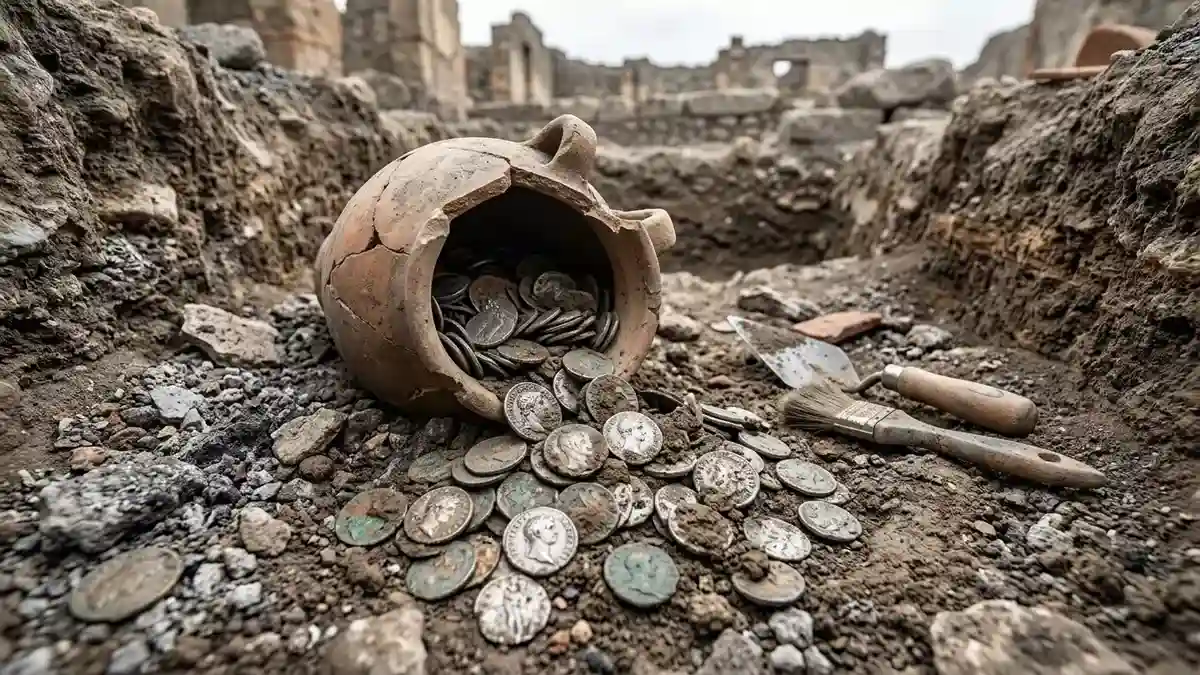
For centuries, amateur metal detectorists and professional archaeologists have unearthed spectacular treasures buried deep within the soil of the former Roman Empire. From clay pots overflowing with silver denarii to bronze jugs packed with gold coins, these discoveries continually captivate the public imagination. Yet, these discoveries raise a haunting historical question: Why did the ancient owners never return to claim their life savings?
A groundbreaking new historical study offers a compelling explanation. By analyzing thousands of documented coin hoards, researchers have revealed that while the reasons for burying wealth varied, the reasons for abandoning it almost always pointed to sudden catastrophe. For these ancient citizens, a hidden fortune was a temporary safety net; its abandonment, however, was a definitive sign of tragedy.
Why Millions of Roman Coins Were Left Behind The Grim Truth

Unlocking History Through the Coin Hoards of the Roman Empire
To understand the patterns behind these lost fortunes, researchers turned to the massive Coin Hoards of the Roman Empire database. This comprehensive digital repository tracks more than 18,200 unique hoards containing over 7.5 million Roman coins across Europe, North Africa, and the Middle East.
Filtering for True Hidden Savings
To ensure the data reflected intentional, personal savings rather than casual losses or religious offerings, the study implemented strict criteria:
Hoard Size: The team isolated deposits containing between 100 and 10,000 coins. This range typical represents individual, family, or merchant wealth.
Time Period: The scope was limited to the first three centuries CE, a period before rampant currency debasement fundamentally altered how Roman citizens valued and stored money.
Context: Researchers specifically analyzed hoards found in domestic containers or deliberate underground settings, indicating that the owners fully expected to dig them up later.

The Core Distinction: Burying Money vs. Losing It Forever
Historically, people buried currency for everyday reasons. In a world without modern banking systems, storing coins beneath a floorboard or in a nearby field was the safest way to guard wealth. Families hid money to shield it from local thieves, merchants buried their daily earnings during localized unrest, and wealthy citizens accumulated older, high-purity silver coins as inflation began to creep into the Roman economy.

However, the new study emphasizes that historians must separate the act of concealment from the failure to retrieve it. While the initial burial was driven by financial prudence, the permanent abandonment of these hoards serves as a proxy marker for localized disasters, military invasions, and mass mortality events.
Mapping Ancient Tragedies: Where War and Wealth Intersect
When researchers overlaid the chronological data of the unrecovered hoards with documented historical timelines, a precise geographic pattern emerged. High concentrations of abandoned money directly correlate with major military conflicts and structural collapses throughout Roman history.
The Slaughter at Teutoburg Forest (9 CE)
One of the earliest and most dramatic spikes in abandoned hoards occurs around the year 9 CE in modern-day Germany. This aligns perfectly with the Battle of the Teutoburg Forest, an ambush where Germanic tribes annihilated three entire Roman legions under the command of Publius Quinctilius Varus.
Maps generated from the database show a dense cluster of unrecovered coin hoards near Kalkriese, the universally accepted site of the military disaster. The sheer volume of abandoned currency tells a grim story of soldiers and camp followers who buried their valuables before or during the chaotic battle, only to be killed or enslaved, leaving their wealth lost to time.
The Bloody Roman Conquest of Britain
Across the English Channel, the data reveals a tumultuous landscape during the first century CE. A high concentration of unrecovered hoards dating between 20 CE and 60 CE saturates southeastern Britain.
This specific timeframe matches a prolonged period of intense violence, including tribal warfare, the official Roman invasion ordered by Emperor Claudius in 43 CE, and the subsequent bloody uprising led by Queen Boudica. The widespread abandonment of these coins indicates that the violent transition into a Roman province displaced or destroyed entire communities before they could recover their property.
Natural Disasters: The Shadow of Mount Vesuvius
While warfare accounts for the majority of the spikes in the database, natural catastrophes left an equally undeniable signature on the landscape. By the late first century, the pattern of abandoned hoards shifts dramatically away from a pacified Britain and concentrates in a singular, infamous region of Italy.
Between 70 CE and 90 CE, unrecovered coin hoards spike dramatically in the immediate vicinity of Mount Vesuvius. The catastrophic volcanic eruption of 79 CE buried the vibrant cities of Pompeii and Herculaneum under meters of ash and toxic pumice. The owners of these hoards were either instantly suffocated by pyroclastic surges or forced into a desperate, lifelong flight, leaving their buried family savings trapped beneath the volcanic debris for millennia.
Crisis on the Frontiers: The Danube and the Third Century
As the Roman Empire aged, the pressure on its borders intensified, leaving a trail of forgotten fortunes along its outer frontiers.
The Dacian Wars
During the reigns of Emperors Domitian and Trajan, the Danube frontier became a hotbed of geopolitical conflict. The study highlights a notable wave of unrecovered coin hoards concentrated near the Roman military border and surrounding Sarmizegetusa, the capital of Dacia (modern-day Romania). Decades later, during the mid-third century, another dense wave of abandoned wealth swept across the Balkans, tracking the path of destructive Carpic and Gothic invasions.
The Imperial Collapse of the Third Century
The ultimate peak in unrecovered Roman wealth occurred during the Crisis of the Third Century (253–268 CE). During this chaotic era, the Roman Empire nearly collapsed under the combined weight of:
Simultaneous foreign invasions from Germanic tribes and the Sasanian Empire
Relentless civil wars between rival imperial pretenders
Widespread economic collapse and devastating plagues
The database maps for this period reveal hundreds of abandoned coin hoards stretching from the fields of Gaul all the way to Asia Minor. The sheer density of these lost fortunes underscores the vast human toll of an era where security vanished, and millions of citizens never made it back to their hiding places.
Conclusion: The Silent Witness of Forgotten Wealth
Ultimately, these thousands of unrecovered Roman coin hoards represent far more than a treasure trove for modern museums. They serve as silent, tangible monuments to individual human tragedies. By separating the motives behind hiding money from the harsh realities that prevented its recovery, modern researchers have turned ancient currency into a powerful diagnostic tool for mapping human suffering, revealing exactly where history’s most destructive events left no survivors to claim the past.
Frequently Asked Questions
Why did ancient Romans bury their coins in the ground?
In the ancient world, there were no commercial banking systems or secure safety deposit boxes. Burying coins in clay jars, bronze vessels, or fabric bags beneath house floors or in remote fields was the standard method for protecting personal wealth from opportunistic thieves, local unrest, or invading armies.
How do archaeologists know these hoards weren’t religious offerings?
To eliminate religious, votive, or funeral offerings from the data, researchers focused strictly on coin hoards found in domestic settings, tucked inside utilitarian storage containers, and containing between 100 and 10,000 coins. Religious offerings were typically deposited in sacred springs, temples, or graves and were often intentionally damaged to prevent reuse.
What is the Coin Hoards of the Roman Empire database?
It is a massive digital research project that aggregates data on documented Roman coin finds. At present, the database contains detailed records of more than 18,200 individual hoards and over 7.5 million individual coins, allowing historians to track economic and military trends across centuries.
Why does the study stop after the third century CE?
The study focused on the first three centuries of the Common Era because later periods experienced severe, state-driven currency debasement. When the Roman government radically reduced the precious metal content of its coins, it changed how people used, hoarded, and valued money, which would skew the data regarding standard saving habits.
What happened to the people who buried these coins?
The high correlation between unrecovered hoards and major historical disasters suggests that the vast majority of the owners met tragic ends. They were either killed in battles, died during natural disasters like the eruption of Mount Vesuvius, were captured and sold into slavery, or were permanently displaced by invading armies, leaving no one behind who knew the secret location of the wealth.