
Table of Contents
- 1. Unlocking the Secrets of Zerzevan Castle
- 1.1. A Year-Long Linguistic Breakthrough
- 2. The Cross and the Inscription: A Symbolic Farewell to Paganism
- 3. The Rise and Fall of the Mithras Cult
- 3.1. From Imperial Rival to Forgotten Sanctuary
- 4. A Window into Rome’s Eastern Frontier
- 5. Conclusion
- 6. Frequently Asked Questions
- 6.1. What does the newly decoded inscription at Zerzevan Castle reveal?
- 6.2. Why is this specific inscription so important to historians?
- 6.3. Who was the god Mithras, and who worshipped him?
- 6.4. Where is Zerzevan Castle located, and what was its original purpose?
- 6.5. What symbols were found alongside the Aramaic text?
Ancient Text Reveals How Christians Sealed a Roman Temple 1,700 Years Ago
A groundbreaking archaeological breakthrough in southeastern Türkiye has solved a centuries-old mystery surrounding a subterranean Roman sanctuary. By successfully decoding a rare Aramaic inscription, scholars have uncovered direct written proof of a pivotal religious transformation that occurred 1,700 years ago. The newly deciphered text reveals that early Christians formally and ceremonially sealed an underground Mithras temple at Zerzevan Castle, marking the precise historical moment when Christianity replaced paganism as the dominant faith of the Roman Empire.
While physical evidence of abandoned Roman temples is relatively common, written accounts detailing their closure are exceptionally rare. This landmark discovery provides historians with an unprecedented, first-hand look at the dramatic religious shifts that reshaped the ancient Mediterranean world.
Ancient Text Reveals How Christians Sealed a Roman Temple 1,700 Years Ago
Unlocking the Secrets of Zerzevan Castle
Zerzevan Castle, located in the Çınar district of Diyarbakır, was once a vital military installation on the eastern frontier of the Roman Empire. Perched strategically on a hilltop, this vast complex acted as a powerful border fortress. Since systematic excavations began at the site in 2014, archaeologists have uncovered a sprawling network of defensive structures, including massive fortifying walls, watchtowers, civilian residences, subterranean shelters, hidden passageways, water storage systems, and rock-cut tombs.
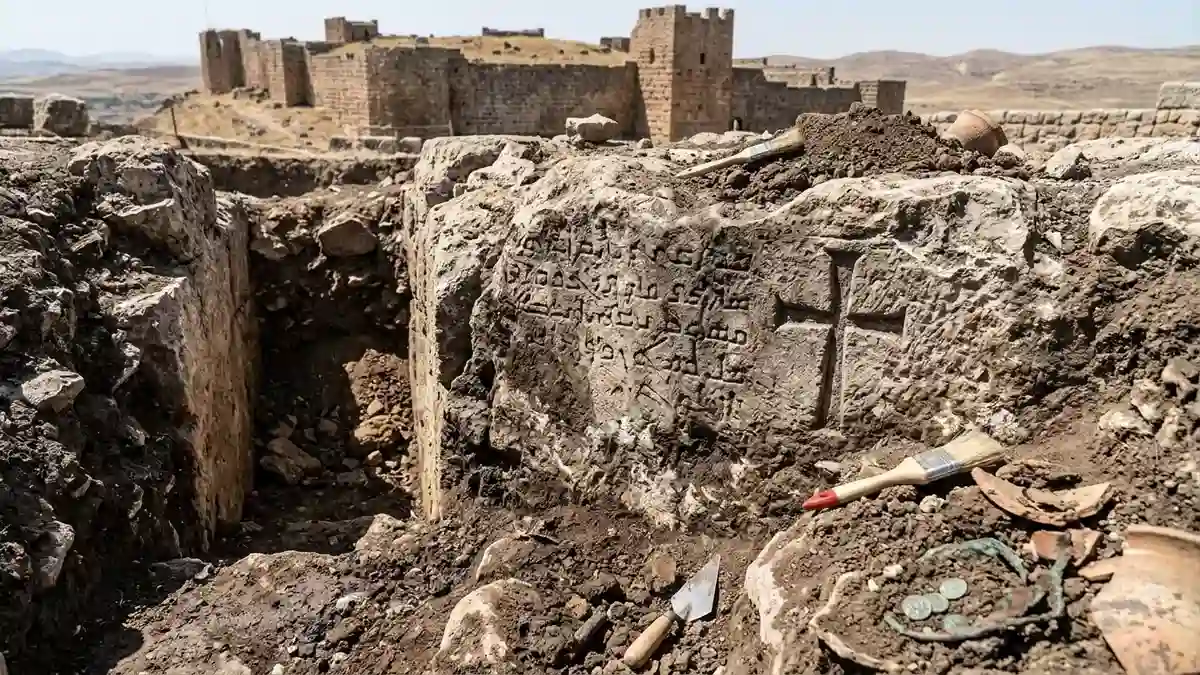
However, the most captivating feature of the fortress is its underground Mithraeum—a subterranean temple dedicated to the mysterious god Mithras. Discovered by archaeologists in 2017, the temple entrance featured a mysterious inscription that eluded translation for years.
A Year-Long Linguistic Breakthrough
The breakthrough came thanks to the dedicated work of Professor Mehmet Sait Toprak from Mardin Artuklu University. Professor Toprak spent roughly a year meticulously analyzing the ancient text, studying its specific paleography (the study of ancient writing systems), linguistic structures, and broader historical context.

To accurately read the carvings, the research team compared the text with known Old Syriac and Aramaic inscriptions dating to the second and third centuries CE, including prominent artifacts housed at the nearby Şanlıurfa Museum. This comparative analysis allowed scholars to reliably date the inscription to the late third or early fourth century CE—aligning perfectly with the rise of Christian political dominance in Rome.
The Cross and the Inscription: A Symbolic Farewell to Paganism
The placement of the text leaves little doubt about its purpose. Carved directly into the stone at the entrance of the underground sanctuary, the inscription sits immediately adjacent to a deeply etched Christian cross. Together, the physical text and the Christian symbol served as a formal, highly visible declaration that the pagan space was officially closed.
What makes the text truly remarkable is its juxtaposition of conflicting religious worldviews. The inscription explicitly references the “Invincible Sun God Mithras” alongside Jesus Christ. By invoking the Holy Cross in the name of God, the author recorded a direct ideological bridge, capturing the exact transition point where an old empire’s faith was systematically replaced by a new one.

According to Professor Toprak, this artifact stands as the first known Old Aramaic text ever discovered that explicitly describes the closing of a Mithras temple. It bridges a massive gap in our understanding of how these transformations occurred on the ground, moving past archaeological guesswork into verified historical fact.
The Rise and Fall of the Mithras Cult
To understand the weight of this discovery, one must look at the immense popularity of Mithraism within the Roman military. Mithras originated as a prominent solar deity in ancient Iranian religion. As the Roman Empire expanded eastward, Roman soldiers adopted modified aspects of this Persian god, transforming the worship into a highly secretive mystery religion.
During the second and third centuries CE, Mithraism spread like wildfire through the ranks of the Roman legions. Because it was a mystery cult, worship did not take place in open-air public temples. Instead, initiates gathered in secretive, dimly lit underground chambers known as Mithraea. In these hidden spaces, soldiers engaged in private rituals, communal meals, and esoteric initiation rites aimed at fostering fierce loyalty and spiritual brotherhood.
From Imperial Rival to Forgotten Sanctuary
For generations, Mithraism was one of the primary rivals to early Christianity. Both faiths offered personal salvation, moral codes, and tight-knit communities. However, the geopolitical scales tipped permanently when Roman emperors began converting to Christianity, setting off a chain reaction across the empire’s vast territories.
Professor Aytaç Coşkun, the long-time excavation director at Zerzevan Castle, noted that prior discoveries of ancient coins at the site had already given researchers a rough timeline of when the temple stopped functioning. However, the newly decoded text provides the definitive “why.”
As Christianity secured its status as the official imperial religion, pagan sanctuaries faced vastly different fates based on their location. Some Mithras temples were physically modified and rebuilt into Christian churches. Others, like the highly secure military sanctuary at Zerzevan Castle, were ceremonially neutralized, closed off, and permanently sealed away from the world.
A Window into Rome’s Eastern Frontier
Zerzevan Castle’s historical importance has gained global recognition, earning a spot on the UNESCO World Heritage Tentative List in 2020. Today, it stands as one of the most visited and studied archaeological sites in southeastern Türkiye.
The successful translation of the entry inscription elevates the castle from a simple military ruin to a monumental archive of cultural evolution. It provides an undeniable, written testimony of how the religious policies enacted in Rome and Constantinople manifested along the dangerous, heavily fortified borders of the empire.
Conclusion
The decoding of the Zerzevan Castle inscription marks a historic milestone in biblical-era archaeology. By preserving the names of both Mithras and Christ on a single block of stone, this 1,700-year-old message provides an unfiltered look at a civilization in flux. It stands as an enduring monument to the twilight of Roman paganism and the definitive dawn of the Christian era along the ancient world’s outermost frontiers.
Frequently Asked Questions
What does the newly decoded inscription at Zerzevan Castle reveal?
The inscription reveals that early Christians formally and symbolically sealed the underground Mithras temple approximately 1,700 years ago. It marks the transition of the Roman Empire away from pagan mystery cults toward Christianity.
Why is this specific inscription so important to historians?
While archaeologists frequently find physical signs that pagan temples were abandoned or damaged, finding direct written proof explaining the closure of a Mithras temple is incredibly rare. This is the first known Old Aramaic text that explicitly documents such an event.
Who was the god Mithras, and who worshipped him?
Mithras was an ancient Iranian solar deity whose worship was adopted and modified by the Romans. It became a highly popular mystery religion among Roman soldiers during the second and third centuries CE, featuring private rituals conducted in secret underground sanctuaries.
Where is Zerzevan Castle located, and what was its original purpose?
Zerzevan Castle is located in the Çınar district of Diyarbakır in southeastern Türkiye. In antiquity, it served as a vital, highly fortified Roman military base tasked with defending the empire’s eastern border against rival nations.
What symbols were found alongside the Aramaic text?
A Christian cross was found carved directly into the stone right next to the inscription at the entrance of the underground temple. The combination of the cross, the text, and the references to Jesus Christ indicates a deliberate, holy sealing of the pagan site.