
Table of Contents
- 1. The Coriovallum Stone: A Century-Old Cold Case
- 2. Inside the Digital Arena: AI Recreates Ancient Play
- 3. Redrawing the Timeline of Strategy Games
- 4. A New Framework for Silent Artifacts
- 5. Frequently Asked Questions
- 5.1. What is the Coriovallum stone, and where was it found?
- 5.2. What are “blocking games” in board game history?
- 5.3. How did artificial intelligence help solve this ancient mystery?
- 5.4. Why does this discovery change our understanding of European history?
- 5.5. What kind of pieces were used to play this game?
AI Simulations Decode Mysterious Roman Board Game in the Netherlands
By combining advanced artificial intelligence with microscopic forensics, researchers have unlocked the secrets of a mysterious limestone artifact from the Roman era. The breakthrough not only identifies a completely unique ancient board game but also pushes the history of European “blocking games” back by several centuries, revealing that frontier communities were playing complex strategic games completely unrecorded in ancient texts.
AI Simulations Decode Mysterious Roman Board Game in the Netherlands
The Coriovallum Stone: A Century-Old Cold Case
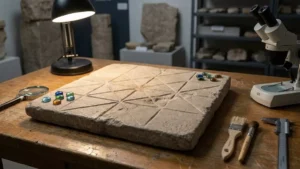
The artifact at the center of the discovery is a flat piece of limestone unearthed at the ancient Roman settlement of Coriovallum—modern-day Heerlen in the Netherlands. Preserved within the collections of Het Romeins Museum, the stone features a puzzling pattern of shallow, hand-incised geometric lines on its flattened face.
For decades, archaeologists suspected the object was a game board, but they hit a dead end: the unique arrangement of lines failed to match any known Roman, Greek, or Celtic board game in the historical record.

To break the stalemate, a research team decided to look closer at the physical damage on the stone itself. Using high-powered microscopic use-wear analysis, scientists examined the microscopic abrasions inside the engraved grooves.
The wear patterns were highly uneven; specific paths and diagonal routes were heavily smoothed down from friction, while neighboring lines remained sharp and crisp. This uneven friction proved the lines weren’t decorative—small game pieces had been repeatedly slid across very specific paths over generations of active play.
Inside the Digital Arena: AI Recreates Ancient Play
To figure out exactly how the game was played, the researchers turned to the Ludii system—an advanced artificial intelligence platform specifically engineered to model, test, and analyze historical board games.

[Microscopic Use-Wear Data] + [Archaeological Trait Profiles]
                              │
                              ▼
               ┌──────────────────────────────┐
               │    Ludii AI Simulator        │
               │  (Tens of thousands of bots  │
               │   compete across rule-sets)  │
               └──────────────┬───────────────┘
                              │
                              ▼
               [Winner: The Blocking Rule Set]
               (AI movement heat-maps perfectly
                match the stone's uneven wear)
The team programmed the exact layout of the Coriovallum stone into the AI. They then unleashed thousands of automated AI players to compete against one another in millions of simulated matches.
The AI players didn’t just play randomly; they tested tens of thousands of different historical rule variations gathered from ancient Scandinavian, Germanic, and Roman gaming traditions. As the AI bots played, the software tracked which routes on the digital board were used most frequently under each specific rule set, generating a predictive “heat map” of physical wear.
The results were definitive. When the AI simulated blocking games—strategic matches where the primary goal is to trap and restrict an opponent’s pieces rather than capturing them—the digital movement heat maps perfectly matched the uneven, heavy microscopic wear observed on the actual limestone artifact. Every other rule set tested, including capture-based war games, failed to replicate the stone’s unique physical friction footprint.
Redrawing the Timeline of Strategy Games
The successful identification of the Ludus Coriovalli (The Game of Coriovallum) has sent shockwaves through the history of leisure. In European archaeology, secure evidence for strategic blocking games was thought to be a strictly medieval phenomenon, appearing only centuries after the collapse of Roman authority.
The Coriovallum board completely shatters this timeline, proving that these mind games were actively played during the height of the Roman Empire. It demonstrates that frontier players were highly creative, experimenting with and inventing localized rule systems that were never recorded in elite Roman literature or classical art.
A New Framework for Silent Artifacts
The study, published in the prestigious archaeology journal Antiquity, introduces a revolutionary blueprint for modern artifact analysis. Ancient games are notoriously difficult to track because they were routinely scratched into short-lived materials like wood, leather, or loose dirt, using simple pebbles or twigs as temporary tokens. Surviving physical boards, like this limestone slab, are rare, isolated anomalies.
By successfully bridging the gap between physical use-wear analysis and AI-driven game simulation, the research team has given a voice to an otherwise silent object. This cutting-edge methodology allows archaeologists to objectively analyze completely unique, one-of-a-kind artifacts without needing a written manual or an identical twin object for comparison—providing an immersive, data-driven window into the social life and mental recreation of human beings who lived nearly two millennia ago.
Frequently Asked Questions
What is the Coriovallum stone, and where was it found?
The Coriovallum stone is a flat limestone block featuring hand-carved lines, discovered in the ancient Roman frontier settlement of Coriovallum, located in what is now the city of Heerlen in the Netherlands.
What are “blocking games” in board game history?
Blocking games are pure abstract strategy games where the primary objective is to strategically surround, corner, or immobilize an opponent’s pieces to prevent them from making a legal move, rather than jumping over or capturing them.
How did artificial intelligence help solve this ancient mystery?
Scientists used the Ludii AI platform to simulate millions of matches on a digital replica of the board. By testing thousands of historical rules, the AI generated movement maps. The map for “blocking games” perfectly matched the physical friction wear found on the real stone.
Why does this discovery change our understanding of European history?
Previously, firm archaeological evidence for blocking games in Europe only dated back to the Middle Ages. The Coriovallum board pushes the timeline back by several centuries, proving these games were actively enjoyed during the Roman era.
What kind of pieces were used to play this game?
Excavations at the Coriovallum site have yielded beautiful, small, semi-spherical game tokens made from colored glass, which players slid along the incised limestone pathways to play the game.