
Table of Contents
- 1. Rediscovering a Forgotten Masterpiece of Engineering
- 2. The Mechanics of the Badari Bow Drill System
- 3. Metallurgy of the Gods: The Hardened Arsenic-Nickel Alloy
- 4. From Grave 3932 to Modern Museums
- 5. Frequently Asked Questions
- 5.1. Why is the Badari drill discovery so historically important?
- 5.2. How did researchers know this was a drill rather than a basic needle or awl?
- 5.3. What role did the preserved leather fibers play?
- 5.4. How did ancient Egyptians make the copper strong enough to drill hard objects?
- 5.5. Where did the ancient inhabitants get these rare metals?
Pre-Pharaonic Breakthrough: 5,300-Year-Old Metal Bow Drill Found in Egypt
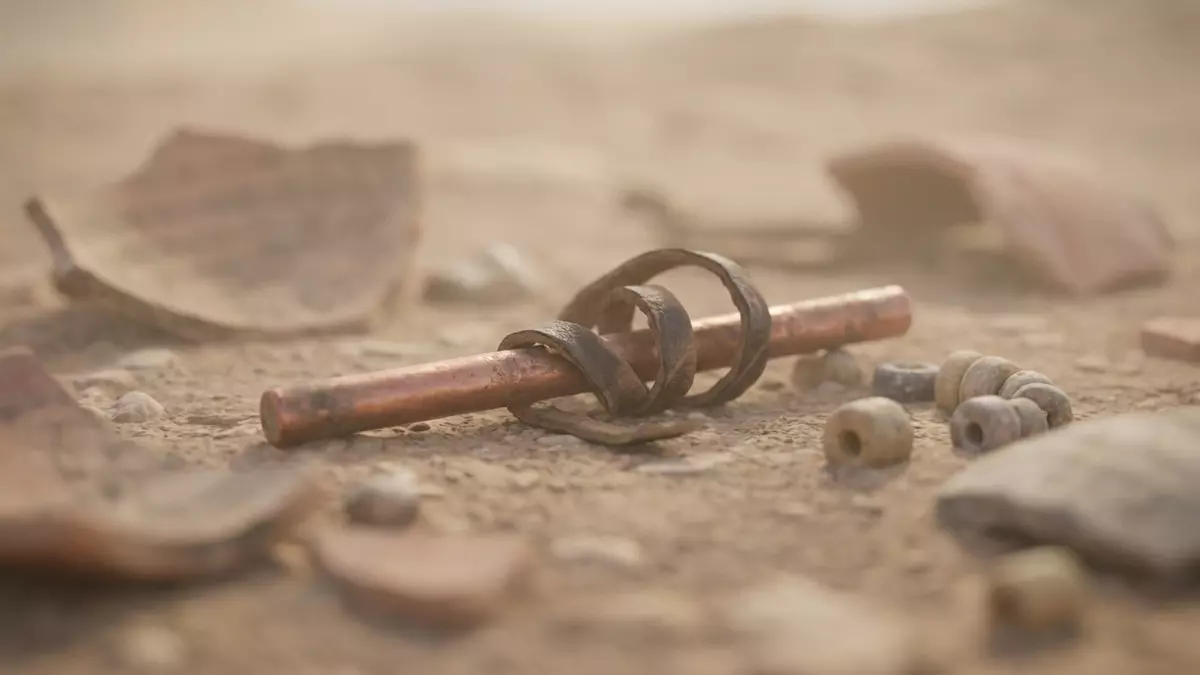
A meticulous re-examination of a forgotten museum artifact has shattered previous timelines for ancient engineering. Archaeologists have identified a tiny, unassuming metal tool from a Predynastic cemetery in Upper Egypt as a specialized bow drill bit. Dating back to the late fourth millennium BCE—centuries before the rise of the first pharaohs—this extraordinary artifact now stands as the earliest known metal rotary tool in human history.
Pre-Pharaonic Breakthrough 5,300-Year-Old Metal Bow Drill Found in Egypt
Rediscovering a Forgotten Masterpiece of Engineering
The story of this revolutionary discovery began roughly a century ago at the ancient burial grounds of Badari. During the 1920s, British archaeologists excavated a short copper rod with a fragile strip of dried leather wrapped around its middle. Classified in early excavation notes as a basic sewing awl, the tiny object—measuring just 63 millimeters in length and weighing a meager 1.5 grams—was cataloged and tucked away in a museum storage drawer, largely ignored for nearly a century.
Recently, a collaborative research team from Newcastle University and the Academy of Fine Arts Vienna pulled the artifact out of storage for high-resolution macroscopic study. Under intense magnification, the true nature of the tool was finally revealed:
 2,500-Year-Old Celtic Chariot Burial With Gold and Etruscan Treasures Discovered in Germany
Rotary Micro-Wear: The working tip featured microscopic parallel lines running in tight circles around the circumference of the metal point.
Friction Blunting: The cutting edges showed distinctive rounding patterns caused exclusively by high-speed spinning against dense surfaces.
Mechanical Stress Bends: A subtle, precise structural warp near the business end of the shaft matched the exact mechanical stress patterns generated when a spinning drill bit binds inside a hard material.
These diagnostic physical signatures completely ruled out the old “pushing or piercing” awl theory. This was a tool designed engineered to spin.
The Mechanics of the Badari Bow Drill System
The most astonishing feature of the Badari drill is the preservation of its fragile organic components. Small, tightly bound coils of petrified leather fibers still cling stubbornly to the center of the metal shaft after more than 5,000 years in the desert sand.
          [Downward Pressure Palm Piece]
                        |
                        v
    =======(==============O==============)=======  <-- [Bow Moved Back & Forth]
                          |
                          | <-- [Leather Cord Wrapped Around Shaft]
                          |
                          v
                   [Metal Drill Bit]
                          |
                          v
                 [Hard Stone / Wood]
These coils represent the earliest physical evidence of a functioning bow drill system. In this ancient configuration, a taut leather cord attached to a curved wooden bow was looped securely around the metal drill shaft. By pushing and pulling the bow horizontally in a rhythmic sawing motion, the user forced the drill bit to rotate at high speeds with minimal physical exertion.
While New Kingdom tomb paintings executed 2,000 years later frequently depict artisans utilizing this exact technique to hollow out wooden furniture or bore holes into tiny jewelry beads, the Badari artifact proves that the foundational physics of rotary automation were already mastered by Predynastic craftsmen.
Metallurgy of the Gods: The Hardened Arsenic-Nickel Alloy
To understand how a soft metal like copper could withstand the intense heat and friction of rotary drilling, scientists subjected the bit to portable X-ray fluorescence (pXRF) analysis. The chemical readout revealed a highly sophisticated, intentional metallurgical recipe rather than crude, unrefined ore.
+-------------------------------------------------------------------------+
|                  BADARI METAL DRILL BIT ALLOY READOUT                   |
+------------------------------------+------------------------------------+
| Metal Component                    | Engineering & Economic Purpose     |
+------------------------------------+------------------------------------+
| Copper (Base Metal)                | Structural core of the drill bit   |
| Arsenic & Nickel                   | Intentional mix to harden copper   |
| Silver & Lead (Trace elements)     | Indicates foreign trade networks   |
+------------------------------------+------------------------------------+
The tool was cast from a complex blend of copper heavily enriched with arsenic and nickel, alongside trace signatures of silver and lead. In an era before the invention of bronze, adding arsenic and nickel to molten copper was a brilliant engineering workaround; it dramatically altered the molecular structure of the metal, creating a hardened alloy capable of cutting through dense wood, bone, and soft stone without melting or flattening.
Furthermore, the specific geochemical presence of silver and lead tells a story of extensive pre-pharaonic trade networks. Because these specific ore combinations do not occur naturally within the local Nile Valley geology, the Predynastic communities must have maintained active trade routes extending deep into the Eastern Desert or across the waters of the eastern Mediterranean to secure their raw industrial materials.
From Grave 3932 to Modern Museums
The historic drill bit was recovered from Grave 3932, the final resting place of an adult male. The surrounding cemetery filled with high-status grave goods—including incredibly delicate stone vessels, thousands of uniform decorative beads, and carved wooden cosmetics boxes—proves that Badari was a major industrial center populated by highly skilled artisans.
The discovery underscores the immense, untapped historical value locked inside existing museum backrooms. A tiny, forgotten scrap of metal, once summarized in a single line of a 1920s paper catalog, has rewritten the history of human automation—proving that the technological foundations of the pharaohs were built by ingenious tribal engineers centuries before the first pyramid was ever conceived.
Frequently Asked Questions
Why is the Badari drill discovery so historically important?
Dating back 5,300 years, it represents the oldest known metal rotary tool ever found in Egypt and the wider world, pushing back the timeline for automated drilling technology by centuries.
How did researchers know this was a drill rather than a basic needle or awl?
High-magnification microscopic analysis revealed circular wear lines around the tip, rounded edges from high-speed friction, and a structural bend matching the specific mechanical stress of rotary spinning.
What role did the preserved leather fibers play?
The leather coils wrapped around the shaft served as the friction point for a bow string. Cords from a wooden bow were wrapped around the bit, allowing a back-and-forth sawing motion to spin the drill quickly and efficiently.
How did ancient Egyptians make the copper strong enough to drill hard objects?
X-ray analysis showed the copper was intentionally alloyed with arsenic and nickel. This chemical combination significantly hardened the metal, creating a durable tool long before the widespread development of bronze or iron.
Where did the ancient inhabitants get these rare metals?
Because the trace elements of silver and lead found in the tool do not exist in the immediate Nile Valley, the artisans must have obtained the raw ores through long-distance trade networks reaching into the Eastern Desert or the Mediterranean.