
Table of Contents
- 1. The First Comprehensive Mapping of the Vishaps
- 2. A Chalcolithic Engineering Feat Parallel to Stonehenge
- 2.1. The Fish vs. Cow-Hide Division
- 3. Logistical Marvels of High-Altitude Transport
- 3.1. Overcoming the Mountain Elements
- 4. Sanctifying the Flow: Water as Life and Religion
- 5. Overlapping Layers of Ancient Civilizations
- 5.1. A Legacy Written in Stone
- 6. Conclusion: A Sophisticated Prehistoric Worldview
- 7. Frequently Asked Questions
- 7.1. What are the dragon stones of Armenia?
- 7.2. How old are these monuments?
- 7.3. What was the actual purpose of the dragon stones?
- 7.4. Why are some stones shaped like fish and others like cow hides?
- 7.5. Did later cultures alter or destroy the dragon stones?
6,000-Year-Old Mystery of Armenia’s Dragon Stones Solved
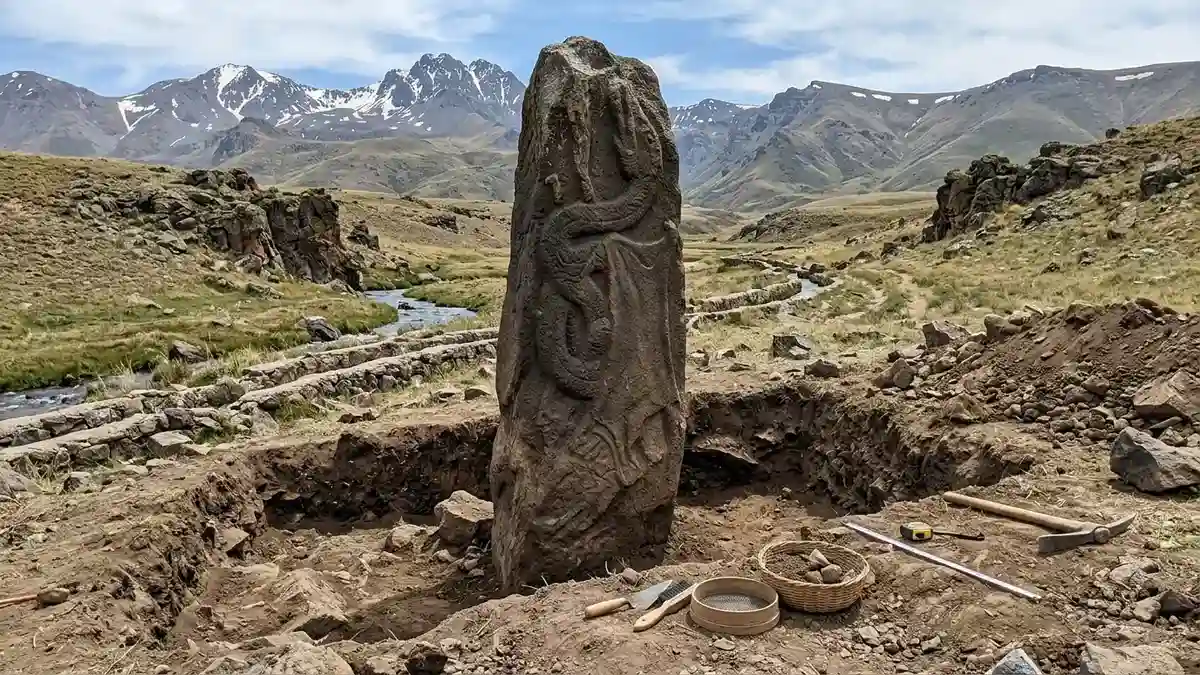
For over a century, archaeologists and historians have been deeply mystified by a series of massive prehistoric stone monuments rising from the rugged landscape of the Armenian Highlands. Known locally as vishaps or “dragon stones,” these monolithic sculptures stand up to 18 feet tall and weigh several tons.
Carved with enigmatic depictions of fish, or draped in shapes resembling cow hides, these giants have long been thought to belong to a lost, ancient mythological cult. However, a comprehensive breakthrough study has finally decoded the true purpose of these prehistoric marvels. Rather than haphazard relics of an isolated religion, the dragon stones served as sacred markers in a highly advanced, 6,000-year-old water management and agricultural network.
6,000-Year-Old Mystery of Armenia’s Dragon Stones Solved
The First Comprehensive Mapping of the Vishaps
The turning point in this century-old cold case came from a collaborative research team spearheaded by experts from Yerevan State University and the Institute of Archaeology and Ethnography. Published in the journal npj Heritage Science, the milestone study represents the first rigorous statistical and spatial analysis ever performed on these monuments.

Scientists meticulously examined 115 individual vishaps scattered across the highlands. By pairing advanced radiocarbon dating with geographic information systems (GIS) spatial analysis and precise dimensional measurements, the team successfully uncovered a clear, undeniable pattern.
The prehistoric engineers did not drop these stones randomly across the mountains; they deliberately anchored them adjacent to natural freshwater springs, alpine lakes, and ancient, human-made irrigation channels. The monoliths acted as physical and spiritual guardians of the region’s most precious resource: fresh water.
A Chalcolithic Engineering Feat Parallel to Stonehenge
Dating back to between 4200 and 4000 BCE, the dragon stones originate from the Chalcolithic era (the Copper Age). This places their construction timeline on par with the earliest megalithic foundations of iconic European ancient monuments like Stonehenge.

The new data reveals that the ancient builders developed a highly sophisticated, multi-tiered layout that correlated the specific art style of a stone with its precise elevation and agricultural function.
The Fish vs. Cow-Hide Division
The study definitively split the 115 surveyed dragon stones into two distinct groups based on location and carving imagery:
Fish-Shaped Monoliths: These stones are consistently found clustered at extreme high-altitude zones, often climbing to heights exceeding 9,000 feet above sea level. They were placed directly at the primary headwaters, mountain springs, and pristine glacial lakes where the region’s water supply originated.
Cow-Hide-Shaped Monoliths: These examples dominate the mid-altitude valleys and lower plains. They are positioned precisely where natural mountain water was diverted into early channels to support livestock and irrigate early agricultural crops.
This clever geographic zoning scheme perfectly vindicates theoretical predictions proposed by pioneering researchers nearly a century ago, confirming that these early communities possessed a thorough, advanced understanding of watershed management.
Logistical Marvels of High-Altitude Transport
The sheer physical scale of the dragon stones highlights an astonishing degree of social organization and engineering capability during the Chalcolithic era. Most vishaps were chiseled from solid blocks of heavy local basalt or andesite, with single stones frequently weighing upwards of four tons.
Overcoming the Mountain Elements
One of the most surprising revelations of the study was the location of the largest discovered monument, cataloged as Karakap 3. This massive multi-ton monolith was transported and erected at an altitude surpassing 9,100 feet above sea level.
Historically, some academics argued that prehistoric people would only build smaller, simpler monuments at such high elevations due to the brutally short, snow-free working seasons characteristic of the Armenian mountains. The reality of Karakap 3 completely shatters that assumption.
To mine, carve, move, and raise a four-ton stone monument in such a punishing alpine environment required an immense, highly disciplined collective effort. The builders had to organize massive pools of manpower, coordinate long-term construction planning, and secure complex supply lines to provide food, clothing, and shelter to teams of laborers working on the frozen peaks.
Sanctifying the Flow: Water as Life and Religion
By placing these magnificent stone fish and hidden beasts at strategic nodes along natural water channels, these early societies accomplished something profound: they seamlessly blended practical civil engineering with deep spiritual devotion.
To the ancient mind, water was not merely a passive chemical utility to grow crops; it was a sacred, life-giving deity that required protection, respect, and spiritual validation. The dragon stones operated as holy sentinels. They sanctified the landscape, visually marking the vital lifelines of the community while simultaneously asserting human territorial stewardship over the surrounding watersheds.
Overlapping Layers of Ancient Civilizations
The sacred aura surrounding these high-altitude landscapes did not vanish when the Chalcolithic culture faded. Instead, subsequent empires and passing civilizations continuously recognized the spiritual gravity of the vishap locations, adding their own cultural layers directly onto the prehistoric stones.
A Legacy Written in Stone
A prime example of this continuous reuse is found at the archaeological site of Tirinkatar on Mount Aragats. Boasting a dense cluster of twelve individual dragon stones—the largest known concentration in the world—Tirinkatar serves as a perfect timeline of Armenian history.
Centuries after the stones were raised, the Bronze Age Urartian Kingdom carved complex cuneiform inscriptions directly into the ancient surfaces to declare royal decrees. Millennia after that, early medieval Christian communities chiseled beautiful, intricate crosses (khachkars) and Christian motifs onto the same monuments. This incredible continuity proves that despite massive shifts in language, politics, and religion, these precise mountain coordinates remained permanently anchored as the holy centers of human life.
Conclusion: A Sophisticated Prehistoric Worldview
Ultimately, the resolution of the dragon stone mystery provides invaluable new insights into the behavior of prehistoric human societies on a global scale. By connecting these monolithic vishaps directly to high-altitude water systems, the study shifts our view of Chalcolithic people, showing they possessed a sophisticated, integrated worldview where technology, environment, and spirituality were completely intertwined.
Six thousand years ago, the ancient communities of the Armenian Highlands looked up at their towering peaks and recognized a vital truth: that the mountains, the water, and human survival were all bound together in a single, sacred cycle. By raising the dragon stones, they permanently chiseled that vision into the very bedrock of the earth.
Frequently Asked Questions
What are the dragon stones of Armenia?
The dragon stones, locally called vishaps or vishapakars, are large prehistoric stone monoliths carved from basalt or andesite. They can stand up to 18 feet tall, weigh several tons, and typically feature chiseled imagery of fish or shapes resembling cow hides.
How old are these monuments?
The dragon stones have been dated to the Chalcolithic era (Copper Age), specifically between 4200 and 4000 BCE. This makes them roughly 6,000 years old, meaning they were built around the same time as the earliest phases of Stonehenge.
What was the actual purpose of the dragon stones?
A 2025 spatial and statistical study revealed that the stones served as sacred markers and protectors for ancient water systems. They were intentionally placed near natural springs, high-altitude lakes, and early irrigation channels to manage water resources and bless agricultural lands.
Why are some stones shaped like fish and others like cow hides?
The study found that the shapes correspond to altitude and water usage. Fish-shaped stones are located at high altitudes (above 9,000 feet) near natural water sources and springs. Cow-hide-shaped stones are found primarily at mid-altitudes in valleys where water was actively diverted for farming and livestock.
Did later cultures alter or destroy the dragon stones?
Instead of destroying them, later civilizations respected the sites and added their own cultural marks. The Iron Age Kingdom of Urartu carved cuneiform inscriptions onto existing stones, and centuries later, early Christian communities chiseled crosses and holy motifs into the ancient monuments.