
Table of Contents
- 1. The Architecture of Cosmic Fertility
- 1.1. The Standing Monolith
- 1.2. The Sacred Rock Shelter
- 2. The Solstice Ritual: A Drama Written in Light
- 2.1. The Sacred Marriage
- 3. Mapping the Sacred Route of the Jandulilla Valley
- 3.1. Connection to the Heroon of El Pajarillo
- 4. The Deeper Meaning of the Winter Solstice
- 5. Frequently Asked Questions
- 5.1. Where was this ancient solstice sanctuary discovered?
- 5.2. How old is the El Fontanar sanctuary?
- 5.3. What happens at the site during the winter solstice?
- 5.4. What is “hierogamy” and how does it relate to this find?
- 5.5. Did the Iberians have advanced knowledge of astronomy?
Ancient Iberian Winter Solstice Sanctuary Uncovered in Southern Spain
A magnificent 2,500-year-old sanctuary has been discovered near the town of Jódar in the Spanish province of Jaén, revealing how ancient Iberian cultures seamlessly merged advanced astronomy, stone architecture, and profound religious mythology.
The site, known as El Fontanar, dates back to the 5th or 4th century BCE. Long before the rise of massive urban settlements or major fortified towns in the region, this sacred landscape was actively modified to stage an annual, dramatic ritual written entirely in sunlight and shadow. According to the international research team, the sanctuary served as both a precise cosmic calendar and a theatrical stage for a sacred union myth intended to guarantee the seasonal renewal of the cosmos and the agricultural fertility of the community.
Ancient Iberian Winter Solstice Sanctuary Uncovered in Southern Spain
The Architecture of Cosmic Fertility
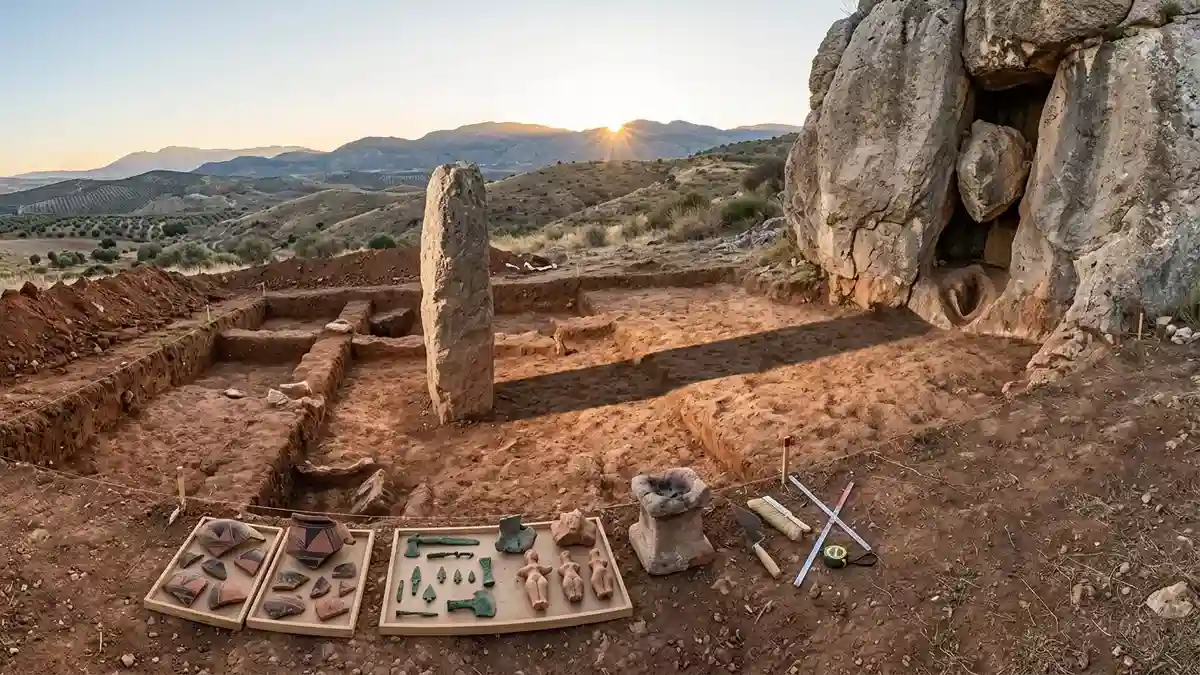
The monumentality of El Fontanar relies on two prominent geological structures that were purposefully selected and sculpted by ancient builders to mirror the male and female anatomy.
The Standing Monolith
The first primary feature is a massive, free-standing stone pillar, or monolith, that looms more than five meters (over 16 feet) high. This pillar was deliberately erected and positioned to interact directly with the horizon line precisely where the sun crests the mountains during the winter solstice.
The Sacred Rock Shelter
Directly across from the monolith stands a towering natural rock shelter rising nearly seven meters (23 feet) in height. The entrance to this shelter forms a distinct, narrow V-shape that ancient travelers and modern archaeologists recognize as a striking representation of female reproductive anatomy.
A massive, rounded boulder suspended directly above the opening evokes the form of fallopian tubes, while the natural limestone contours below taper down into a deep, vulva-like recess at the base of the rock.
The Solstice Ritual: A Drama Written in Light
At dawn on the winter solstice—the shortest day and longest night of the year—the sanctuary becomes the stage for a spectacular astronomical alignment. As the first rays of the morning sun breach the distant hills, they hit the exact tip of the five-meter monolith.
 [Solstice Rising Sun]
         \
          \
           v
    [5-Meter Monolith] ---> (Casts Long Shadow) ---> [V-Shaped Rock Entrance]
                                                              |
                                                    (Touches Female Recess)
As the sun continues its slow ascent into the winter sky, the monolith projects a massive, lengthening shadow straight across the valley floor. The tip of this dark shadow stretches forward until it penetrates the V-shaped opening, precisely touching the vulva-like recess at the base of the shelter. The shadow rests momentarily within the stone chamber before slowly retreating as the sun climbs higher into the heavens.
The Sacred Marriage
Archaeologists interpret this breathtaking event as a deliberate, architectural staging of hierogamy—the sacred marriage or cosmic union between opposing cosmic forces. In this case, the monolith acts as a conduit for the male solar force, extending its shadow to unite with the female earth deity represented by the rock shelter.
While symbolic themes of solar-earth unions are documented throughout the broader ancient Mediterranean world, El Fontanar represents a rare instance where the myth was permanently carved directly into the living geology of the European landscape.
Mapping the Sacred Route of the Jandulilla Valley
The discovery of El Fontanar carries immense broader value for regional Mediterranean history because it reshapes our understanding of how the early Iberians organized their territories before building cities. The fact that this sanctuary predates large-scale urban development in Jaén indicates that shared religious practices and spiritual pathways actively shaped the land long before political or economic centers emerged.
Furthermore, El Fontanar does not exist in isolation. It functions as a crucial astronomical anchor within a broader, highly integrated ritual landscape winding through the Jandulilla River valley.
Connection to the Heroon of El Pajarillo
The solstice sanctuary connects directly via ancient pathways to another landmark Iberian monument located nearby: the heroon (a heroic monument or sanctuary) of El Pajarillo.
While El Fontanar celebrated cosmic fertility and the birth of light, El Pajarillo was dedicated to a solar hero’s epic descent into the darkness of the underworld and his ultimate, triumphant victory over death.
| Monument Site | Primary Mythological Focus | Architectural Medium |
| El Fontanar | Cosmic rebirth, fertility, and solar union (hierogamy) | Monolith, rock shelter, and solstice shadows |
| El Pajarillo | Heroic underworld descent and triumph over death | Sculptural stone monuments and local hill alignments |
Together, these two sites formed a sacred geographic route. Along this trail, traveling Iberian pilgrims could physically track, witness, and experience the entire lifecycle of their gods, viewing the landscape as a living canvas where myth, territory, and astronomy intersected.
The Deeper Meaning of the Winter Solstice
To the ancient Iberian mindset, the winter solstice was not merely a change in seasons or a data point on a calendar; it was a profound, high-stakes moment of cosmic vulnerability and ultimate relief.
The shortest day of the year marked the end of the solar hero’s long, exhausting decline into winter darkness. The precise moment the monolith’s shadow touched the inner sanctuary signaled to the community that the sun had successfully united with the fertility goddess. This guaranteed that the days would begin lengthening once more, ensuring the return of spring, the rebirth of crops, and the survival of the human community.
Ultimately, El Fontanar stands as a timeless testament to the advanced astronomical capabilities, architectural precision, and deep spiritual sophistication of prehistoric Iberian society. Rather than viewing themselves as separate from nature, they managed to capture the very cycles of the heavens and permanently weave their grandest myths into the stone of the earth.
Frequently Asked Questions
Where was this ancient solstice sanctuary discovered?
The sanctuary, known as El Fontanar, was discovered by archaeologists near the rural town of Jódar, located within the southern Spanish province of Jaén, Spain.
How old is the El Fontanar sanctuary?
The site has been securely dated to the 5th or 4th century BCE, making it approximately 2,500 years old. It was constructed and utilized during the iron-age Iberian culture, prior to the arrival of major Roman influence.
What happens at the site during the winter solstice?
At dawn on the winter solstice, the rising sun hits a five-meter-tall stone monolith, casting a long, precise shadow across the ground. This shadow extends directly into the entrance of a nearby seven-meter-tall rock shelter, touching a specific recess modeled after female anatomy before retreating.
What is “hierogamy” and how does it relate to this find?
Hierogamy translates to a “sacred marriage” or spiritual union between deities. At El Fontanar, the alignment of the monolith’s shadow entering the earth shelter symbolized the physical and spiritual union between a male solar deity and a female earth-fertility goddess, an event believed to jumpstart the renewal of nature.
Did the Iberians have advanced knowledge of astronomy?
Yes. The precise placement and deliberate shaping of the monolith and rock shelter prove that the ancient Iberians possessed highly advanced astronomical observation skills. They were fully capable of tracking solar pathways and calculating horizon vectors to integrate cosmic cycles directly into their monumental architecture.