
Table of Contents
- 1. The Unexpected Discovery at Twentyshilling Hill
- 1.1. Unearthing the Prehistoric Barrow
- 1.2. A Deviant Burial Practice
- 2. Decoding the Radiocarbon Data: A Timeline of Crisis
- 2.1. A Single, Devastating Event
- 2.2. Who Were the Victims?
- 3. What Caused the Sudden Bronze Age Tragedy?
- 3.1. The Tell-Tale Signs of Regional Hardship
- 4. Deep Roots: The Neolithic Connection
- 4.1. The Power of Ancestral Memory
- 5. Redefining Our View of Prehistoric Resilience
- 6. Frequently Asked Questions
- 6.1. What makes the Twentyshilling Hill burial unique compared to other Bronze Age sites?
- 6.2. How many people were found in the mass grave?
- 6.3. When exactly did this ancient crisis take place?
- 6.4. What do scientists believe caused the mass deaths?
- 6.5. Who conducted the excavation at this site?
3,000-Year-Old Scottish Mass Burial Unceasingly Reshapes Bronze Age History
A remarkable archaeological discovery in the rugged highlands of southwest Scotland is forcing historians to rethink what we know about prehistoric societies. While prepping land for a modern wind farm near Sanquhar in Dumfries and Galloway, researchers stumbled upon a highly unusual 3,000-year-old mass burial site.
Uncovered near Twentyshilling Hill, this ancient cemetery offers a rare, haunting snapshot of a prehistoric community gripped by a sudden and devastating catastrophe. The unique nature of the site suggests that instead of following traditional, multi-generational funeral customs, this ancient society had to quickly adapt to an unexpected, widespread tragedy.
3,000-Year-Old Scottish Mass Burial Unceasingly Reshapes Bronze Age History
The Unexpected Discovery at Twentyshilling Hill
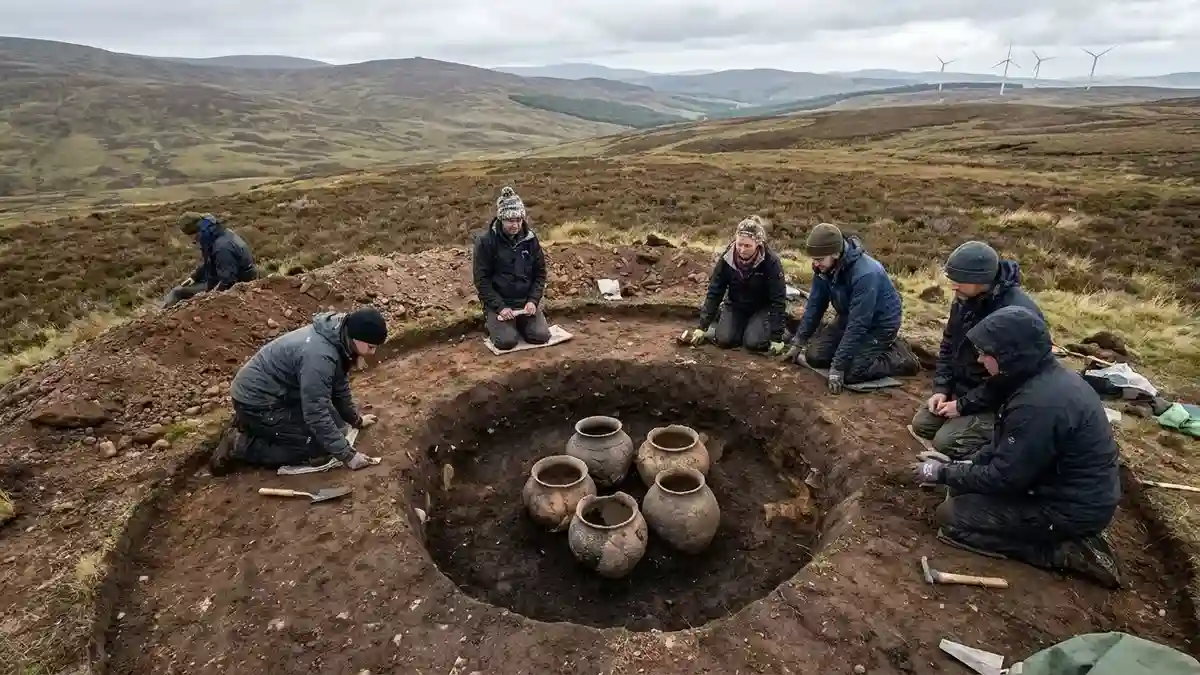
The breakthrough occurred during routine archaeological mitigation work ahead of a green energy project. Experts from GUARD Archaeology were tasked with surveying the proposed access routes to the wind farm site. Initially, the high-altitude terrain was thought to be devoid of significant prehistoric activity, making the subsequent discovery all the more astonishing.
Unearthing the Prehistoric Barrow
What the team uncovered was a distinct Bronze Age barrow—a specialized earthen burial mound designed to honor the dead. At the very center of this mound lay a single, purposefully dug pit. Tightly packed inside this central chamber were five beautifully preserved ceramic urns, each holding the cremated remnants of a forgotten tragedy.
A Deviant Burial Practice
What makes the Twentyshilling barrow profoundly significant to science is the manner in which these individuals were laid to rest. In typical Scottish Bronze Age traditions, burial mounds served as dynamic, long-term monuments. Families would return to these sites over decades or centuries, exposing bodies to the elements, reopening mounds, and adding new remains as generations passed.
However, the Twentyshilling site completely breaks this pattern. Physical analysis of the cremated bone fragments and the tight arrangement of the pottery vessels indicate that the deceased were cremated and buried almost immediately. There are absolutely no signs of prolonged ritual exposure or subsequent entries into the mound, pointing directly to a sudden, concentrated period of mass mortality.
Decoding the Radiocarbon Data: A Timeline of Crisis
To pinpoint the exact moment this ancient crisis unfolded, scientists utilized advanced radiocarbon dating on the organic materials recovered from the ceramic urns. The data revealed a surprisingly narrow window of time for the mass burial event.
A Single, Devastating Event
According to the laboratory results, the burial took place between 1439 and 1287 BCE. More importantly, the data confirms that all five urns were interred simultaneously during a single funerary event. This was not a routine neighborhood cemetery built up over time; it was an emergency response to a swift and brutal loss of life.
| Feature Analyzed | Discovery Details | Estimated Time Period |
| Central Burial Pit | 5 Ceramic Urns (Min. 8 Individuals) | 1439 – 1287 BCE (Bronze Age) |
| Surrounding Landscape Pits | Ancestral Memory Markers | 2867 – 2504 BCE (Late Neolithic) |
Who Were the Victims?
Osteological analysis of the burnt bone fragments inside the urns revealed that the pit contained the remains of at least eight distinct individuals. Rather than separating the dead by age or gender, each ceramic vessel contained a mix of adults and juveniles.
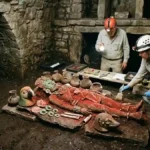
Because the community took the time to bury these individuals together in a single, highly coordinated event, researchers strongly suspect that the victims belonged to the exact same family unit or tight-knit social group. The presence of young children alongside adults highlights the indiscriminate nature of the tragedy that befell them.
What Caused the Sudden Bronze Age Tragedy?
The anomalies surrounding the Twentyshilling Hill site leave archaeologists with a compelling question: What happened to this community more than three millennia ago?
The Tell-Tale Signs of Regional Hardship
Archaeologists hypothesize that a sudden, extreme environmental or social crisis struck the region. The simultaneous death of adults and children within a single household points toward an acute catastrophe rather than prolonged warfare, which typically leaves distinct trauma on skeletal remains. The most likely culprits include:
Famine and Crop Failure: A sudden shift in localized climate patterns could have shortened growing seasons, leading to rapid starvation.
Devastating Disease Outbreaks: A virulent pathogen could easily sweep through an isolated Bronze Age settlement, wiping out vulnerable families within days.
Extreme Resource Scarcity: A sudden collapse in local ecosystems could have triggered acute hardship, leaving communities unable to sustain themselves.
This theory of a widespread regional crisis is firmly supported by broader archaeological data collected across Dumfries and Galloway. Other regional excavations from the same era show distinct markers of severe hardship, sharp population declines, and the sudden abandonment of long-established settlements. The Twentyshilling mass burial serves as concrete, human evidence of this broader regional collapse.
Deep Roots: The Neolithic Connection
Interestingly, the story of Twentyshilling Hill stretches back even further into antiquity than the Bronze Age crisis. Further excavations in the immediate vicinity exposed a cluster of much older pits dating to the late Neolithic period, roughly between 2867 and 2504 BCE.
The Power of Ancestral Memory
These older features mean that more than a thousand years before the mass burial took place, human communities were already interacting with this specific landscape. The absence of permanent structures suggests that people did not live here continuously. Instead, they returned to this specific hilltop over many centuries, driven by a powerful ancestral memory.
When the catastrophic event struck the Bronze Age community over a millennium later, they chose this exact hill to bury their loved ones. They were drawing upon a deeply rooted sacred geography, choosing a place that their ancestors had recognized as significant for centuries to comfort them during a time of unprecedented grief.
Redefining Our View of Prehistoric Resilience
The discoveries at Twentyshilling Hill provide an invaluable, rare window into the realities of prehistoric life and death in southern Scotland. It moves past the traditional view of a static, slowly evolving Bronze Age culture and replaces it with a narrative of dynamic human resilience in the face of sudden, catastrophic change.
While the story is undeniably tragic, the care and effort put into constructing the barrow and crafting the urns prove that even during moments of absolute societal breaking points, these ancient people maintained their dignity, their family bonds, and their profound connection to the landscape.
Frequently Asked Questions
What makes the Twentyshilling Hill burial unique compared to other Bronze Age sites?
Most Bronze Age burials in Scotland show evidence of being reused over long periods, with mounds being reopened for new generations. The Twentyshilling barrow was created for a single, immediate burial event where multiple individuals were interred simultaneously, indicating an emergency response to a sudden crisis.
How many people were found in the mass grave?
Archaeologists discovered the cremated remains of at least eight individuals. The remains included a mix of both adults and juveniles distributed across five ceramic urns.
When exactly did this ancient crisis take place?
Radiocarbon dating places the mass burial event between 1439 and 1287 BCE, during the British Bronze Age. The older surrounding pits date back even further, to the late Neolithic period between 2867 and 2504 BCE.
What do scientists believe caused the mass deaths?
The combination of rapid burials, a mix of adults and children, and regional evidence of community abandonment suggests a sudden crisis such as a severe famine, a deadly disease outbreak, or localized environmental collapse.
Who conducted the excavation at this site?
The fieldwork and subsequent archaeological analyses were conducted by the expert team at GUARD Archaeology Ltd during surveys in 2020 and 2021.