
Table of Contents
- 1. Mapping the Eurasian Genetic Divide
- 2. The Jomon Outlier: A Pristine Lineage
- 3. Shifting Archipelagos: The Kofun Dilution
- 4. Conclusion
- 5. Frequently Asked Questions
- 5.1. Who were the Denisovans?
- 5.2. Who were the Jomon people?
- 5.3. Why do modern Japanese people have more Denisovan DNA than ancient Jomon?
- 5.4. What was the Last Glacial Maximum?
- 5.5. How does low Denisovan DNA prove a separate migration route?
Prehistoric Jomon DNA Explores a Lost, Denisovan-Free East Asian Lineage
A groundbreaking genomic study has challenged long-held views on early human migrations in East Asia, revealing that Japan’s prehistoric Jomon people carried the lowest levels of Denisovan DNA ever recorded in the region. The findings suggest that a distinct, early lineage of Homo sapiens traveled across Asia while completely bypassing or avoiding contact with archaic Denisovan populations.
Published in Current Biology, the study analyzed hundreds of ancient and modern genomes to map how DNA from Denisovans—an extinct group of archaic humans that inhabited Eurasia between 200,000 and 30,000 years ago—became distributed across the globe. While Denisovan genetic heritage is found in varying degrees across modern East Asia, Southeast Asia, the Americas, and Oceania, its distribution is incredibly uneven. The Jomon people have emerged as a massive genetic outlier, reshaping the map of ancient human interactions.
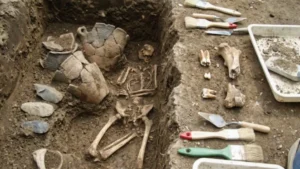
Prehistoric Jomon DNA Explores a Lost, Denisovan-Free East Asian Lineage
Mapping the Eurasian Genetic Divide
To chart these ancient interbreeding events, an international team of geneticists evaluated a massive dataset comprising the genomes of 115 ancient individuals from East Asia, Siberia, the Americas, and West Eurasia, alongside genetic profiles from 279 modern humans.
 Mamluk Infrastructure Uncovered: Medieval Water System and Mosque Discovered Near Cairo’s Citadel
The genomic maps revealed two vastly different ancestral experiences across ancient Eurasia:
Mainland East Asians: Ancient populations in modern-day China and Mongolia exhibited the highest density of Denisovan ancestry in Eurasia. Their genetic profiles show signals from multiple, distinct Denisovan groups, with interbreeding events occurring well before the Last Glacial Maximum (roughly 26,500 to 19,000 years ago).
Western Eurasians: Showed minimal to non-existent Denisovan genetic input, indicating that geographic barriers heavily restricted contact between early modern humans and Denisovans in the West.
       [Ancient Denisovan Admixture Spectrum]
 ___________________________________________________________
| Mainland East Asians: | Highest Eurasia levels (Multiple events) |
| Modern East Asians:   | Moderate levels (Diluted by migrations)  |
| Western Eurasians:    | Minimal / Negligible genetic trace       |
| Jomon Culture (Japan):| Extreme Outlier (Lowest regional trace)  |
 ___________________________________________________________
The Jomon Outlier: A Pristine Lineage
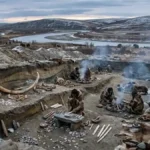
The prehistoric Jomon people of Japan, who lived between 16,000 and 3,000 years ago, stood completely apart from their mainland neighbors. The study revealed that their genomes contained a fraction of the Denisovan DNA found in ancient mainland Asians, dropping even well below the percentages seen in modern-day East Asian populations.
In fact, the genome of a Jomon individual who lived roughly 4,000 years ago demonstrated only a small percentage of the Denisovan DNA carried by modern Japanese people today.
[Early Out-of-Africa Wave] ---> Separate Migration Route (No Denisovans) ---> Ancient Jomon (Japan)
[Mainland Asian Wave]      ---> Deep Denisovan Interbreeding             ---> Mainland East Asians
This discovery provides strong evidence for the existence of a deep, isolated East Asian lineage that successfully avoided Denisovan contact. Researchers hypothesize that this group may have taken a completely different, highly isolated migration route into East Asia, or traveled through regions where Denisovan populations were entirely absent due to patchy, fragmented territories.
Shifting Archipelagos: The Kofun Dilution
The genetic landscape of Japan did not remain static. The exceptionally low Denisovan signature of the isolated Jomon people was gradually altered by subsequent waves of migration from the Asian mainland.
During the Kofun period (CE 300–710), large-scale migrations from mainland East Asia swept into the Japanese archipelago. These incoming populations brought advanced agricultural techniques, distinct cultural practices, and a vastly different genetic profile—one heavily shaped by ancient mainland interbreeding with Denisovans. Over centuries of integration, these migrations introduced higher levels of Denisovan DNA into the islands, dilatively masking the original, unique genetic signature of the Jomon ancestors.
| Historical Cohort | Sample Age | Denisovan Ancestry Profile |
| Ancient Mainland Asians | Pre-Glacial Maximum | Maximum Eurasian density; multi-group input |
| Ancient Jomon Individual | ~4,000 years ago | Extremely low; fraction of modern baselines |
| Modern Japanese | Contemporary | Moderate; increased via Kofun period migrations |
While modern humans are known to have inhabited the Japanese islands as early as 32,000 years ago, the oldest Jomon genome sequenced so far dates back only 9,000 years.
Conclusion
The genomic profiling of the Jomon people has exposed a fascinating chapter in human evolution, proving that the settlement of East Asia was far more complex than a single wave of moving populations. By demonstrating that the Jomon belonged to an isolated lineage that largely evaded Denisovan contact, this research opens up new pathways for exploring ancient migration corridors. As paleogeneticists work to bridge the remaining 23,000-year gap in Japan’s skeletal record, the bones of the Jomon continue to serve as an invaluable biological library documenting the diverse paths our ancestors walked.
Frequently Asked Questions
Who were the Denisovans?
The Denisovans are an extinct species or subspecies of archaic humans that lived across Eurasia during the Lower and Middle Paleolithic periods. Closely related to Neanderthals, they are known primarily through advanced genetic sequencing of fragile bone fragments discovered in Siberia’s Denisova Cave, as well as structural remains found on the Tibetan Plateau and in China.
Who were the Jomon people?
The Jomon were the prehistoric hunter-gatherer-fisher populations of Japan, active from roughly 14,000 BCE to 300 BCE. They are famous for creating some of the oldest developed ceramic pottery in the world, building complex pit-dwelling villages, and maintaining a highly affluent, sedentary foraging lifestyle.
Why do modern Japanese people have more Denisovan DNA than ancient Jomon?
The original Jomon population had almost no Denisovan DNA. However, during the later Kofun period (CE 300–710), mass migrations from mainland East Asia moved into Japan. These mainland populations carried significant amounts of Denisovan DNA from ancient interbreeding events. Their integration with the indigenous Jomon population raised the overall Denisovan genetic percentage in modern Japanese populations.
What was the Last Glacial Maximum?
The Last Glacial Maximum (LGM) occurred between 26,500 and 19,000 years ago, representing the peak of the last ice age when global ice sheets reached their greatest structural extent. The severe climate shifts altered sea levels and created land bridges, radically redirecting human migration pathways across East Asia.
How does low Denisovan DNA prove a separate migration route?
Because mainland ancient populations across China and Mongolia possess high, uniform levels of Denisovan DNA from multiple old interbreeding events, any group branching directly from them would share that signature. The fact that the Jomon lack this marker indicates their ancestors must have split off and migrated eastward before those mainland interbreeding events occurred, traveling through areas devoid of Denisovan populations.