
Table of Contents
- 1. Unveiling the Secrets of Sugarloaf Hill
- 1.1. Advanced Dating Techniques Confirm a 7,000-Year Legacy
- 2. The Ancient Supply Chain: Trading Across the Murray-Darling Basin
- 2.1. Society, Trade, and the Middle Holocene Boom
- 3. Archaeological Footprints: Camps, Middens, and Raw Materials
- 4. Mapping the Future of Indigenous Heritage
- 4.1. Chemical Fingerprinting of Ancient Stone
- 4.2. Culturally Centered Conservation
- 5. Conclusion
- 6. Frequently Asked Questions
- 6.1. What is the significance of the Sugarloaf Hill Quarry discovery?
- 6.2. What types of stone were mined at the quarry?
- 6.3. How do scientists know the stone was traded over long distances?
- 6.4. What other societal changes happened during the peak of this quarry’s use?
- 6.5. Who conducted this research?
7,000-Year-Old Aboriginal Quarry Rewrites Australian History
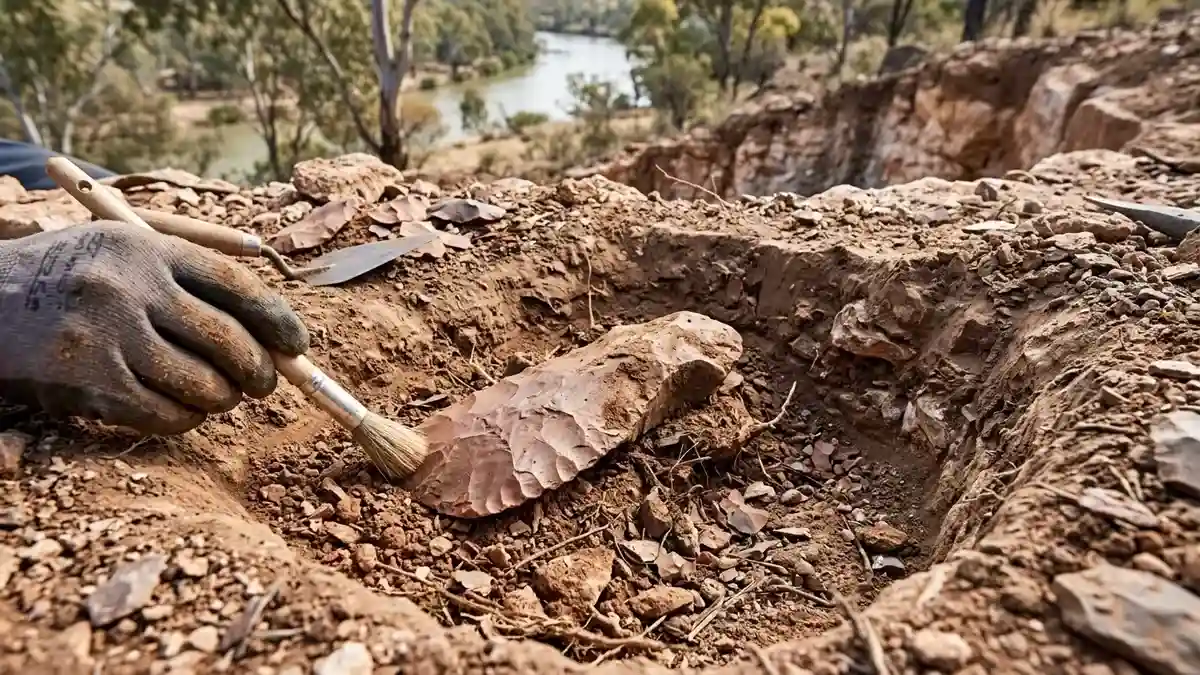
A groundbreaking archaeological discovery along South Australia’s Murray River is reshaping our understanding of ancient Indigenous civilization. A collaborative study has revealed that Aboriginal communities utilized a major stone quarry in the Riverland region for at least 7,000 years. This landmark research provides the first comprehensive look at the Sugarloaf Hill Quarry, proving that the site was not just a local resource, but a bustling hub for tool production and sophisticated long-distance trade networks.
The study, published in the journal Archaeology in Oceania, represents a monumental step forward in validating the rich, deep-time history of Australia’s First Nations people. By establishing a reliable timeline for this ancient mining operation, researchers are filling critical gaps in the archaeological record of the southwestern Murray-Darling Basin.
7,000-Year-Old Aboriginal Quarry Rewrites Australian History
 1,600-Year-Old Coin Hoard Unearthed in Galilee Tunnels Reveals Last Jewish Rebellion Against Rome
Unveiling the Secrets of Sugarloaf Hill
Situated near Overland Corner in South Australia’s picturesque Riverland, Sugarloaf Hill has long been recognized by archaeologists as a place of historical interest. However, until recently, very little was known about the exact age of the quarry or its broader role in ancient Australian society.
The geological landscape of the area features the Woorinen Formation, where ancient peoples successfully mined two highly prized types of rock: silcrete and chert. These hard, fine-grained materials were the premium choices for crafting sharp, durable stone tools and weapons.
Advanced Dating Techniques Confirm a 7,000-Year Legacy
To unlock the timeline of the quarry, a diverse team of scientists employed multiple advanced dating methods to analyze both the archaeological artifacts and the surrounding geological strata. The results were staggering, confirming that systematic mining activities at Sugarloaf Hill stretched back seven millennia.

A 15-meter-deep geological exposure in a nearby quarry section provided a clear cross-section of the Earth’s layers, allowing researchers to contextualize the landscape that supported this multi-generational mining enterprise. This discovery challenges the outdated notion that ancient Aboriginal societies were purely nomadic, revealing instead a deeply rooted, sustainable relationship with specific industrial sites.
The Ancient Supply Chain: Trading Across the Murray-Darling Basin
One of the most exciting revelations of the study is the evidence of an extensive, highly organized regional trade network. The specific silcrete and chert formations found at Sugarloaf Hill only occur naturally within a narrow, geographical stretch of the Murray River, spanning from Berribee in northwestern Victoria to Overland Corner in South Australia.
Despite this localized source, tools made from these exact materials have been discovered by archaeologists far beyond these geographic boundaries. This indicates that Riverland stone was a highly valued commodity distributed through sophisticated, long-distance exchange networks.

Society, Trade, and the Middle Holocene Boom
Evidence suggests that the distribution of Riverland stone reached the Lower Murray by the middle Holocene epoch—a period that coincided with profound social and cultural shifts among Aboriginal populations.
During this timeframe, the archaeological record shows a dramatic increase in:
Large-scale cemeteries: Indicating more permanent territories and growing populations.
Massive earth oven mounds: Used primarily for processing abundant aquatic plant foods.
Advanced grinding stones: Reflecting intensive food preparation techniques.
The parallel growth of stone tool distribution and these massive community infrastructures suggests that the Sugarloaf Hill Quarry played a foundational role in fostering stronger, more interconnected social ties between different Aboriginal groups living along the river system.
Archaeological Footprints: Camps, Middens, and Raw Materials
Interestingly, the research team discovered very few large-scale stone-working workshops directly adjacent to the Sugarloaf Hill Quarry site itself. Instead, the surrounding landscape tells a different story.
Numerous ancient campsites and shell middens scattered throughout the Riverland region contain an abundance of finished stone artifacts and discarded flakes made from Sugarloaf Hill silcrete and chert. This suggests that the quarry functioned primarily as a raw material extraction site. Aboriginal miners would extract the high-quality stone and transport it to nearby residential camps or trade hubs to be meticulously shaped into specialized tools.
Despite its massive historical significance, the Riverland region has historically received far less archaeological attention than other famous Aboriginal quarry sites across Australia. This study firmly places the region on the map as a critical center of ancient industry.
Mapping the Future of Indigenous Heritage
The research was spearheaded by Dr. Craig Westell alongside a dedicated team from Flinders University and the River Murray and Mallee Aboriginal Corporation (RMMAC). According to the research team, establishing this 7,000-year timeline is just the beginning of a much larger initiative.
Chemical Fingerprinting of Ancient Stone
The next phase of the project involves identifying the unique “chemical fingerprints” of the silcrete and chert found at Sugarloaf Hill. By creating a chemical profile of the source rock, scientists can compare it to stone artifacts found at various archaeological sites across Australia. This innovative process will allow researchers to:
Trace the exact geographic origin of displaced artifacts.
Map prehistoric trade routes with unprecedented accuracy.
Understand the economic relationships between distant tribal nations.
Culturally Centered Conservation
Beyond its scientific value, the study underscores the profound cultural and spiritual importance of these ancient quarries. For Indigenous communities, these sites are not merely historical anomalies; they represent unbroken, living connections to their ancestors, traditional land ownership, and the Dreaming.
The authors emphasize that this scientific data is intended to empower community-led conservation efforts, ensuring that the River Murray and Mallee Aboriginal Corporation and local guardians have the resources and recognition necessary to protect these sacred heritage spaces for generations to come.
Conclusion
The revelation that the Sugarloaf Hill Quarry was actively mined for 7,000 years is a powerful reminder of the complexity and longevity of Aboriginal civilization. It paints a vivid picture of ancient Australia as a place of industry, innovation, and interconnected economies. As researchers continue to uncover the chemical trails of these ancient tools, we can look forward to a deeper, more respectful understanding of the continent’s first engineers and traders.
Frequently Asked Questions
What is the significance of the Sugarloaf Hill Quarry discovery?
The discovery proves that Aboriginal people systematically mined the Sugarloaf Hill site for at least 7,000 years. This fills a major gap in the archaeological history of the Murray-Darling Basin and provides concrete evidence of long-term ancient industry and regional trade networks.
What types of stone were mined at the quarry?
Aboriginal miners primarily extracted silcrete and chert from the site. These are hard, fine-grained sedimentary rocks that were ideal for fracturing into sharp edges to create durable tools, scrapers, knives, and weapons.
How do scientists know the stone was traded over long distances?
The specific geological formations of silcrete and chert found at Sugarloaf Hill only exist along a narrow stretch of the Murray River. However, tools made from these distinct stones have been found far outside this native zone, proving they were moved through complex, long-distance Indigenous trade networks.
What other societal changes happened during the peak of this quarry’s use?
During the middle Holocene, the period when trade from the quarry flourished, archaeologists also noted a rise in permanent cemeteries, large food-processing oven mounds, and a higher prevalence of grinding stones. This points to growing populations and increased social connectivity among river groups.
Who conducted this research?
The study was a collaborative effort led by Dr. Craig Westell and researchers from Flinders University, working in close partnership with the traditional owners represented by the River Murray and Mallee Aboriginal Corporation (RMMAC).