
Table of Contents
- 1. Redefining the History of the Hukok Complex
- 2. The Faces of the Oppressors: Constans I and Constantius II
- 3. A Dream of Survival Never Realized
- 4. From War Zone to Unexpected Prosperity
- 5. Frequently Asked Questions
- 5.1. What is the significance of the Hukok coin hoard?
- 5.2. Who is depicted on the faces of the coins?
- 5.3. Why were the tunnels originally built?
- 5.4. Why did the owner leave the coins behind?
- 5.5. What happened to the town of Hukok after the rebellion was crushed?
1,600-Year-Old Coin Hoard Unearthed in Galilee Tunnels Reveals Last Jewish Rebellion Against Rome
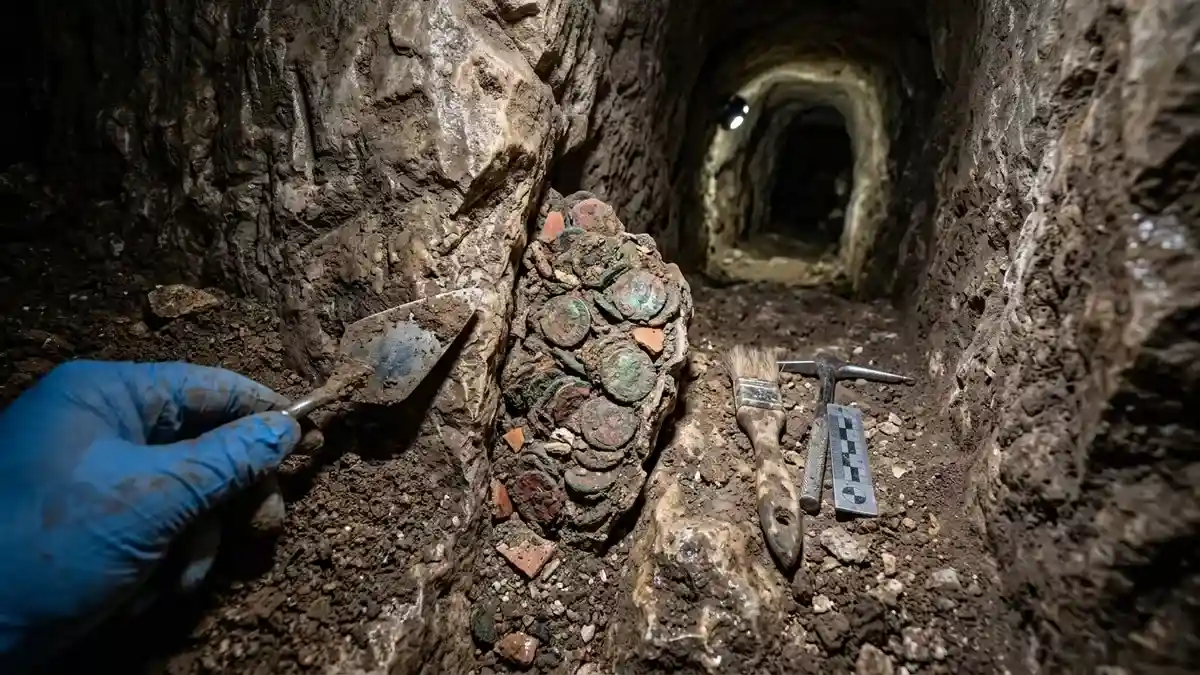
Deep within a labyrinth of ancient underground tunnels in northern Israel, archaeologists have made an extraordinary discovery that sheds light on one of the most turbulent and poorly documented chapters of Roman Judea. A hidden stash of 22 copper coins, dating back more than 1,600 years, was found wedged tightly into a narrow rock crevice at the end of a winding subterranean passageway.
Uncovered at the historic Hukok site in Lower Galilee, this coin hoard provides rare, tangible evidence of the Gallus Revolt (351–352 CE)—the final, desperate Jewish rebellion against Roman imperial rule. The find dramatically reshapes our understanding of the site, proving that underground networks built centuries earlier were secretly repurposed as bomb shelters during a later, bloody conflict.
1,600-Year-Old Coin Hoard Unearthed in Galilee Tunnels Reveals Last Jewish Rebellion Against Rome
Redefining the History of the Hukok Complex
The discovery was made during a collaborative excavation project spearheaded by the Israel Antiquities Authority alongside Zefat Academic College. The team was clearing the underground system in preparation for transforming the ancient settlement into an archaeological tourism destination.

The Hukok hiding complex is a massive, highly intricate subterranean web featuring twisting tunnels, defensive chambers, and hidden drop-pits.
Phase 1 Construction: The network was originally carved out of the bedrock during the Great Revolt against Rome (66–70 CE).
Phase 2 Expansion: It was later widened and heavily modified during the Bar-Kochba Revolt (132–136 CE).
Because the tunnels were structurally tied to these two massive historical conflicts, historians initially assumed that any artifacts uncovered inside would date to the first or second centuries. The newly discovered cache of coins completely defied those expectations.
The Faces of the Oppressors: Constans I and Constantius II
Once laboratory conservators carefully cleaned and stabilized the 22 corroded copper pieces, the true age of the treasure came to light. The coins do not bear the imagery of first-century Judean rebels. Instead, they are stamped with the official profiles of Roman Emperors Constans I and Constantius II.
[Great Revolt (66–70 CE)] ──► Tunnels Carved
                                  │
[Bar-Kochba Revolt (132–136 CE)] ─┼─► Tunnels Expanded
                                  │
[Gallus Revolt (351–352 CE)] ─────► Hidden Coin Hoard Deposited (Constantius II Era)
The reigns of these specific fourth-century emperors align perfectly with the timeline of the Gallus Revolt. This brief, bloody insurrection erupted in the mid-4th century CE when Jewish communities across Galilee rose up against the heavy-handed authority of Constantius Gallus, the Caesar assigned to govern the eastern Roman provinces.
Because contemporary accounts written by ancient Roman historians are incredibly scarce, physical evidence of the Gallus Revolt has remained exceptionally rare. The Hukok hoard acts as an undeniable physical confirmation that the local population was actively participating in the rebellion, fleeing deep underground to escape marching Roman legions.
A Dream of Survival Never Realized
The Gallus Revolt ended in absolute disaster for the rebels, with elite Roman military forces systematically crushing the regional uprisings. However, the exact placement of the Hukok coins suggests that the individuals fleeing into the dark were not entirely devoid of hope.
Tucked away at the absolute terminus of a narrow crawlspace, the small cache of currency was likely hidden as an emergency financial reserve. The owner intended to survive the immediate military onslaught, hide out in the dark, and dig up their savings once the smoke cleared.
Because the copper coins remained sealed in the rock crevice for 1,600 years, it is clear that the person who hid them never made it back.
From War Zone to Unexpected Prosperity
While the suppression of the Gallus Revolt was a dark chapter for the region, the archaeological record reveals that Hukok’s story didn’t end in permanent ruin.
Surprisingly soon after the Roman military campaign ended, the settlement on the surface entered a golden age of economic recovery and cultural prosperity. This post-war renaissance was highlighted by the construction of a monumental public synagogue on top of the hill, famous for its lavish, intricately detailed mosaic floors.
The Israel Antiquities Authority now views Hukok as a flagship archaeological site, highlighting the sheer resilience of Jewish communities in Galilee under centuries of changing Roman authority. The coins are slated to be formally published in the journal Israel Numismatic Research before being displayed to the public.
Frequently Asked Questions
What is the significance of the Hukok coin hoard?
The 22 copper coins provide rare, definitive physical evidence of the Gallus Revolt (351–352 CE), which was the very last documented Jewish uprising against Roman rule. Physical artifacts from this specific conflict are incredibly rare in the archaeological record.
Who is depicted on the faces of the coins?
The coins bear the portraits of Roman Emperors Constans I and Constantius II, who ruled during the mid-fourth century CE. These profiles allowed numismatists (coin experts) to date the hoard precisely.
Why were the tunnels originally built?
The Hukok underground complex was originally engineered during the Great Revolt against Rome (66–70 CE) and later expanded during the Bar-Kochba Revolt (132–136 CE). The discovery proves that these ancient military hideouts were reused by locals over 200 years later.
Why did the owner leave the coins behind?
Archaeologists believe the coins were hidden away as an emergency fund during the chaos of the Roman military crackdown. Because the coins were never retrieved, it is highly likely the owner was captured, displaced, or killed during the conflict.
What happened to the town of Hukok after the rebellion was crushed?
Despite the tragic failure of the revolt, Hukok quickly recovered. Shortly after the war, the town entered a highly prosperous era, building a grand synagogue decorated with world-renowned mosaic artwork right over the hill.