
Table of Contents
- 1. Redefining the Gestures of Royalty
- 2. Deconstructing the Maya Long Count Calendar
- 3. Scepticism and the Search for Parallel Texts
- 4. A New Window Into Pre-Columbian Art
- 5. Frequently Asked Questions
- 5.1. What is Altar Q and where is it located?
- 5.2. Who are the figures carved onto the sides of the altar?
- 5.3. How do the hand signs supposedly reveal calendar dates?
- 5.4. What is the Maya Long Count calendar?
- 5.5. Why are some archeologists skeptical of this new theory?
Maya Hand Signs on 1,300-Year-Old Altar May Reveal Hidden Calendar Dates
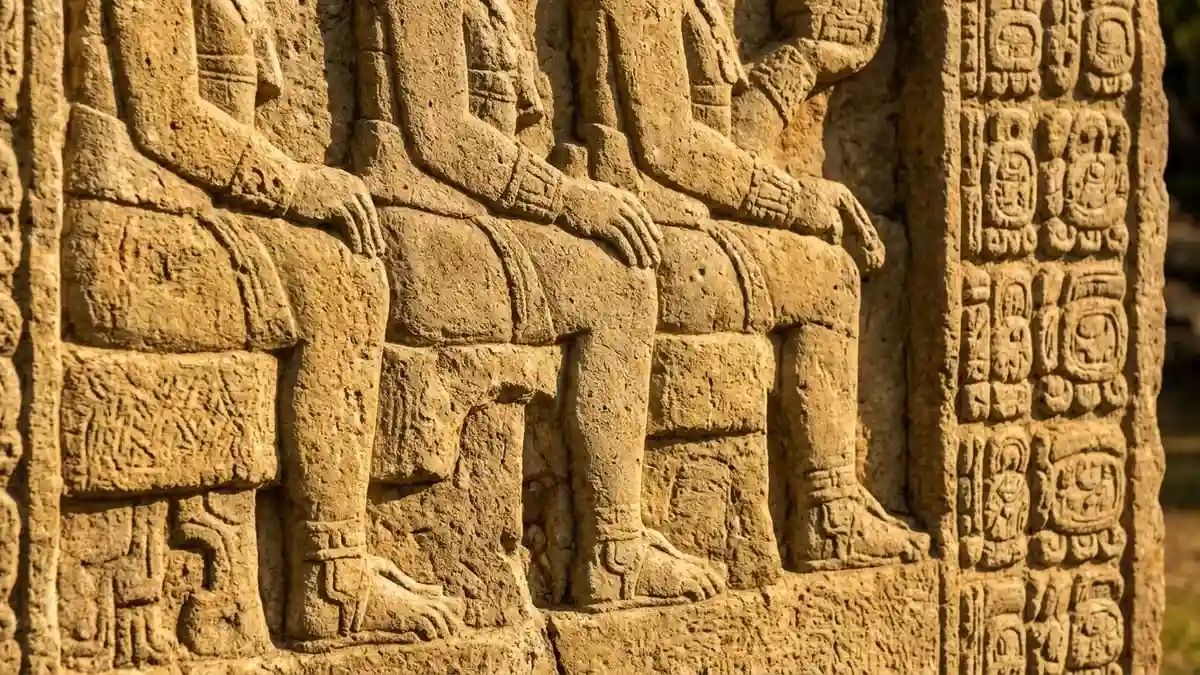
For well over a century, Altar Q has stood as one of the most iconic and thoroughly studied masterpieces of the ancient Maya civilization. Carved in 776 CE within the regal acropolis of Copán—a major Maya capital located in modern-day Honduras—this four-sided limestone monument features an intricate relief of 16 seated figures accompanied by a dense block of hieroglyphic text.
While mainstream archaeology has long accepted the monument as a straightforward dynastic history tracing the lineage of Copán’s kings, a groundbreaking linguistic study has introduced a radical new theory: the specific hand gestures performed by the carved rulers are not mere artistic flourishes, but rather a hidden, highly structured sign language that encodes precise numerical dates from the complex Maya Long Count calendar.
Published in the Transactions of the Philological Society, this research suggests that ancient Maya monuments utilized a dual-script system, embedding parallel written records directly into figural artwork. If proven correct, the theory adds an entirely new dimension to pre-Columbian communication systems and fundamentally rewrites how we decode Mesoamerican art.
Maya Hand Signs on 1,300-Year-Old Altar May Reveal Hidden Calendar Dates

Redefining the Gestures of Royalty
The innovative study was spearheaded by Rich Sandoval, a linguistic anthropologist at the Metropolitan State University of Denver. Sandoval carefully isolated and cataloged the physical hand positions of all 16 rulers seated around the perimeter of Altar Q.
Sandoval discovered that the gestures could be systematically grouped into four distinct sets—one for each face of the altar. Rather than random royal poses, these signs are organized in a sequential, left-to-right reading order. By comparing repeating hand positions to known hieroglyphic variants of the number zero and other numeric symbols, Sandoval identified 11 distinct numeral forms based entirely on finger orientation, palm position, and hand shape.
According to his hypothesis, these gestures mathematically spell out four specific chronological milestones within the ninth bʼakʼtun of the Maya calendar:

9.0.2.0.0 (Corresponding to November 27, 437 CE)
9.16.13.12.0 (Corresponding to October 21, 764 CE)
9.17.5.0.15 (Corresponding to January 7, 776 CE)
9.19.10.0.0 (Corresponding to April 30, 820 CE)
Deconstructing the Maya Long Count Calendar
To understand how these hand signs carry meaning, one must look at how the Maya structured time. Unlike our modern linear calendar, the Maya Long Count tracked time using a nested system of base-20 chronological cycles, counting the exact number of days that had passed since a mythical creation date in 3114 BCE.
The nested blocks of the Long Count calendar include:
[1 kʼin = 1 Day] ──► [20 kʼin = 1 winal] ──► [18 winal = 1 tun (360 days)] ──► [20 tun = 1 kʼatun] ──► [20 kʼatun = 1 bʼakʼtun]
Sandoval’s structural analysis indicates that the individual hand gestures of the rulers explicitly convey the numeric values for the kʼatun, tun, winal, and kʼin placeholders.
The largest cycle, the bʼakʼtun (which encompasses 144,000 days), is not signed with a hand gesture. Instead, Sandoval speculates that the overarching bʼakʼtun values are cleverly broadcasted by broader design motifs across the monument, such as the stylistic rendering of the rulers’ heads and the structural borders of the altar rim.
Interestingly, while the standard hieroglyphs carved onto the top of Altar Q explicitly describe major calendar rituals and historical events, they conspicuously omit the standard Long Count dates. Sandoval argues that the hidden hand script was designed to step in and fill those exact chronological gaps, providing a secondary, parallel narrative to the text.
Scepticism and the Search for Parallel Texts
While the hypothesis offers an elegant solution to some of the unwritten elements of Copán’s iconography, it has sparked intense debate among traditional Mayanists and epigraphers (ancient script experts).
Several specialized researchers urge caution, noting that Sandoval’s model might rely on selective patterns. Skeptics argue that hand gestures are a ubiquitous feature of Mesoamerican art used to convey a wide variety of non-numerical concepts, such as submission, royal authority, conversation, or the presentation of sacred objects.
Before the academic community officially declares these hand forms a formal, standardized writing system, epigraphers require the model to be successfully tested against other monuments outside of Copán to see if the numerical values hold up across the wider Maya region.
A New Window Into Pre-Columbian Art
Despite the pushback, Sandoval’s research underscores the immense, multi-layered sophistication of ancient Maya communication. By demonstrating that figural body language could potentially operate as a formal numeric code alongside standard hieroglyphic blocks, the study challenges researchers to re-examine thousands of stone monuments, murals, and painted ceramics across Central America. What modern eyes have dismissed for centuries as simple artistic portraits may actually be highly complex mathematical records waiting to be read.
Frequently Asked Questions
What is Altar Q and where is it located?
Altar Q is a world-famous, four-sided stone monument carved in the late eighth century CE. It is located in the ancient Maya capital city of Copán, within modern-day western Honduras.
Who are the figures carved onto the sides of the altar?
The monument features relief carvings of 16 individuals. They represent the official dynastic lineage of Copán’s rulers, seated in chronological order around the perimeter of the stone block.
How do the hand signs supposedly reveal calendar dates?
According to the new linguistic study, the specific shapes, positions, and finger orientations of the rulers’ hands correspond to distinct numbers. Read in a sequence, these signed numbers mirror the numerical structure used to calculate dates in the Maya Long Count calendar.
What is the Maya Long Count calendar?
The Long Count is a sophisticated, cyclical timekeeping system used by the ancient Maya to record large stretches of history. It calculates time through nested blocks of days: the kʼin (1 day), winal (20 days), tun (360 days), kʼatun (7,200 days), and bʼakʼtun (144,000 days).
Why are some archeologists skeptical of this new theory?
Many epigraphers and Mayanists are hesitant to accept the hand-sign theory without further evidence. They caution that the pattern might be coincidental and that more examples of this signed numerical script must be discovered on other regional monuments to prove it was a widespread, formal writing system.