
Table of Contents
- 1. The Bedale Hoard: A Masterpiece of the Bullion Economy
- 1.1. Inside the Norse Bullion System
- 2. Fingerprinting the Metal: Lead Isotopes and Trace Elements
- 3. The Austrvegr Highway: How Silk Road Silver Reached Yorkshire
- 4. Local Craftsmanship and Advanced Metallurgy
- 5. Conclusion: An Interconnected Medieval World
- 6. Frequently Asked Questions
- 6.1. What is the Bedale Hoard, and where was it found?
- 6.2. How did scientists prove the silver came from Iran and Iraq?
- 6.3. What is a “bullion economy”?
- 6.4. What was the “Austrvegr,” and how was it used?
- 6.5. Did the Vikings make their own jewelry in England?
Viking Silver Hoard Reveals 9th-Century Trade Links From England to Iran
For generations, the popular image of the Vikings has been defined by bloodcurdling coastal raids, the burning of defenseless Christian monasteries, and the ruthless extortion of silver randsoms from European kings. While plunder was undoubtedly a primary driver of the early Scandinavian economy, a groundbreaking new archaeological study is proving that this one-dimensional caricature is incomplete. Deep within the soil of northern England, a spectacular hoard of ancient treasure has revealed that the Norsemen were also highly sophisticated global merchants whose commercial networks stretched far past the borders of Europe into the heart of the Middle East.
By subjecting a legendary 9th-century silver cache to state-of-the-art chemical and isotopic analysis, researchers have successfully mapped the microscopic fingerprints of ancient wealth. The data confirms that early Viking settlers in England were actively trading with partners thousands of miles away in modern-day Iran and Iraq, using a vast web of river systems and desert routes to funnel massive quantities of Islamic silver directly into the British Isles.
Viking Silver Hoard Reveals 9th-Century Trade Links From England to Iran
The Bedale Hoard: A Masterpiece of the Bullion Economy
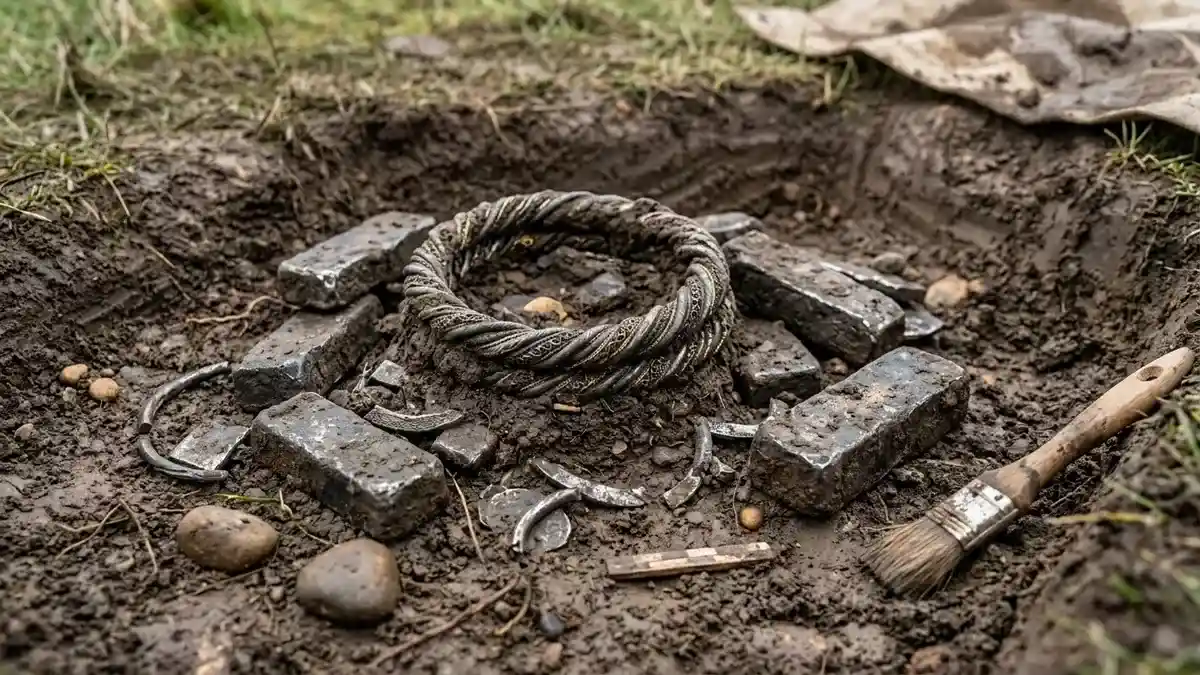
The scientific catalyst for this historical rewrite is the Bedale Hoard, an exceptionally rich collection of Viking Age precious metals discovered by a metal detectorist in North Yorkshire in 2012. Dating to the late 9th or early 10th century, the cache captures a pivotal transitional moment in British history—an era when Norse warriors were transitioning away from seasonal coastal raids to establish permanent settlements, farmsteads, and governance hubs across northern England.
Inside the Norse Bullion System
Unlike the Anglo-Saxons or Carolingians, who used standardized, state-minted coins to conduct daily commerce, the Viking world operated primarily on a bullion economy. To a Viking merchant, the specific face stamped onto a coin carried absolutely zero value; only the physical weight and purity of the silver mattered. Foreign coins were routinely chopped into raw fragments (known as hacksilver), melted down into uniform bars (ingots), or twisted into wearable arm-rings and neck-pieces that could be sliced apart at the market scale to buy goods.

Fingerprinting the Metal: Lead Isotopes and Trace Elements
To map out the hidden origins of the Bedale wealth, a team of researchers led by Dr. Jane Kershaw, an Associate Professor of Viking Age Archaeology at the University of Oxford, partnered with experts from the British Geological Survey. The team selected 29 solid silver ingots alongside several of the hoard’s most ornate, multi-strand neck-rings to undergo intensive geochemical profiling.
By measuring the precise ratios of lead isotopes and analyzing trace elemental impurities locked within the silver matrix, scientists can match an artifact to the exact geographic mining region where the ore was initially pulled from the earth. The results, published in the scientific journal Archaeometry, identified three distinct, primary pipelines of precious metal flowing into Viking-age Yorkshire:
Western European Coinage: High-purity silver originating from Anglo-Saxon and Carolingian mints.
Islamic Dirhams: Near Eastern silver minted thousands of miles away in the Abbasid Caliphate.
Hybrid Blends: Recycled combinations of both eastern and western metals melted down in the same melting pot.
The Austrvegr Highway: How Silk Road Silver Reached Yorkshire
While the presence of Western European silver was fully expected—likely accumulated through localized raiding, regional trade, or the collection of Danegeld (protection money paid to buy off Viking armies)—the massive volume of Near Eastern silver stunned the research team. Nearly one-third of all the analyzed ingots were traced directly to silver coins minted inside the Islamic Caliphate.
These coins, known formally as dirhams, were originally struck using silver extracted from rich mining deposits located across modern-day Iran and Iraq. To travel from the royal mints of Baghdad or Samarkand to a muddy field in North Yorkshire, this treasure traversed the Austrvegr (literally “the Eastern Way”)—a sprawling network of dangerous Scandinavian trade routes that cut through Eastern Europe.
Viking merchants sailed their specialized longships down the expansive river systems of the Volga and the Dnieper, crossing the Baltic Sea to establish deep-time trading posts in modern-day Russia, Ukraine, and Belarus. There, they traded valued northern luxuries—such as high-grade amber, dark animal pelts, weapons, and enslaved captives—directly with Arab and Persian merchants in exchange for millions of silver dirhams flowing off the Silk Road. As these traders returned to Scandinavia or migrated west to settle in England, they brought this massive reservoir of Middle Eastern capital with them.
Local Craftsmanship and Advanced Metallurgy
Beyond tracking long-distance trade, the Oxford study uncovered fascinating evidence of highly advanced, localized metalworking operating within northern England itself. One of the most visually stunning artifacts within the Bedale Hoard is a massive, multi-strand twisted neck-ring inlaid with delicate gold foil.
The geochemical analysis revealed that this specific piece was manufactured using a highly complex hybrid blend of Eastern Islamic dirhams and Western European coins. This means that local Viking smiths—possibly setting up workshops right in Yorkshire—were actively gathering diverse international currencies, tossing them into a single crucible, and refining the molten liquid to forge traditional, high-status Scandinavian jewelry.
Furthermore, the study proved that these local metalworkers were not entirely dependent on imported metallurgical supplies. When refining and purifying their silver mixes, the smiths mixed in local lead sourced directly from the nearby mining fields of the North Pennines. This localized production loop demonstrates that the Norse settlers rapidly mapped the natural mineral resources of their new English homes, integrating local raw materials into their globalized industrial workflows.
Conclusion: An Interconnected Medieval World
Ultimately, the chemical breakdown of the Bedale Hoard serves as an invaluable diagnostic tool for dismantling old historical biases. The treasure proves that 9th-century England was not an isolated, terrified island cut off from global progress. Through the medium of Viking enterprise, the fields of North Yorkshire were linked directly to the booming economies of the Islamic Golden Age, framing the Vikings not merely as destructive barbarians, but as the primary global distributors who knitted the medieval world together.
Frequently Asked Questions
What is the Bedale Hoard, and where was it found?
The Bedale Hoard is a significant collection of silver and gold artifacts dating to the late 9th or early 10th century. It was discovered by a metal detectorist in 2012 in Bedale, North Yorkshire, England.
How did scientists prove the silver came from Iran and Iraq?
Researchers from the University of Oxford and the British Geological Survey utilized lead isotope and trace element analysis. By measuring the unique chemical signatures of the silver, they matched nearly one-third of the hoard’s ingots directly to silver mined and minted as “dirhams” inside the Islamic Caliphate.
What is a “bullion economy”?
Unlike modern economies that rely on printed paper or standardized coins with set values, a bullion economy measures wealth strictly by the physical weight and purity of precious metals. Vikings would routinely melt foreign coins down into bar-shaped ingots or wearable jewelry to use as raw currency weight.
What was the “Austrvegr,” and how was it used?
The Austrvegr, or “Eastern Way,” was a massive network of river and overland trade routes controlled by Scandinavian merchants. It cut through Eastern Europe along the Volga and Dnieper rivers, connecting the Baltic Sea directly to Islamic Silk Road markets near the Caspian and Black Seas.
Did the Vikings make their own jewelry in England?
Yes. The study revealed that a thick, multi-strand twisted neck-ring from the hoard was manufactured locally, combining recycled Islamic and European silver with local lead sourced directly from the North Pennines mining region.