
Table of Contents
- 1. The Surprising Rescue of a Near East Masterpiece
- 2. Reclaiming Hierapolis: The Sacred Crossroads of Antiquity
- 2.1. The Center of the Atargatis Cult
- 2.2. Witnessed by Lucian of Samosata
- 3. A Decoupled Heritage: The Tragedy of Syrian Looting
- 4. Manbij as a Staging Ground for the Illicit Antiquities Trade
- 5. A Monument to Resilience
- 6. Frequently Asked Questions
- 6.1. What exactly is the newly discovered artifact in Manbij?
- 6.2. What was the original purpose of this basalt stone?
- 6.3. What was Manbij called in ancient times?
- 6.4. How did the Syrian civil war impact the archaeology of the region?
- 6.5. What will happen to the eagle stele now?
Rare 2,000-Year-Old Roman Eagle Stele Discovered in Manbij, Syria
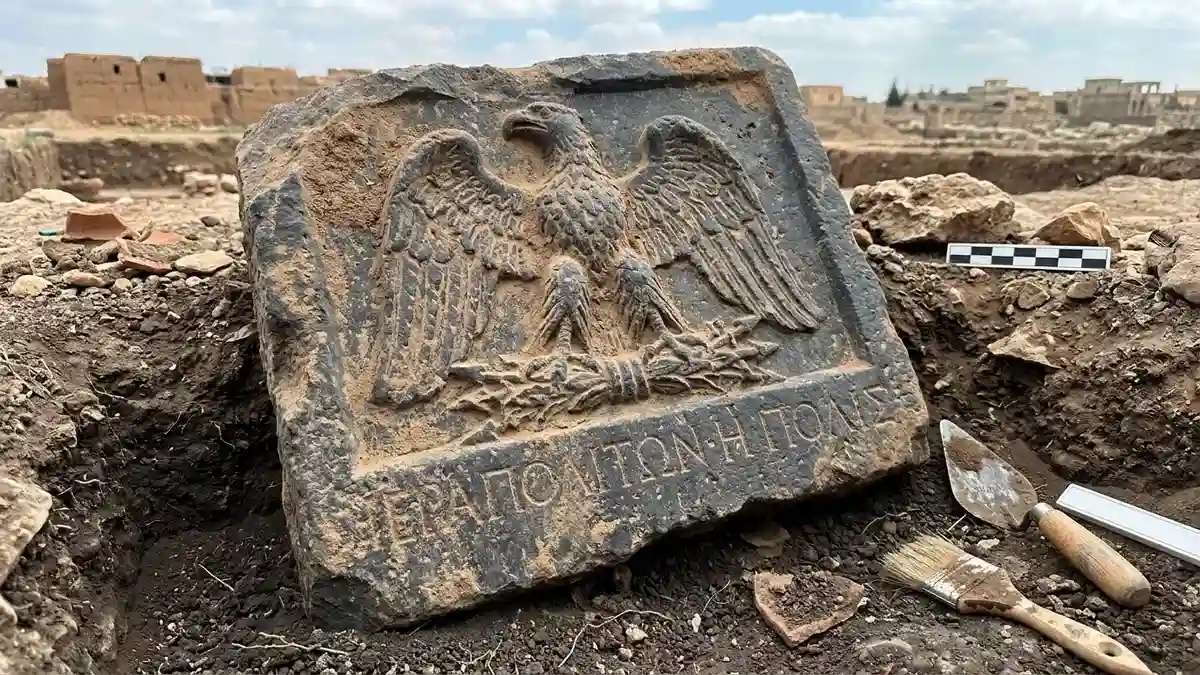
An exceptional archaeological discovery has emerged from northern Syria, where a local resident stumbled upon a highly significant Roman-era monument. Uncovered near the Cardamom wholesale market in the historic city of Manbij, east of Aleppo, the artifact is a beautifully carved, 2,000-year-old stone stele (an upright stone slab). Carved from dense, heavy black basalt, the monument features the detailed imagery of an imperial eagle spreading its wings while clutching a ceremonial wreath in its powerful talons.
Accompanying the masterfully executed relief is a clearly legible inscription written in ancient Greek. Based on the stylistic design and structural format, international experts theorize that this remarkable monument originally functioned as a high-status funerary marker or a public commemorative plaque during the peak of Roman rule in the Near East.
Rare 2,000-Year-Old Roman Eagle Stele Discovered in Manbij, Syria
The Surprising Rescue of a Near East Masterpiece
The discovery stands as a rare victory for heritage preservation amid the volatile geopolitical landscape of modern Syria. Upon spotting the carved black basalt stone emerging from the dirt, a civic-minded resident immediately contacted the Directorate of Museums and Antiquities rather than attempting to sell it to underground networks.
The agency rapidly deployed an emergency expeditionary team to secure the site, stabilize the monument, and carefully lift the heavy basalt slab from the ground. Currently, the stele is being kept under tight local security inside Manbij to ensure its safety while specialists finalize logistics to transfer the piece to the secure state laboratories in Aleppo for intensive translation and laser-scanning analysis.
Reclaiming Hierapolis: The Sacred Crossroads of Antiquity
To understand the historical magnitude of this basalt eagle, one must examine the deep, multi-layered history of Manbij itself. Long before the Roman legions marched into the Levant, the city was a thriving strategic powerhouse. Known in deep antiquity as a major cultural center for the Aramaic and Assyrian empires, the city experienced a massive transformation following the conquests of Alexander the Great.
Under the subsequent Greek Seleucid dynasty, the city was renamed Hierapolis, translating literally from Greek as the “Sacred City.” It rapidly blossomed into one of the wealthiest commercial and spiritual hubs on the Syrian Plateau.
The Center of the Atargatis Cult
Hierapolis achieved international fame across the ancient world as the epicenter for the worship of Atargatis, the premier Syrian goddess of fertility, water, and earthly abundance. The city’s massive temple complex was a monumental architectural marvel, drawing hundreds of thousands of pilgrims, merchants, and wealthy donors from every corner of the Mediterranean and Mesopotamia.
Witnessed by Lucian of Samosata
The grandeur and bizarre rituals of this sacred city were famously recorded by Lucian of Samosata, a highly influential, Syrian-born satirist and essayist of the 2nd century CE. In his celebrated treatise De Dea Syria (“On the Syrian Goddess”), written in exquisite Ionic Greek, Lucian provided a vivid, eyewitness account of the city’s massive religious processions, temple architecture, and the cultural melting pot that defined daily life.
When the Roman Empire eventually absorbed the region, imperial governors chose not to dismantle this local identity. Instead, they integrated Hierapolis into the Roman administrative fabric, allowing its Greek-speaking markets and traditional temples to flourish as a vital bridge between East and West.
A Decoupled Heritage: The Tragedy of Syrian Looting
The discovery of the eagle stele provides a stark, contrasting ray of hope against a tragic backdrop of modern destruction. Over the past fifteen years, the catastrophic Syrian civil war has taken a devastating toll on the country’s ancient monuments, turning priceless historical sites into literal battlefields.
According to conservative estimates released by the Directorate-General of Antiquities and Museums, the scale of the cultural tragedy is unprecedented:
Looted Artifacts: Between 2011 and 2019 alone, up to one million individual ancient artifacts are estimated to have been illegally plundered from museums and active excavation sites.
Destroyed Sites: More than 700 critically important archaeological landscapes across Syria have suffered permanent, catastrophic damage from heavy artillery, military trench-digging, and industrial-scale illegal excavations.
Manbij as a Staging Ground for the Illicit Antiquities Trade
Because of its strategic geographic position near major borders and transit routes, Manbij unfortunately evolved into a primary illicit clearinghouse for smuggled history. The exploitation of the region’s soil shifted dramatically across different phases of the modern conflict, reflecting the dark reality of war profiteering.
Under the pre-war Assad regime, treasure hunting and archaeological exploration were tightly restricted, serving as a highly lucrative monopoly controlled almost exclusively by well-connected political and military elites. However, when the Free Syrian Army captured Manbij in 2012, centralized border control dissolved, leading to a sudden, chaotic expansion of freelance looting as impoverished locals and armed groups dug up ancient cemeteries in search of quick cash.
The situation grew drastically darker in 2014 when the Islamic State (ISIS) captured the city. Recognizing the massive financial potential of the antiquities black market, the extremist group systematically industrialized the plunder of history. They established a formalized bureaucracy, issuing official excavation licenses to locals. While everyday items were heavily taxed to fund military operations, any rare discoveries featuring figural human or animal imagery—such as the newly discovered eagle stele—were immediately confiscated, with high-value items smuggled out to international buyers and less transportable pieces publicly dynamited or smashed for propaganda.
Following the capture of the city by the Syrian Democratic Forces (SDF) in 2016, the underground antiquities trade morphed once again. Local networks and corrupt regional associates took direct control of known historical ruins, demanding aggressive cuts of up to 60 percent of the estimated market value of any discovered treasure. Manbij effectively transformed into a major international staging point, where illicitly plundered treasures from devastated world heritage sites like Palmyra, Raqqa, and Hasakah were consolidated, given forged provenance documents, and smuggled across international borders into underground western and regional private markets.
A Monument to Resilience
The successful recovery and preservation of the black basalt eagle stele marks a major turning point for local scholars. The operation was facilitated by the recently inaugurated Archaeological Office in Manbij, a dedicated local institution built specifically to combat illicit digging, educate the public on the value of preservation, and slowly restore the city’s battered cultural identity. By rescuing this 2,000-year-old eagle from the black market, modern Syrians have preserved an essential link to their cosmopolitan past, proving that the ancient spirit of Hierapolis can still withstand the forces of modern conflict.
Frequently Asked Questions
What exactly is the newly discovered artifact in Manbij?
The artifact is a 2,000-year-old Roman-era stone stele carved from heavy black basalt. It features a detailed relief of an imperial eagle spreading its wings while holding a ceremonial wreath, along with an inscription written in ancient Greek.
What was the original purpose of this basalt stone?
Archaeologists and historians theorize that the monument functioned as a high-status funerary marker or a public commemorative plaque celebrating an elite citizen or military figure during the Roman occupation of Syria.
What was Manbij called in ancient times?
Following the conquests of Alexander the Great, the city was renamed Hierapolis, which means “Sacred City” in Greek. It became famous across the ancient world as a major trading hub and the central home for the massive temple complex of Atargatis, the Syrian fertility goddess.
How did the Syrian civil war impact the archaeology of the region?
The conflict turned the region into a major hub for illicit antiquities smuggling. Between 2011 and 2019, up to one million artifacts were looted across Syria, and over 700 vital historical sites were severely damaged or destroyed by occupying forces, including ISIS, which heavily taxed and controlled illegal excavations.
What will happen to the eagle stele now?
Thanks to the quick actions of a local resident and the newly formed Archaeological Office in Manbij, the stele was saved from looters. It is currently guarded locally and will be transferred to specialized laboratories in Aleppo for comprehensive restoration, cleaning, and translation.