
Table of Contents
- 1. Stumbling Upon a Hidden Jungle Time Capsule
- 2. Decoding the Mystic Three-Finger Geometric Patterns
- 3. A New Dimension for Southeast Asian Archaeology
- 4. Unlocking a Broader Pattern of Prehistoric Life
- 5. Frequently Asked Questions
- 5.1. Where exactly was the ancient cave discovered?
- 5.2. How old is the rock art inside Ta Kueng Cave?
- 5.3. Who discovered the site?
- 5.4. What do the ancient drawings look like?
- 5.5. Why is this discovery important for Thailand’s history?
2,000-Year-Old Rock Art Discovered in Remote Thai Forest Sanctuary
A routine forest patrol in northern Thailand has led to a breathtaking archaeological discovery deep within a rugged wildlife sanctuary. Rangers navigating the dense jungles of the Khao Noi–Khao Pradu landscape in Phitsanulok Province have stumbled upon a hidden sandstone cave containing ancient rock paintings and engravings estimated to be roughly 2,000 years old.
Now officially named Tham Ta Kueng (Ta Kueng Cave), the undisturbed site offers historians a pristine window into prehistoric human activity along the Khwae Noi River basin. Because the cavern has been completely sealed off by thick tropical flora for centuries, the artwork remains in an exceptional state of preservation, promising to reveal entirely new dimensions of early human migration and cultural development during Southeast Asia’s enigmatic Metal Age.
2,000-Year-Old Rock Art Discovered in Remote Thai Forest Sanctuary
Stumbling Upon a Hidden Jungle Time Capsule
The remarkable discovery was made by a specialized team of rangers from the Phu Khat Wildlife Sanctuary during a rigorous, three-day routine patrol. The primary objective of the mission was modern ecological enforcement—specifically monitoring wildlife populations and deterring illegal poaching networks operating near the highly biodiverse Khwae Noi River basin.
While cutting through a trackless section of old-growth jungle roughly two kilometers from the sanctuary’s regional headquarters, the rangers noticed a natural sandstone rock formation jutting out from the dense foliage. Upon closer inspection, they realized it concealed a deep, hidden cavern entrance. The site is so intensely isolated that it features absolutely no visible footpaths or human tracks; it is completely inaccessible to vehicles and can only be reached on foot by navigating rough, mountainous terrain using precise GPS coordinates.
Decoding the Mystic Three-Finger Geometric Patterns
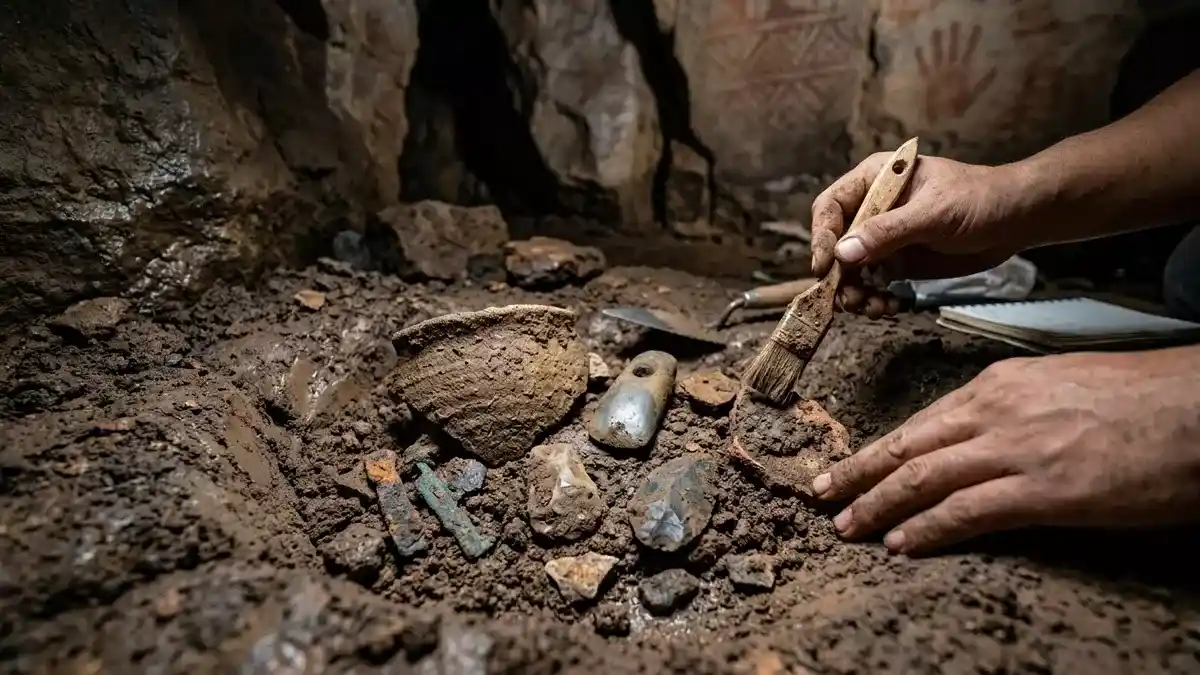
Inside the twilight of Tham Ta Kueng, the rangers discovered that the sandstone walls were covered in prehistoric carvings and painted iconography. Rather than chaotic graffiti, the markings are highly stylized, intentional, and structured.
The ancient gallery features a distinct array of prehistoric motifs:
Complex Geometric Line Work: Intricate, interlocking linear patterns etched deeply into the sandstone face, potentially representing early territorial maps, calendar systems, or tribal markers.
The Three-Finger Motif: A highly unusual, repeating three-finger pattern that stands out as a unique stylistic signature in regional rock art.
Preserved Etchings: While the total number of individual engravings is relatively small, their structural details have successfully resisted the intense humidity and erosion of the tropical jungle.
Specialists from the Fine Arts Office 6 in Sukhothai—the governmental department responsible for preserving Thailand’s national heritage—have taken control of the scientific analysis. Preliminary stylistic reviews suggest the artwork dates back to Thailand’s prehistoric Metal Age, a formative era that existed centuries before the dawn of the country’s written historical records.
A New Dimension for Southeast Asian Archaeology
The discovery of Ta Kueng Cave has generated immense enthusiasm across national scientific institutions. Mongkol Khamsuk, head of the Phu Khat Wildlife Sanctuary, described the find as a monumental landmark that seamlessly bridges the worlds of environmental conservation and human history. He noted that comprehensive, multi-disciplinary research will allow scientists to map out the exact relationship between prehistoric human tribes and the ancient ecosystems they relied on for survival.
The Department of National Parks, Wildlife and Plant Conservation (DNP) echoed this sentiment, hailing the cave as a massive win for Thai archaeology. The department highlighted that active forest patrols do far more than protect endangered flora and fauna; they serve as frontline guardians of the nation’s hidden cultural patrimony.
Unlocking a Broader Pattern of Prehistoric Life
The discovery of Tham Ta Kueng is not an isolated anomaly. It follows a series of recent, high-profile breakthroughs across northern Thailand, including the documentation of ancient cliffside carvings at the nearby Pratu Mueang Cliff site.
When these scattered geographic pieces are viewed together, they reveal a clear, widespread pattern of early human habitation and spiritual activity cutting across the Phitsanulok highlands two millennia ago. In the coming weeks, an elite coalition of state archaeologists, specialized geologists, and forensic artists will enter Ta Kueng Cave to execute comprehensive 3D digital scanning, soil core sampling, and chemical analysis of the rock pigments.
Until the scientific teams arrive, the exact coordinates of the cavern are being kept confidential, guarded by the same dense jungle that successfully shielded it from the outside world for two thousand years. The site stands as a powerful reminder that the deep wilderness still holds the keys to understanding our shared human origin story, waiting quietly for the right eyes to find them.
Frequently Asked Questions
Where exactly was the ancient cave discovered?
The cave, named Tham Ta Kueng, was discovered deep within the thick jungle of the Khao Noi–Khao Pradu wildlife sanctuary landscape, managed by the Phu Khat Wildlife Sanctuary in the Phitsanulok Province of northern Thailand.
How old is the rock art inside Ta Kueng Cave?
Archaeologists estimate that the rock paintings and engravings are approximately 2,000 years old, tracing back to Southeast Asia’s prehistoric Metal Age.
Who discovered the site?
The cavern was discovered by a team of forest rangers during a three-day routine patrol aimed at monitoring wildlife biodiversity and stopping illegal poachers along the Khwae Noi River basin.
What do the ancient drawings look like?
The sandstone walls feature remarkably well-preserved geometric line configurations alongside a highly distinctive, repeating three-finger pattern carved into the rock face.
Why is this discovery important for Thailand’s history?
The artwork was created centuries before the beginning of Thai recorded history. It provides vital new data on how prehistoric hunter-gatherer and early metal-working societies lived, traveled, and expressed their culture within the river basin ecosystems.