
Table of Contents
- 1. From the Zagros Mountains to the Cradle of Civilization
- 2. The Primeval Link: Femininity, Birth, and Fertility
- 2.1. Prehistoric European Parallelisms
- 2.2. The Luristan Bronze Continuity
- 3. Water Gods and Calendar Animals: The Mesopotamian Context
- 3.1. Enki and the Streams of Life
- 3.2. The Symbolic Language of Ishtar
- 4. The Master Crafters of Iran: Susa to the Achaemenid Empire
- 5. Star-Horned Deities: The Celestial Dimension
- 6. Conclusion
- 7. Frequently Asked Questions
- 7.1. What did the new study reveal about the ancient ibex symbol?
- 7.2. Where and when was the ibex originally domesticated?
- 7.3. Why did ancient Mesopotamians link the ibex to water gods?
- 7.4. What is the meaning behind the “star-horned” title?
- 7.5. How does the ancient ibex symbol connect to modern astrology?
10,000 Years of Cosmic Secrets Revealed in Ancient Goat Art
For millennia, human civilization has relied on animals not just for physical survival, but as a canvas for our deepest spiritual, cosmological, and artistic expressions. While creature designs like lions, eagles, and bulls frequently dominate modern discussions of ancient iconography, a humble yet majestic mountain dweller held an even more profound sway over the ancient imagination. The ibex—a wild mountain goat characterized by its massive, sweeping horns—served as a primary nexus where prehistoric humanity connected the concepts of feminine fertility, life-giving water, and the overarching celestial order.
A comprehensive academic study published in the journal L’Anthropologie has shed light on how this elusive mountain animal became deeply entangled in the religious and mythological traditions of the ancient Near East and Iran. Far from being a simple game animal or ordinary domestic resource, the ibex functioned as a powerful, multi-dimensional symbol that tracked the rhythms of nature, the shifting of seasons, and humanity’s early efforts to decipher its place within the cosmos.
10,000 Years of Cosmic Secrets Revealed in Ancient Goat Art

From the Zagros Mountains to the Cradle of Civilization
The deep relationship between humans and the ibex (Capra aegagrus) began long before the invention of writing. Genetic and archaeological evidence indicates that this resilient wild goat species was originally domesticated roughly 10,000 years ago in the rugged terrain of the Zagros Mountains, a vast range stretching across modern-day Iran, northern Iraq, and eastern Anatolia (Turkey). This pivotal evolutionary milestone gave birth to the common domestic goat, an animal that completely transformed human history by providing a stable, high-yield supply of milk, protein-rich meat, and durable fibers for textile production.
Yet, as the study emphasizes, the physical utility of the goat was immediately mirrored by its immense spiritual value. As early human communities shifted away from nomadic hunting and gathering toward settled agricultural life, the ibex became a sacred anchor in their visual language. Its image began appearing with astonishing frequency across prehistoric rock shelters, hand-carved stone amulets, and early ceramic vessels throughout Eurasia, establishing a continuous symbolic tradition that survived intact for thousands of years.
The Primeval Link: Femininity, Birth, and Fertility
One of the most remarkable findings highlighted in the new research is the striking consistency of ibex symbolism across entirely different geographic regions and historical eras. Since the Paleolithic period, the ibex was universally recognized as an emblem of fertility, motherhood, and the sacred feminine.

Prehistoric European Parallelisms
This connection is vividly demonstrated in some of the oldest surviving works of human art discovered across Europe. At the famous Laussel rock shelter in France, a prehistoric limestone relief depicts a nude female figure—popularly known as the Venus of Laussel—holding what archaeologists strongly believe is a carved ibex horn.
Similarly, a prehistoric European Neolithic rock art panel, known to science as the Mother Ranaldi panel, displays a highly detailed scene of wild ibex or deer gathering reverently around a woman in the active process of giving birth. These ancient compositions suggest that early humans associated the curved, rapidly growing horns of the ibex with the expanding cycles of pregnancy, renewal, and the generation of new life.
The Luristan Bronze Continuity
This exact artistic theme reappeared centuries later in the ancient Near East, showcasing an incredible transmission of cultural ideas. Among the most stunning artifacts analyzed in the study is a series of specialized bronze plaques recovered from the Luristan region of western Iran, dating between 1500 and 700 BCE.

One beautifully cast plaque depicts two highly stylized ibex flanking a parturient woman (a woman giving birth), mirroring the exact compositional framework found in European rock art thousands of years prior. This continuous iconography proves that across vast stretches of time and distance, the mountain goat remained a primary symbol used to protect and celebrate human childbirth.
Water Gods and Calendar Animals: The Mesopotamian Context
As human societies organized into the world’s first true urban civilizations across the plains of Mesopotamia, the ibex was elevated directly into the state pantheons. In the complex mythological systems of Sumer and Babylonia, the animal became explicitly linked to the preservation of agricultural life through its association with fresh water.
Enki and the Streams of Life
The ibex was frequently depicted alongside Enki (known to the Babylonians as Ea), the supreme Mesopotamian god of wisdom, magic, and fresh subterranean waters. Enki was believed to control the Tigris and Euphrates rivers, the literal lifeblood of Mesopotamian agriculture. Ancient cylinder seals often portray Enki with streams of water flowing from his shoulders, flanked by agile mountain goats drinking from the divine current.
This association was deeply rooted in animal biology. The natural mating season of the wild ibex occurred during the autumn months, a period that precisely coincided with the arrival of the highly anticipated autumn rains in Mesopotamia. Because the visible behavioral changes and mating calls of the ibex directly heralded the return of water to the parched desert landscape, the animal became a natural, living time indicator—a calendar animal signaling the rebirth of regional vegetation.
The Symbolic Language of Ishtar
The sexual and reproductive connotations of the animal also saturated ancient Near Eastern literature. In classical Babylonian love poetry and religious hymns, the goddess Inanna (Ishtar), the supreme deity of love, war, and fertility, explicitly refers to her own anatomy using the metaphor of a “horn.” This poetic association tied the sharp, rigid, and defensive horns of the mountain goat directly to themes of raw carnal desire, sexual potency, and imperial abundance.
“The ibex was far more than an item of prey or a farm asset. It was a living metaphor for the hidden mechanisms of nature, connecting the water in the earth to the stars in the heavens.” — Research Commentary, L’Anthropologie
The Master Crafters of Iran: Susa to the Achaemenid Empire
While Mesopotamia integrated the ibex into its literature, ancient Iranian cultures transformed the animal into the absolute pinnacle of their visual arts. The study tracks an unbroken chain of ibex-themed masterpieces cutting through every major archaeological site in Iranian prehistory, including Tall-i-Bakun, Tepe Hissar, and the grand metropolis of Susa.
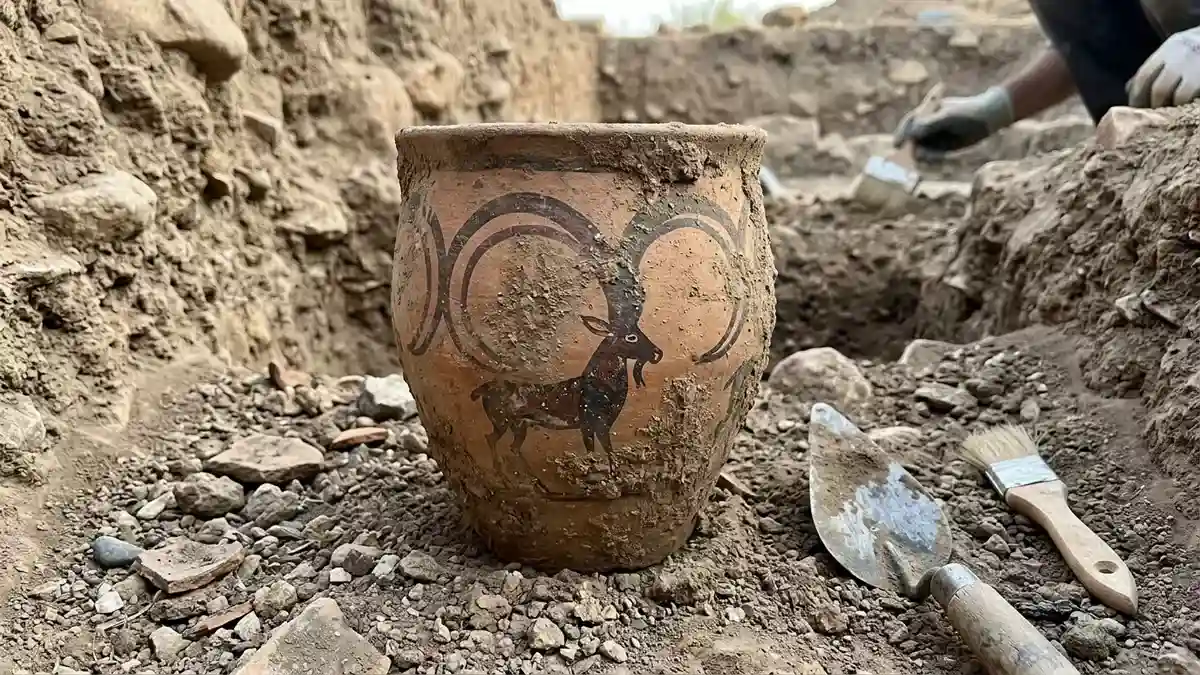
Iranian artisans excelled at abstracting the form of the goat. On iconic painted ceramic beakers recovered from Susa (dating to around 4000 BCE), the body of the ibex is often reduced to a few geometric lines, while its horns are exaggerated into a massive, elegant circle that frames the entire vessel. This artistic choice shows that the horns themselves carried the primary symbolic weight of the object.
This artistic obsession did not fade with the arrival of the Iron Age. The motif transitioned seamlessly into the elite luxury arts of the great Persian empires:
Achaemenid Luxury: Persian nobles wore complex tattoos featuring stylized ibex motifs and drank from elaborate gold and silver pouring vessels (rhytons) fitted with handles sculpted into the shapes of winged ibex.
Sassanian Metalwork: Master metalsmiths engraved detailed hunting scenes on silver plates where the ibex represented both royal game and divine fortune.
The Islamic Era: Following the cultural shifts of the Islamic golden age, the geometric form of the ibex survived, finding a home inside the complex tile mosaics and architectural reliefs that adorned regional mosques and palaces.
Star-Horned Deities: The Celestial Dimension
The final, most ambitious layer of ibex symbolism identified by the researchers is its connection to ancient astronomy and cosmology. In cuneiform texts recovered from Mesopotamia, the ibex is frequently referred to by the specialized astronomical title si-mul, translating literally as “star-horned.”
On thousands of ritual boundary stones (kudurrus) and ceremonial seals found throughout Elam and Babylonia, the ibex is carved in close proximity to symbols of the sun, the crescent moon, and multi-pointed stars. Ancient stargazers viewed the immense, curved horns of the goat as a physical mirror to the crescent moon or the curved vault of the night sky. Because the animal lived on the highest, most inaccessible mountain peaks, ancient cultures naturally believed it existed closer to the gods and the cosmic mechanisms of the universe.
This ancient cosmic connection lives on today in modern astrology through the zodiac constellation of Capricorn. Originally conceptualized by Babylonian astronomers as a “goat-fish” hybrid, this constellation was intentionally positioned in the sky to mark the winter solstice—the exact turning point of the year that brought about the return of light, rain, and seasonal fertility.
Conclusion
By weaving together the disparate fields of mythology, animal biology, and field archaeology, the study published in L’Anthropologie reminds us that the ancient world was bound together by a deep reverence for the natural environment. The ibex was a brilliant symbol of balance: its feet were planted firmly on the rugged, practical earth of nomadic survival, while its sweeping, star-oriented horns reached directly into the heavens to decipher the eternal laws of creation.
Frequently Asked Questions
What did the new study reveal about the ancient ibex symbol?
The study proved that the ibex was a dominant, cross-cultural symbol in the ancient Near East and Iran for millennia, representing feminine fertility, human childbirth, life-giving water, and the astronomical cycles of the stars.
Where and when was the ibex originally domesticated?
Genetic and archaeological data shows that the wild ibex was first domesticated approximately 10,000 years ago in the Zagros Mountains of Iran and eastern Anatolia, giving rise to the modern domestic goat.
Why did ancient Mesopotamians link the ibex to water gods?
The mating season of the wild ibex perfectly aligned with the arrival of the crucial autumn rains in the desert. Because their behavioral changes signaled the return of water, the animals were seen as sacred companions to Enki, the god of fresh water.
What is the meaning behind the “star-horned” title?
In ancient cuneiform tablets, the ibex is called si-mul, meaning “star-horned.” Prehistoric populations associated the sweeping curve of the goat’s horns with the shape of the crescent moon and the curved dome of the night sky.
How does the ancient ibex symbol connect to modern astrology?
The ancient Mesopotamian and Iranian cosmic associations with the ibex directly evolved into the zodiac sign Capricorn, the goat-fish constellation that ancient astronomers created to mark the winter solstice and the return of agricultural fertility.