
Table of Contents
- 1. The Nighttime Raid at Ras Tamim
- 2. Inside the Ancient Chalkstone Factory
- 3. Mapping Jerusalem’s Industrial Belt
- 4. The “Outbreak of Purity” and the Stone Vessel Boom
- 5. From the Black Market to the Museum Display
- 6. Frequently Asked Questions
- 6.1. Why did ancient people prefer chalk limestone for making these vessels?
- 6.2. Where did the antiquities looters plan to sell these items?
- 6.3. What is a mikve and why was one found near the stone workshop?
- 6.4. How did ancient craftsmen hollow out the inside of a stone vessel?
- 6.5. Can tourists visit the Mount Scopus cave workshop?
Antiquities Sting Leads to Discovery of 2,000-Year-Old Stone Vessel Factory in Jerusalem
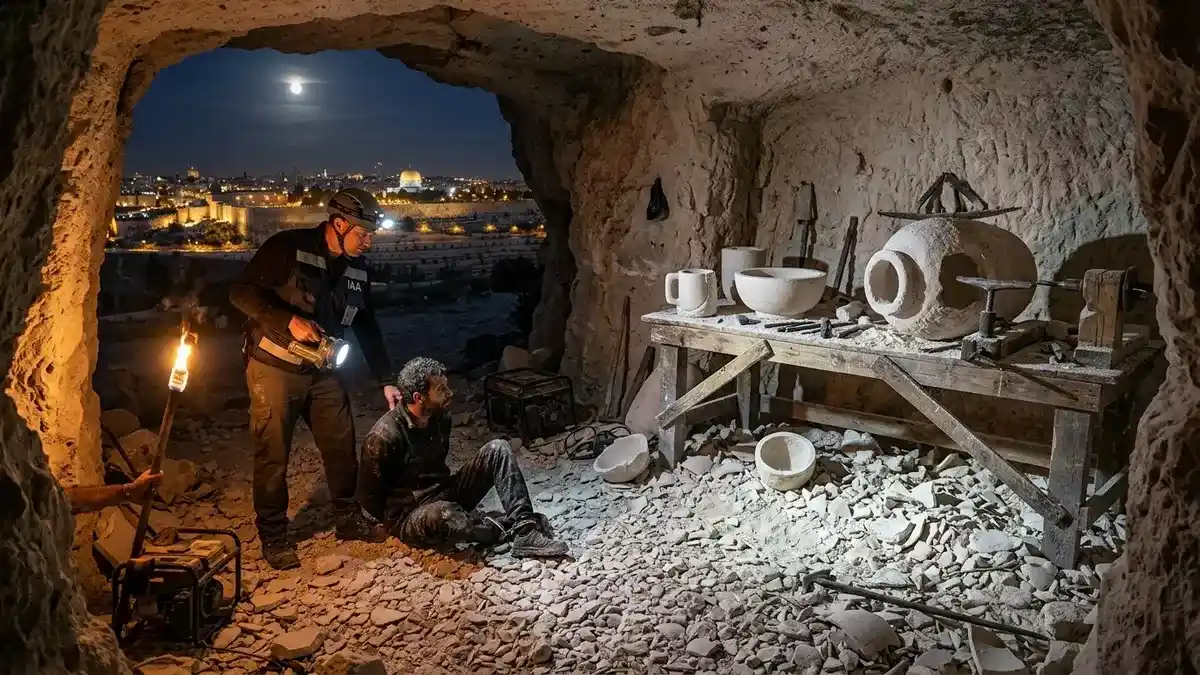
A dramatic nighttime raid by the Israel Antiquities Authority (IAA) has broken up an active looting operation while simultaneously unlocking a major archaeological treasure. On the eastern slopes of Jerusalem’s Mount Scopus, authorities caught a group of antiquities thieves red-handed. Once the underground site was secured, inspectors stepped inside to find a massive, perfectly preserved Second Temple period stone vessel factory that has been sealed for two millennia.
The discovery offers a vivid look into the ancient Judean economy and a fascinating phenomenon known historically as the “outbreak of purity” among the ancient Jewish population.
Antiquities Sting Leads to Discovery of 2,000-Year-Old Stone Vessel Factory in Jerusalem
The Nighttime Raid at Ras Tamim
The discovery began not with trowels and brushes, but with a high-stakes sting operation. Inspectors from the IAA’s Theft Prevention Unit flagged suspicious, fresh digging at a site known as Ras Tamim on Mount Scopus. Surveillance teams monitored the area for several days, tracking a group of individuals attempting to break into a subterranean cavern.
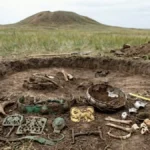
During a coordinated midnight operation, officers ambushed and arrested five suspects. The looters were fully equipped with a portable generator, heavy quarrying equipment, and an advanced metal detector. While some suspects were caught deep inside the cave, others were apprehended on the surface acting as lookouts. The individuals confessed during interrogation and now face illegal excavation charges, which carry a prison sentence of up to five years.
Inside the Ancient Chalkstone Factory
With the criminals in custody, archaeologists entered the cavern to find a subterranean workshop completely buried in the debris of ancient craftsmanship. The cave floor was thick with thousands of white stone chips, specialized carving waste, and hundreds of fractured vessel shards.
[The Production Floor of Ras Tamim]
├── Raw Material: Local chalk limestone (soft, easily carved)
├── Debris: Piles of industrial stone chips and shavings
├── Unfinished Goods: Half-carved mugs, bowls, and storage jars
└── Ruined Stock: Misfired or cracked fragments broken during carving
Scattered among the industrial waste were several half-finished stone items that had cracked or warped mid-production and were cast aside by the ancient artisans. The sheer volume of waste and unfinished inventory points to a large-scale, industrialized manufacturing center operating roughly 2,000 years ago, during the late Second Temple period (1st century BCE to 70 CE).
Mapping Jerusalem’s Industrial Belt
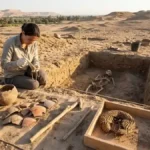
The discovery at Ras Tamim is not an isolated find. Rather, it acts as a critical piece of a much larger economic puzzle. Archaeologists have previously exposed similar chalkstone workshops in the region, including one uncovered during the construction of the nearby Naomi Shemer Tunnel and another further north in the village of Hizma.
+-------------------------------------------------------------+
|             JERUSALEM'S ANCIENT EASTERN APPROACH            |
+----------------------+--------------------------------------+
| Discovered Feature   | Practical & Economic Function        |
+----------------------+--------------------------------------+
| Limestone Quarry     | Raw material extraction for vessels  |
| Water Reservoirs     | Essential hydration for stone cutters|
| Ritual Bath (Mikve)  | Spiritual purification for workers   |
| Elite Tombs          | Final resting places for residents   |
| Stone Workshop       | High-volume luxury manufacturing     |
+----------------------+--------------------------------------+
The presence of this manufacturing cluster along the eastern slopes of Mount Scopus is highly strategic. This zone sat directly along the bustling highway leading into Jerusalem from the east. Countless Jewish pilgrims traveling to the Temple from the Jordan Valley, Jericho, Transjordan, and the Dead Sea region would have marched right past these workshops. Wholesalers and merchants likely bought the vessels directly from the cave factories to supply the busy markets of Jerusalem’s Old City.
The “Outbreak of Purity” and the Stone Vessel Boom
To understand why a massive cave factory dedicated solely to carving stone cups and bowls was so profitable, one must look at ancient Jewish ritual law (Halakha).
During the late Second Temple period, society experienced what rabbinic literature terms an “outbreak of purity”—a cultural movement where regular households began strictly adhering to elite priestly dietary and ritual washing laws. This sparked a dramatic archaeological footprint, with ritual baths (mikvaot) appearing in almost every private home, rural village, and urban neighborhood across Judea.
According to ancient Jewish law, standard clay pottery was highly susceptible to spiritual defilement. If a clay pot touched something ritually impure, the pot became unclean, could not be purified, and had to be completely smashed. Stone, however, was a theological loophole: it was viewed as entirely immune to ritual impurity.
[The Ritual Loophole: Pottery vs. Stone]
Pottery Vessel + Impure Contact ===> Permanently Defiled ===> Must Be Smashed
Stone Vessel   + Impure Contact ===> Immune to Impurity ===> Simply Wash & Reuse
Because an expensive stone jar could be washed and reused indefinitely without risk of spiritual contamination, households seeking to maintain strict kosher standards preferred stone for storing water, oil, and food. This legal distinction created an insatiable, high-volume market for chalkstone dinnerware, turning the artisans of Mount Scopus into highly prosperous manufacturers.
From the Black Market to the Museum Display
The artifacts recovered from the Ras Tamim raid have bypassed the illegal black market completely and gone straight into the public eye. The Israel Antiquities Authority has placed the seized stone mugs, bowls, and manufacturing debris on permanent display.
The collection is a centerpiece of a specialized exhibition titled “Criminal Past” housed at the new Jay and Jeanie Schottenstein National Campus for the Archaeology of Israel in Jerusalem. The exhibition walks visitors through the dark underbelly of antiquities trafficking, showcasing items rescued from looters and highlighting the field tactics used by the Theft Prevention Unit to save history from being sold off to the highest bidder.
Frequently Asked Questions
Why did ancient people prefer chalk limestone for making these vessels?
Chalk limestone (often called soft chalk or baq’ah) was highly favored by ancient stonecutters because it is exceptionally soft, porous, and easy to carve using primitive iron hand tools when first quarried from underground caves. However, once exposed to the open air, the moisture inside the stone evaporates, causing the vessel to harden significantly and become highly durable for daily household use.
Where did the antiquities looters plan to sell these items?
Illegal excavators typically target remote or unmonitored caves to steal artifacts, which they sell to unlicensed antiquities dealers on the black market. These items are smuggled out of the country to international private collectors or fraudulent galleries. This illicit trade destroys the “stratigraphy” (the surrounding soil layers), which robs historians of the ability to accurately date and contextually understand the finds.
What is a mikve and why was one found near the stone workshop?
A mikve (plural: mikvaot) is a specialized ritual bath designed for immersion to cleansing a person or object from ritual impurity. Finding a mikve right next to an industrial stone workshop indicates that the stonecutters themselves likely immersed regularly to ensure that the vessels they were manufacturing remained ritually pure from the moment they were carved out of the bedrock.
How did ancient craftsmen hollow out the inside of a stone vessel?
For smaller items like mugs and bowls, craftsmen used specialized bow-drills and chisels to scoop out the soft interior core while the vessel was spun on a primitive wooden foot-lathe. For massive stone water jars (like the ones famously mentioned in biblical accounts like the Wedding at Cana), the interior was laboriously chipped out by hand using specialized curved iron gouges.
Can tourists visit the Mount Scopus cave workshop?
No, the active excavation cave at Ras Tamim is currently closed to the general public to protect the fragile subterranean environment and prevent structural collapses or further looting attempts. However, the complete assembly of finished vessels, tools, and raw stone chunks can be viewed by the public at the Criminal Past exhibition in Jerusalem.