
Table of Contents
- 1. The Mystery of the Ceramic Cones
- 2. Simple Engineering for Mass Participation
- 3. Illuminating the Past: The Lamp Hypothesis Tested
- 4. Sacred Murals and Midnight Destruction
- 5. A Unique Category of Ancient Material Culture
- 6. Frequently Asked Questions
- 6.1. What exactly was the Chalcolithic period?
- 6.2. Why does a lamp need to be shaped like a sharp cone?
- 6.3. Why is beeswax significant compared to other ancient fuels like olive oil?
- 6.4. Why did ancient people intentionally break their pottery after a ritual?
- 6.5. What do the wall paintings at Teleilat Ghassul look like?
Chalcolithic Cornets Unlocked: Ancient Vessels Reveal Prehistoric Night Rituals in Jordan
A systematic analysis of an enigmatic ceramic vessel from the Chalcolithic period (the Copper Age) is shedding new light on the spiritual lives and collective gatherings of humanity’s early farming communities. For nearly a century, archaeologists have fiercely debated the function of “cornets”—small, cone-shaped clay cups found exclusively in layers dating between 4500 and 3600 BCE.
Now, a comprehensive study published in the journal Tel Aviv has cracked the case. By combining 3D laser scanning, mineral analysis, and live experimental replication, researchers have demonstrated that these unique cones were utilized as long-burning beeswax lamps. Furthermore, their deliberate breakage patterns suggest they played a central role in dramatic prehistoric night ceremonies and vigils before being ceremonially destroyed.
Chalcolithic Cornets Unlocked Ancient Vessels Reveal Prehistoric Night Rituals in Jordan
The Mystery of the Ceramic Cones
Cornets have long been an archaeological puzzle in the Southern Levant. These vessels appear suddenly in the archaeological record during the Chalcolithic era and vanish just as quickly, completely absent from both earlier Stone Age and later Bronze Age pottery traditions.
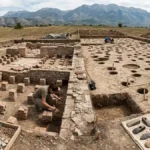
The geographical distribution of these artifacts is highly uneven. While massive caches of cornets have been unearthed at specific regional sites like Ashkelon, ʿEn Gedi, Abu Hof, and Grar—frequently packed inside rooms interpreted as sacred or cultic storage chambers—they are entirely absent or extremely rare at neighboring settlements like Safadi, Abu Matar, and Shiqmim.
To resolve the debate over their purpose, the research team focused their efforts on the single largest collection of cornets ever discovered: the historic assemblage excavated at Teleilat Ghassul in present-day Jordan by the Pontifical Biblical Institute between 1929 and 1999. The database includes 35 completely intact vessels and roughly 550 fragments, the vast majority of which are pointed, weighted bases.
Simple Engineering for Mass Participation
To determine how the cornets were manufactured, the team utilized petrographic analysis—microscopic examination of the mineral content within the clay—to pinpoint the origin of the raw materials.
 Prehistoric Time Capsule: Sealed Cave Discovered Near Haifa Unlocks Secrets of Human Evolution
The tests revealed that the vast majority of the cornets were built using highly localized clays found immediately surrounding Teleilat Ghassul. This discovery ruled out the theory that these were mass-produced luxury items imported from a centralized manufacturing capital.
[Cornet Manufacturing Blueprint]
1. Take a single lump of local clay.
2. Insert a rounded wooden stick lengthwise to hollow out the interior.
3. Elongate and pinch the bottom base by hand into a sharp cone.
4. Total Production Time: ~10 Minutes per vessel.
Through experimental replication, the researchers discovered that making a standard cornet required zero advanced technical pottery skills. A person could easily fashion a functioning vessel from a single lump of clay in about ten minutes by driving a round-cut stick down the center to hollow out the core and pulling the base into a point by hand.
While a small subset of the collection (“Type 3” cornets) displayed the uniform symmetry and fine red slip coatings of master artisans, the overwhelming majority were hastily made and highly variable. This low time-investment strongly indicates that everyday participants traveling to regional festivals manufactured their own custom cornets as part of their ceremonial preparations.

Illuminating the Past: The Lamp Hypothesis Tested
Over the decades, archaeologists have proposed wildly different theories regarding what these vessels held. Some suggested they were used as strainers or funnels for primitive dairy processing, while others argued they were crucibles used in early copper metallurgy due to traces of beeswax associated with lost-wax metal casting.
The new study rigorously tested a third theory: that the cornets were ancient beeswax lamps. While critics historically pointed out that many cornets showed no visible soot marks, the research team re-examined the Teleilat Ghassul collection under high-powered microscopes and successfully identified distinct, localized soot stains inside several vessels.
+-------------------------------------------------------------+
|             BEESWAX CORNET LAMP BURN EFFICIENCY             |
+----------------------+--------------------------------------+
| Fuel Configuration   | Flame Stability & Burn Duration      |
+----------------------+--------------------------------------+
| Pure Beeswax Only    | Stable flame; requires maximum wax   |
|                      | to fill the deep, pointed cone       |
+----------------------+--------------------------------------+
| Clay Base Filler +   | High flame elevation; drastically    |
| Minimal Beeswax      | reduces wax needed; burns up to 9 hrs|
+----------------------+--------------------------------------+
The team then conducted controlled burn experiments using exact replicas filled with modern beeswax. The results were stunning: a single cornet filled halfway with wax could sustain a perfectly stable, continuous flame for up to nine hours.
Furthermore, the experiments revealed a clever design feature: if an ancient user packed a small plug of raw clay into the very bottom of the narrow cone before adding the wax, it prevented the fuel from pooling uselessly in the deep tip, raising the flame to the rim and drastically reducing the amount of precious beeswax required.
Sacred Murals and Midnight Destruction
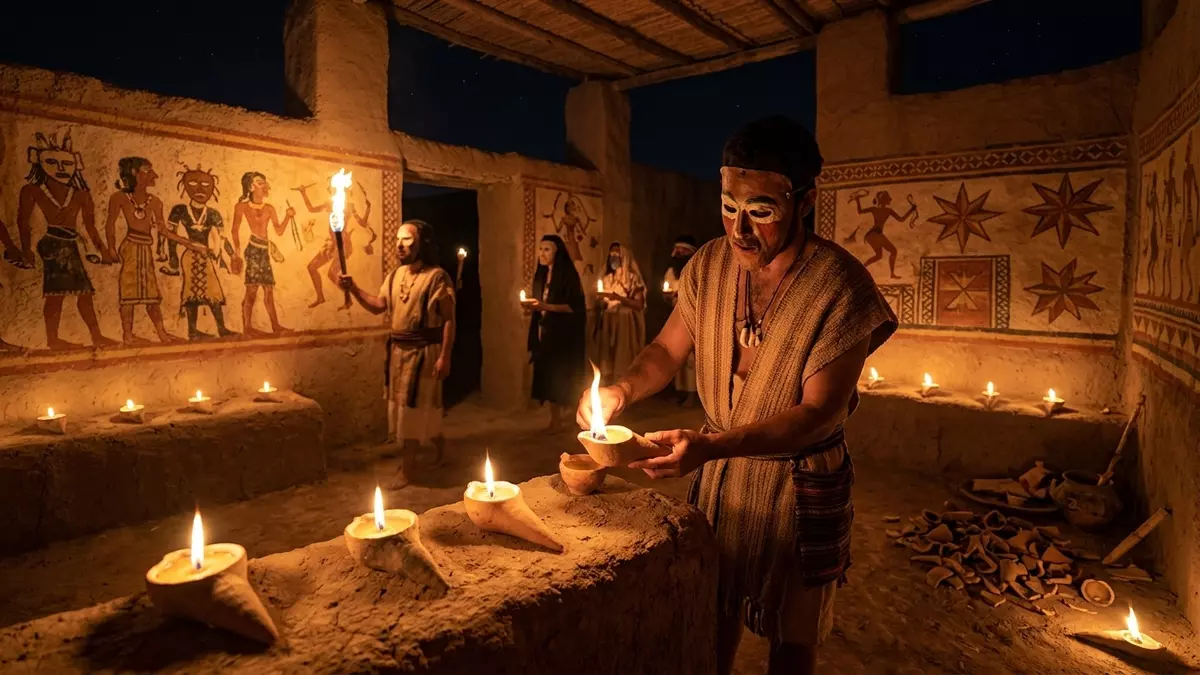
The functional success of the cornet lamps aligns perfectly with the cultural environment of Teleilat Ghassul. The site is world-renowned among prehistorians for its spectacular, brightly colored wall frescoes depicting elaborate ceremonial processions, mysterious masked figures, and geometric stars.
[The Life Cycle of a Ritual Vigil Object]
Gathering -> Source local clay -> 10-Min Crafting -> Fill with Beeswax -> 9-Hr Night Ceremony -> Deliberate Destruction -> Leave Behind
The cornets were consistently recovered in the immediate vicinity of these highly ritualized spaces. Crucially, the fracture patterns on the hundreds of broken bases show clear signs of deliberate, forceful destruction rather than natural wear and tear.
The combination of long-lasting illumination capabilities, specialized cultic context, and intentional smashing points toward a specific cultural phenomenon: vibrant night ceremonies or nocturnal vigil events. Participants would gather under the cover of darkness, light up the sacred spaces with hundreds of hand-held or hanging cornet lamps, and then intentionally smash the vessels on the floor at the conclusion of the ritual, leaving the pieces behind as sacred refuse.
A Unique Category of Ancient Material Culture
The life history of the Teleilat Ghassul cornets challenges traditional archaeological categories. They do not fit the profile of standard domestic kitchenware used for everyday cooking, nor do they qualify as elite prestige items traded among tribal chiefs.
Instead, they represent a highly democratic, experiential class of ritual objects. The data suggests that Teleilat Ghassul acted as a major regional sanctuary that drew in large crowds from surrounding communities. Some travelers may have journeyed from significant distances, gathering clay from the local riverbeds upon arrival to craft their own personal source of light for the upcoming midnight ceremonies.
By successfully connecting production, practical application, and ritual disposal, this study provides a clear window into how Chalcolithic communities managed precious natural resources like beeswax to organize powerful collective experiences that bound their societies together.
Frequently Asked Questions
What exactly was the Chalcolithic period?
The Chalcolithic period, also known as the Copper Age, was a transitional era between the Neolithic (Stone Age) and the Bronze Age, lasting roughly from 4500 to 3600 BCE in the Near East. It was defined by the initial development of copper metallurgy, the expansion of early farming villages, and the emergence of complex religious and artistic practices.
Why does a lamp need to be shaped like a sharp cone?
The elongated, pointed base of a cornet is highly functional for mobile rituals. The tapered cone is very comfortable to hold in the hand during long processions. Alternatively, for stationary use, the sharp point could be easily pressed upright into soft dirt floors, or the vessels could be suspended from strings using the small clay loops or handles molded onto their sides to act as hanging lanterns.
Why is beeswax significant compared to other ancient fuels like olive oil?
During the Chalcolithic period in the Southern Levant, large-scale olive oil production had not yet reached its peak efficiency. Beeswax, harvested from wild honeybee colonies, was a highly prized, dense fuel source that burned cleanly with very little smoke and produced a pleasant aroma, making it ideal for use inside enclosed, sacred ceremonial rooms.
Why did ancient people intentionally break their pottery after a ritual?
Deliberate destruction of ritual objects, known as “sacrificial breaking” or ritually killing an object, is a common practice documented throughout global archaeology. By intentionally smashing a vessel used in a sacred context, the community ensured that the object could never be defiled or reused for mundane, everyday domestic tasks, permanently sealing its role as a holy item.
What do the wall paintings at Teleilat Ghassul look like?
The frescoes at Teleilat Ghassul are among the oldest and most complex wall paintings found in the Near East. Painted directly onto mudbrick plaster using natural mineral pigments like red ochre and charcoal, they illustrate complex geometric icons (such as the famous eight-pointed “Ghassulian Star”), animal figures, and lines of masked or costumed individuals walking in formal processions.