
Table of Contents
- 1. The Discovery at Pergamon: A Medical Hub of the Ancient World
- 2. Lab Chemistry Unlocks Secrets of 1,900-Year-Old Residue
- 3. Thyme Oil and the Art of Masking Foul Odors
- 4. Following the Recipes of Galen, Dioscorides, and Pliny
- 5. Redefining the Roman Glass Unguentarium
- 6. Conclusion: A New Era of Molecular Archaeology
- 7. Frequently Asked Questions
- 7.1. Why did ancient Roman doctors use human feces in their medical treatments?
- 7.2. Did the Romans know that using fecal matter could cause infections?
- 7.3. What is an unguentarium and what was it typically used for?
- 7.4. How did scientists prove the residue was actually human waste?
- 7.5. Who was Galen, and what was his connection to this discovery?
Roman Glass Vial Reveals Ancient Use of Human Feces as Medicine
Archaeologists have long debated whether the bizarre medical recipes found in ancient texts were actually practiced or merely written down as theoretical oddities. For centuries, the idea of using human waste to cure illnesses was dismissed by many modern readers as symbolic. However, a groundbreaking discovery has finally bridged the gap between ancient literature and physical reality.
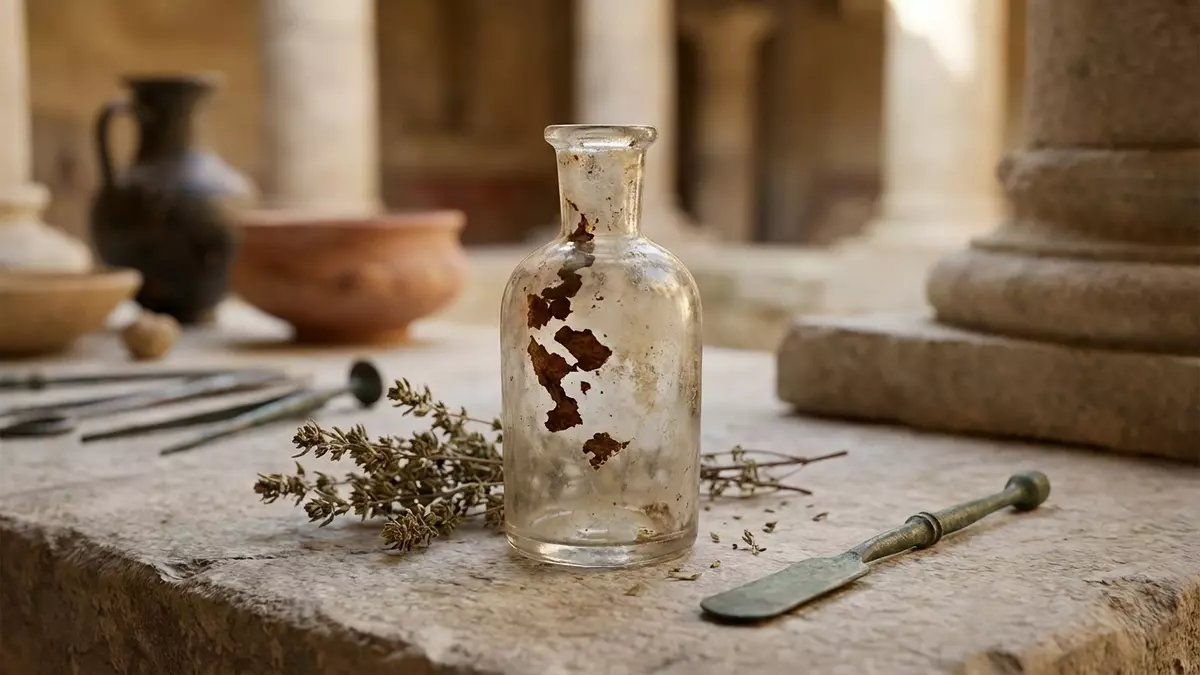
A team of scientists recently analyzed the organic residue left inside a 1,900-year-old Roman glass vial, known as an unguentarium, unearthed from a tomb in the ancient city of Pergamon. The results were nothing short of astonishing. Inside this delicate vessel, researchers found the first direct physical evidence that human feces were actively used as part of medical treatments in the Roman Empire. To make the stomach-churning remedy more tolerable for patients, Roman healers mixed the waste with aromatic herbs like thyme to mask the pungent odor.
This discovery sheds a fascinating new light on the complexities of ancient pharmacology, proving that Roman doctors were fully prepared to deploy highly unconventional ingredients in their quest to heal the sick.
Roman Glass Vial Reveals Ancient Use of Human Feces as Medicine

The Discovery at Pergamon: A Medical Hub of the Ancient World
To understand the significance of this find, one must look at the location where the artifact was recovered. Pergamon, situated in modern-day Turkey near the city of Bergama, was not just any ordinary Roman settlement. During the second and third centuries, it stood as one of the grandest medical and cultural centers of the Mediterranean world.
Home to the famous Sanctuary of Asclepius—the ancient god of healing—Pergamon was a place where thousands of patients traveled from across the empire seeking cures for chronic ailments, physical injuries, and psychological distress. It was also the home base of Galen, one of the most influential physicians in human history, whose medical philosophies dictated Western and Islamic medicine for over a millennium.
The specific glass vial analyzed by researchers was recovered from a Roman tomb within this medical epicenter. Now housed safely in the Bergama Archaeology Museum, the small glass container managed to preserve dark brown flakes clinging tightly to its interior walls. While archaeologists noticed similar residue in other stored glass artifacts from the site, this particular unguentarium was the only one that preserved a large enough sample of material to undergo comprehensive scientific testing.

Lab Chemistry Unlocks Secrets of 1,900-Year-Old Residue
To determine exactly what the dark brown flakes consisted of, scientists carefully extracted a micro-sample from the interior of the vial. They utilized two advanced laboratory techniques: gas chromatography and mass spectrometry. These technologies allow researchers to separate, identify, and quantify individual molecules within a complex organic mixture, essentially providing a molecular fingerprint of the ancient substance.
The chemical breakdown revealed two very specific organic compounds:
Coprostanol
24-ethylcoprostanol

These specific substances are distinct biochemical markers. They are formed exclusively inside the digestive tracts of animals as they process cholesterol. By analyzing the exact mathematical proportions of these biomarkers, the scientific team was able to definitively trace the source back to a human origin. It was not accidental dirt or animal cross-contamination; it was undeniably human fecal matter.
Thyme Oil and the Art of Masking Foul Odors
Finding human waste inside a cosmetic or medical vial would be surprising enough on its own, but the chemical analysis revealed a second, highly deliberate ingredient. Alongside the fecal biomarkers, the testing equipment flagged a high concentration of aromatic molecules, specifically carvacrol.
Carvacrol is the primary active component found in thyme oil. Thyme was highly prized in antiquity not just for its pleasant, earthy scent, but also for its natural antiseptic and antimicrobial properties. The presence of thyme oil serves as a critical piece of evidence for historians. It proves that the human waste inside the vial was not an accidental contaminant that slipped in during excavation or burial. Instead, it was a intentionally manufactured pharmacological mixture.
Ancient medical writers frequently discussed the sensory challenges of treating patients. No one wanted to ingest or apply foul-smelling mixtures, so healers carefully managed the smell of their medicines. By blending strong, pleasant-smelling herbs like thyme with highly offensive ingredients, ancient doctors made their potent remedies far more acceptable to the senses of their patients.
Following the Recipes of Galen, Dioscorides, and Pliny
For historians of science, the pairing of feces and thyme perfectly mirrors the written instructions preserved in surviving classical texts. The use of dung in medicine—a practice sometimes referred to in historical studies as Drekapotheke (fecal pharmacy)—was well-documented by the elite doctors of the Roman world.
Galen of Pergamon wrote extensively about his clinical experiences, recording numerous recipes that utilized animal and human dung to treat severe inflammation, skin infections, open wounds, and various reproductive health conditions. He believed that these substances possessed specific drying and cooling properties necessary to balance the body’s internal fluids.
Similarly, other prominent figures of ancient science, such as the Greek botanist Dioscorides and the Roman natural philosopher Pliny the Elder, compiled massive encyclopedias listing hundreds of remedies derived from bodily wastes. Until now, modern readers often assumed these recipes were either wild exaggerations, desperate last resorts, or purely symbolic formulas. The residue inside this single small bottle confirms that Roman healers actually followed through on these radical recipes in their daily clinical practices.
Redefining the Roman Glass Unguentarium
This research also forces archaeologists to rethink how they categorize ancient artifacts. Walk through any museum with a Roman collection, and you will see dozens of small, delicate glass bottles labeled as “perfume vials” or “oil containers.”
Because these items are so common in gravesites and ancient domestic settlements, scholars have traditionally assumed they were used exclusively for daily hygiene, beauty routines, or funeral rituals. However, this study proves that boundaries in the Roman world were incredibly fluid. What modern society separates into distinct categories—cosmetics, personal hygiene, and professional medical therapy—often completely overlapped in antiquity. A beautifully scented oil mixture could simultaneously serve as a luxury social status symbol and a highly specialized clinical treatment.
Direct physical evidence of dung-based medicine has remained incredibly rare over the centuries because organic matter naturally decomposes rapidly when exposed to air and soil. Furthermore, a general cultural discomfort with the topic has historically limited the number of researchers willing to look for fecal markers in museum collections. By combining advanced laboratory chemistry with a close, non-judgmental reading of ancient texts, researchers are finally building a much more transparent and accurate picture of how ancient therapeutics were prepared and experienced by real people.
Conclusion: A New Era of Molecular Archaeology
The tiny glass unguentarium from the Bergama Archaeology Museum has provided a monumental leap forward in our understanding of Roman life and healthcare. It stands as a powerful reminder that history is not always clean, orderly, or comfortable by modern standards.
By utilizing modern forensic chemistry, science has validated the words of ancient physicians who lived nearly two millennia ago. Roman medicine was a complex, deeply sensory discipline where fragrance and filth coexisted in the exact same bottle—all managed by ancient doctors trying their best to cure the human body with the world around them.
Frequently Asked Questions
Why did ancient Roman doctors use human feces in their medical treatments?
Ancient physicians operated under medical theories like Humorism, which viewed the body as a balance of fluids. They believed that substances like dung possessed specific biochemical properties capable of pulling toxins out of wounds, reducing severe swelling, and drying out stubborn infections.
Did the Romans know that using fecal matter could cause infections?
The Romans did not have a modern understanding of germ theory or bacteria. While they noticed that certain materials helped close wounds or reduce inflammation based on trial and error, they were unaware of the microscopic pathogens present in waste. They used herbs like thyme primarily to combat the foul smell and provide natural cleansing properties.
What is an unguentarium and what was it typically used for?
An unguentarium is a small, narrow-necked glass or ceramic bottle incredibly common throughout the Roman Empire. While traditionally labeled by modern museums as containers for perfumes, scented oils, or funeral cosmetics, this new research proves they were also used to store complex, potent medicinal mixtures.
How did scientists prove the residue was actually human waste?
Researchers extracted a microscopic sample of the dark flakes inside the bottle and ran gas chromatography and mass spectrometry. This allowed them to detect coprostanol and 24-ethylcoprostanol—specific organic compounds created during the digestion of cholesterol. The exact mathematical ratio of these two compounds confirmed a human source.
Who was Galen, and what was his connection to this discovery?
Galen of Pergamon was a highly influential Greek physician in the Roman Empire whose medical texts shaped global medicine for over a thousand years. Because this specific vial was found in Pergamon—Galen’s hometown and a major medical hub—and contains a recipe matching his written records, it provides direct physical proof of his medical theories in action.