
Table of Contents
- 1. Secrets of the Six-Kilometer Necropolis
- 2. Wealth Scattered in the Soil: Gold, Silver, and Chariot Gear
- 3. Inside the Hoard: Human-Faced Dividers and Animal Art
- 4. Ancient Globalization on the Steppe
- 5. Redefining Nomadic Funerary Traditions
- 6. Frequently Asked Questions
- 6.1. What was discovered at the Vysokaya Mogila necropolis?
- 6.2. Who built these ancient burial mounds?
- 6.3. Why did the nomads bury so much horse gear?
- 6.4. Where did the imported items found at the site come from?
- 6.5. What do these finds reveal about ancient nomadic rituals?
Massive Eurasian Nomadic Ritual Complex Discovered in Russia
An extraordinary archaeological discovery in the Orenburg region of Russia has unveiled one of the largest ancient sacrificial sites ever documented in the Southern Urals. Excavations conducted by the Russian Academy of Sciences at the Vysokaya Mogila–Studenikin Mar necropolis have brought to light a massive, elite ritual complex. The site contains hundreds of premium artifacts that reveal the intricate religious practices and vast trade networks of Early Iron Age Eurasian nomads.
Dating back to the 4th to early 3rd centuries BCE, the find proves that monumental burial mounds (known as kurgans) were not merely static graves. Instead, they served as long-term, dynamic ceremonial centers where the nomadic elite returned for generations to perform lavish post-burial rites and animal sacrifices.
Massive Eurasian Nomadic Ritual Complex Discovered in Russia
Secrets of the Six-Kilometer Necropolis
The Vysokaya Mogila–Studenikin Mar necropolis is a sprawling archaeological wonder. It consists of five distinct burial groups aligned along a geographic line extending over six kilometers from east to west.
The focus of the Pre-Urals Expedition turned toward the heart of this complex, specifically investigating the surroundings of Mound 1. This monumental earthen kurgan towers more than seven meters high, indicating it was built for an individual of immense social standing.
While the burial chamber of nearby Mound 19 was found empty, the periphery of the giant Mound 1 yielded a staggering concentration of intentional ritual deposits. Cultivation from modern farming had partially scattered some of these ancient layers, but what remained beneath the surface stunned researchers.
Wealth Scattered in the Soil: Gold, Silver, and Chariot Gear
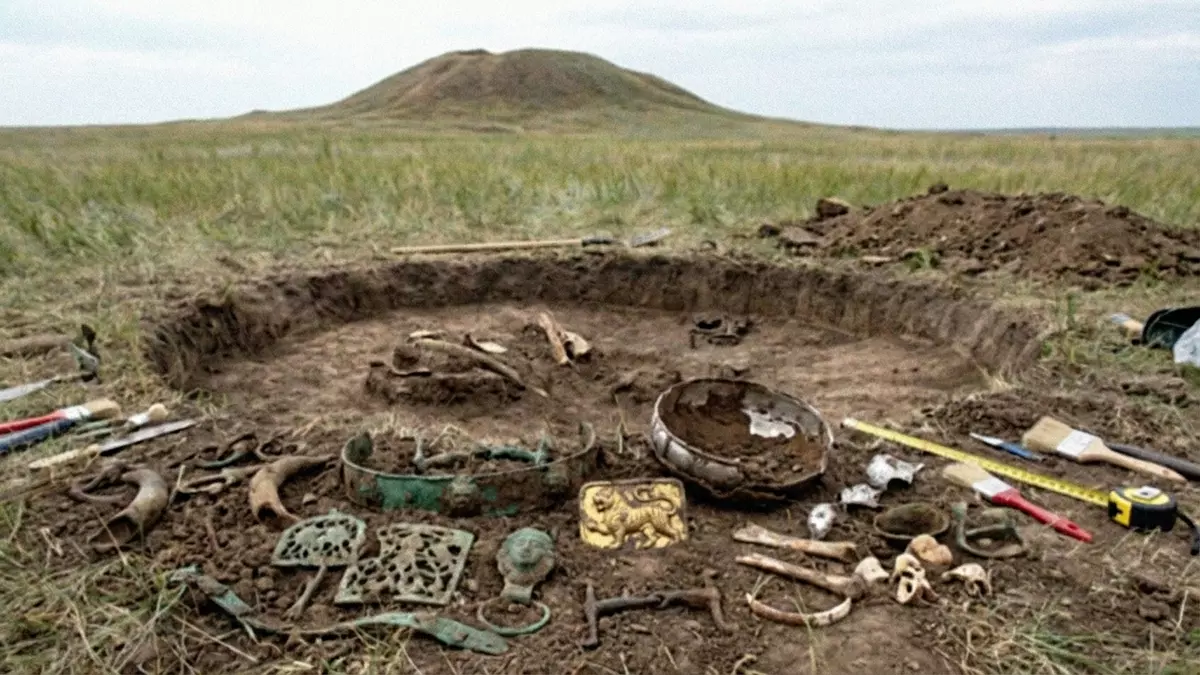
Initial surveys in the agricultural fields immediately east of Mound 1 turned up high-status artifacts that had been dispersed over time by plowing. Among these scattered finds were iron bits, specialized horse tack, and a beautifully crafted bronze browband with a hooked terminal.
The most undeniable markers of elite status were a solid gold plaque depicting a tiger’s head and forepaw, alongside a silver fitting designed for an ornate wooden ceremonial vessel.
To the west of the giant mound, scientists discovered fragments of a heavy bronze ladle and a large bronze cauldron, surrounded by a dense field of shattered horse harness components. These fragmented items pointed toward a dedicated zone where massive ceremonial feasts and sacrifices took place long after the central ruler was laid to rest.
Inside the Hoard: Human-Faced Dividers and Animal Art
The true epicenter of the discovery was a shallow, circular ritual pit packed with over a hundred intact horse-harness items and ceremonial offerings. Nomadic cultures of the Eurasian steppe placed immense spiritual and military value on their horses, making them a central element of their religious architecture.
The pit yielded complete, matched sets of bridles, including iron bits, organic horn cheekpieces, heavy iron buckles, and intricate bone ornaments. Along with more than 500 small decorative bronze beads, archaeologists recovered a breathtaking collection of artistry:
Seventeen Bronze Plate Browbands: Heavy protective and decorative metal plates worn over a horse’s forehead.
Thirty Openwork Plaques: Complex, cut-out metal designs used to adorn leather straps.
Geometric & Mythological Discs: Round plaques featuring dot patterns, stylized birds, sacred swastikas, and fierce mythological creatures.
Human-Faced Strap Dividers: Highly unique, cast bronze pieces shaped into distinct human faces used to organize harness straps.
The Silver Ritual Bowl: A precious wooden bowl reinforced with polished silver mounts, used to hold ceremonial libations.
Ancient Globalization on the Steppe
Many of the artistic styles found within the pit align perfectly with the famous “Filippovka-type” elite burial traditions native to the Southern Urals. However, the sheer diversity of the hoard caught researchers off guard.
Several premium items recovered from Mound 1 have absolutely no historical precedents in the Ural region. Instead, they feature precise artistic and structural parallels to artifacts manufactured in the North Caucasus, the Don River Basin, and the Northern Black Sea region.
This fascinating blend of domestic and foreign craft traditions reveals an unprecedented level of interconnectedness. The elite nomadic tribes of the Southern Urals were not isolated warriors; they were central power brokers in a sprawling, cross-continental network of cultural exchange, trade, and diplomatic gifting that spanned thousands of miles.
Redefining Nomadic Funerary Traditions
The discovery of the broken handmade pottery vessels, wild boar jaws, and the silver-plated ritual bowl paints a vivid picture of complex post-burial rituals.
For centuries, scholarship assumed that once a nomadic kurgan was piled high with earth, the site was abandoned as the tribes moved with their herds. The size and complexity of the Vysokaya Mogila complex proves that these sites remained active religious shrines. Long after the initial funeral, clans returned to these sacred landscapes to renew alliances, sacrifice prized horses, feast, and deposit foreign luxuries to honor the spirits of their ancestors.
Frequently Asked Questions
What was discovered at the Vysokaya Mogila necropolis?
Archaeologists discovered one of the largest early nomadic sacrificial complexes ever found in the Southern Urals. The site yielded over a hundred horse-harness items, unique bronze strap dividers shaped like human faces, a gold tiger plaque, and a silver-mounted ritual bowl.
Who built these ancient burial mounds?
The mounds were constructed by early nomadic communities who inhabited the Eurasian steppes during the Early Iron Age, specifically dating back to the 4th to early 3rd centuries BCE. They shared close cultural ties to the famous Filippovka-type elite societies.
Why did the nomads bury so much horse gear?
To Eurasian nomadic societies, horses were symbols of warfare, wealth, and spiritual power. Burying complete, highly decorated bridles and harness sets was a supreme sacrificial act meant to honor powerful deceased leaders and ensure their status in the afterlife.
Where did the imported items found at the site come from?
While many artifacts were local, several unique pieces show clear stylistic origins from distant regions, including the North Caucasus, the Don Basin, and the Northern Black Sea coast. This proves that these nomadic elites engaged in vast interregional trade and communication networks.
What do these finds reveal about ancient nomadic rituals?
The findings prove that large burial mounds (kurgans) were not just graves, but active ceremonial centers. Nomadic groups regularly returned to the monuments of elite individuals to perform complex post-burial rituals, host communal feasts, and deposit valuable offerings over extended periods.