
Table of Contents
**Coral Blocks Revolutionize Dating of Colonial Sites in Pacific**
Archaeologists have developed an innovative new technique using coral building materials to more accurately date colonial-era structures in remote Pacific islands. In French Polynesia’s Mangareva Islands, scientists successfully applied uranium-thorium (U-Th) dating to coral blocks from 19th-century missionary buildings, providing fresh insights into a transformative period of cultural and architectural change.
This breakthrough offers a powerful tool for historians and archaeologists working in regions where traditional dating methods fall short. By analyzing the coral itself, researchers can establish reliable minimum construction dates even when written records are scarce or incomplete.
Coral Blocks Revolutionize Dating of Colonial Sites in Pacific
### The Challenge of Dating Pacific Colonial Sites
Colonial-era sites in the Pacific often prove difficult to date precisely. Historians typically rely on written archives, coins, ceramics, or glass artifacts, but these sources have limitations in isolated island settings. Imported goods sometimes arrived years after manufacture, and many local communities left few documentary traces. Radiocarbon dating loses precision for the last few centuries, while tropical climates rarely preserve wood suitable for dendrochronology.
The new study, published in *Antiquity*, demonstrates how coral—widely used as a construction material across Polynesia—can help overcome these obstacles. Because coral incorporates uranium from seawater while alive, U-Th dating can determine when the organism died, offering a direct scientific window into when building materials were harvested.
### Testing the Method in Mangareva
Led by archaeologist James Flexner, the research focused on structures linked to French Catholic missionaries who arrived in Mangareva in 1834. The missionaries introduced European-style stone construction and trained local Polynesians in masonry techniques, fundamentally altering traditional architecture and settlement patterns.
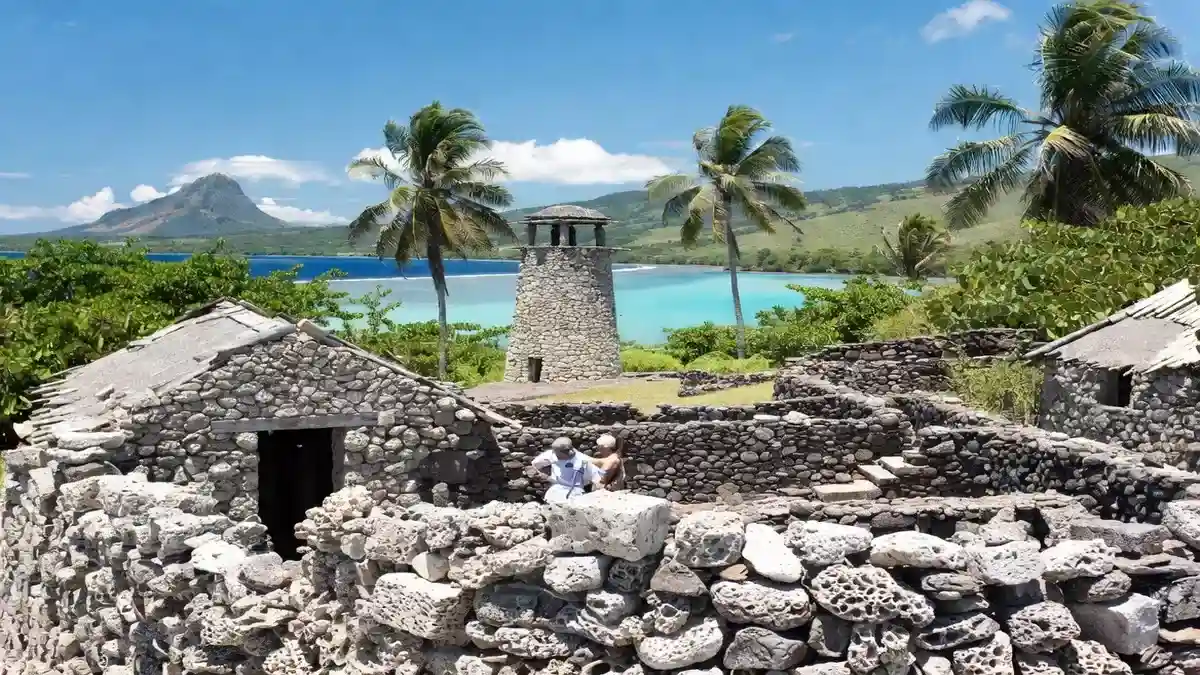
Researchers sampled minimally weathered branch corals from nine ruined buildings. These included seven small stone cottages known locally as *are po’atu*, a coral watchtower, and a school with known historical construction dates used as a control. The buildings sit in a landscape that also contains traces of earlier Polynesian settlements.
Laboratory analysis produced dates that aligned closely with the period of intense missionary activity in the 1830s and 1840s. Several samples clustered tightly in the mid-19th century, confirming the rapid adoption of new building practices following the missionaries’ arrival.
### Inside the Are Po’atu Stone Cottages
The *are po’atu* houses became a hallmark of social and religious transformation in Mangareva. These modest coral-and-stone dwellings reflected both missionary influence and the growth of Polynesian Catholic communities. Unlike earlier thatched structures, these permanent buildings symbolized new ways of living and worship.
One particularly informative site involved comparing coral dates from a house wall with materials from a nearby pit feature. Both the building samples and the pit—containing food remains, metal objects, glass fragments, and other domestic debris—dated to the mid-1840s. This close match suggests the deposits and construction may have occurred during the same short timeframe, possibly linked to a communal work event or feast.
### Understanding Inbuilt Age in Coral Dating
Not all results were straightforward. Some coral blocks returned dates significantly older than the buildings, sometimes predating sustained European contact. Archaeologists attribute this to “inbuilt age”—the time between when coral died on the reef and when it was eventually collected and used in construction. Builders may have gathered dead coral from beaches or reused materials from older structures, including traditional *marae* ceremonial platforms.
While this creates a range rather than a precise construction year, the method still delivers valuable minimum ages. In regions with sparse historical documentation, even broad chronological anchors represent major progress.
### Broader Impact on Pacific Archaeology
The Mangareva study demonstrates the potential of U-Th coral dating across French Polynesia and other tropical areas where coral architecture is common. Expanding the technique could help archaeologists map the spread of missionary influence, track changes in Indigenous building practices, and better understand how local communities adapted to colonial pressures.
This approach shifts focus from imported artifacts to the buildings themselves. By examining materials embedded in the walls, researchers gain direct evidence of when communities invested in new construction styles. The method complements existing techniques, creating more robust chronologies when combined with historical records and traditional artifacts.
### Life During the Missionary Era in Mangareva
The arrival of French Catholic missionaries in 1834 triggered profound changes across the Gambier Islands. Religious conversion, new agricultural practices, and European architectural ideas reshaped daily life. The construction of stone buildings using local coral represented both cultural exchange and adaptation. Polynesian workers learned new skills while incorporating familiar materials, creating hybrid structures that blended old and new traditions.
The *are po’atu* cottages provided more permanent and durable housing compared to traditional homes. They also reflected shifting social organization as Catholic communities grew and centralized around mission stations. The coral dating helps anchor these transformations in real time, moving beyond vague historical narratives.
### Scientific Advantages of U-Th Coral Dating
Uranium-thorium dating excels in the 100–500,000 year range, making it ideal for colonial and late pre-colonial sites. Unlike radiocarbon, it does not suffer from the same calibration challenges in recent centuries. The method requires only small samples, allowing researchers to work with minimal damage to historic structures.
In Mangareva, the team’s careful selection of branch corals minimized issues with inbuilt age while maximizing dating reliability. Future refinements could include statistical modeling to account for older materials and better integration with other archaeological data.
### Challenges and Future Directions
The study acknowledges limitations, particularly the relatively small sample size. Wider application across more islands and structures will help researchers understand how common inbuilt age effects are and develop correction strategies. Collaboration between archaeologists, geochemists, and local communities will be essential for responsible sampling and interpretation.
This technique also opens possibilities for studying other coral-based constructions worldwide, from ancient Pacific monuments to more recent colonial buildings in the Caribbean and Indian Ocean. As climate change threatens coastal heritage sites, precise dating becomes increasingly important for preservation priorities.
### Connecting Past and Present in French Polynesia
French Polynesia’s rich cultural heritage spans thousands of years of Polynesian voyaging, settlement, and adaptation. The colonial period represents just one chapter, yet it dramatically altered island societies. Coral dating helps illuminate this transition while honoring the continuity of Indigenous knowledge and resource use.
Local communities have long worked with coral for practical and ceremonial purposes. Modern archaeological methods now reveal new layers of meaning in these ancient materials, strengthening connections between past practices and contemporary cultural identity.
### Why This Matters for Pacific History
Accurate chronologies are fundamental to understanding colonialism’s varied impacts across the Pacific. In places like Mangareva, where official records often focused on European perspectives, scientific dating of Indigenous and hybrid structures provides a more balanced view. It highlights local agency in adopting and modifying new technologies rather than passive acceptance.
The research also demonstrates how creative scientific approaches can overcome gaps in traditional historical sources. By turning to the buildings themselves, archaeologists access stories that might otherwise remain silent.
### Conclusion: A New Tool for Understanding Colonial Pacific
The successful application of U-Th dating to coral blocks in Mangareva marks an important advance in Pacific archaeology. This method offers a more direct and reliable way to date colonial-era sites, helping researchers reconstruct the timing and nature of cultural transformations during the 19th century.
As the technique spreads to other islands and contexts, it promises to deepen our knowledge of how Pacific communities navigated religious change, architectural innovation, and social shifts. The humble coral block, once simply a building material, now serves as a powerful chronological key—unlocking hidden timelines and enriching our understanding of one of the Pacific’s most dynamic historical periods.
This innovative approach reminds us that even well-studied eras still hold surprises. By combining cutting-edge science with careful fieldwork, archaeologists continue to reveal the complex realities of colonial encounters and Indigenous resilience across the Pacific.
### FAQ: Coral Dating in French Polynesia
**How does U-Th dating work on coral buildings?**
It measures the radioactive decay of uranium into thorium in coral skeletons to determine when the coral organism died, providing a minimum age for when the material was used in construction.
**What islands were studied in this research?**
The study focused on the Mangareva Islands in French Polynesia, examining missionary-era structures built after 1834.
**What types of buildings were dated?**
Researchers sampled coral from *are po’atu* stone cottages, a watchtower, and a school, many linked to French Catholic missionary activity.
**What is “inbuilt age” in coral dating?**
It refers to the time lag between when coral died on the reef and when it was harvested for building. This can make some dates appear older than the actual construction.
**Why is this method important for Pacific archaeology?**
It provides reliable dates in areas with limited written records and poor preservation of other materials, helping clarify colonial-era timelines and cultural changes.
**Can the technique be used elsewhere?**
Yes. Coral-based architecture exists across many tropical regions, suggesting broad potential for dating colonial and late prehistoric sites worldwide.